TUNING IN TO BUDDHA ESSENCE

Tuning In To Buddha Essence
is turning into Buddha essence

To tune in, we adjust.
Adjusting is refining frequency
at the rate at which something occurs
over a particular period of time.
In other words, remembrance.

Although we may have had bad experiences,
through empathy we now have the ability to tune in to others
– to be on the same page.
In other words, compassion.

Posted in Uncategorized | Tagged , | Leave a comment

SCHRODINGER’S CAT AND THE BUDDHA

Schrödinger’s Cat And The Buddha

The videos below will explain Schrödinger’s cat-in-the-box experiment. Basically, a hypothetical cat is placed in a box, and something very unpleasant may or may not happens to the cat. There are many possibilities, but until we open the box and see, we will not know. Investigations all depend on someone seeing the result. The whole point is that nothing is known until we look. Until then, everything remains just in the realm of ideas.

We are both the cat and the observer living in a universal box: we have many possibilities, and lots of things have happened to us, are happening to us and will happen to us, but we will not realise why … until we look.

If we are looking for the truth (or God), even if we find what we seek, it still remains that we are the observer, and therefore the final truth. We are the beginning and the end; the alpha and omega. Things may be happening in the universe that we do not know about, but if we do finally find out, it will still all depend on us, the observer, to verify them.

Whether what we find is true or not is irrelevant. What is true is our awareness of this finding or non-finding. Ultimately, there is only pure awareness of all possibilities.

It doesn’t matter whether we look or walk away, the answer will always be the same. And that answer is our own pure, conscious awareness; it’s not ‘something else’.

Wondering what is in the universal box is what drives us crazy, as we are merely concerned with ideas about matter, forgetting our perfect awareness which is perfect sanity.

Omniscience is seeing and knowing all possibilities:
the cat can be alive, dead, asleep, changed into a dog …
in time it will have become all possibilities, as we will have.
Ultimately, the cat will become enlightened.

Knowing everything there is to know
is ultimate knowingness itself.
Any emotion that exists in the universe, we have within us.
Likewise, pure conscious awareness that exists in the universe is also within us.

It is because of infinite rebirths that we have already gone through all possibilities:
every sentient being has been our mother.
Even the cat.

😀

Posted in Uncategorized | 2 Comments

THE GRADUATED PATH TO LIBERATION – COMPLETE

The Graduated Path to Liberation
(please note that the title has been corrected from The Gradual Path to Liberation).

This post began as a taster, but as many people have shown an interest, here is the full commentary by Geshe Rabten.

There are comprehensive explanations of the Stages of Calm Abiding online: this is an extract from ‘The Graduated Path to Liberation’ by Geshe Rabten.

“It is very difficult to quell mental disturbances because we have built up a routine of following them through many lives, while we haven’t developed the habit of concentration. We may find it very hard to take up the new habit of mind and leave behind the old ones, but concentration is the basic necessity for all higher meditation and for all kinds of mind activity.

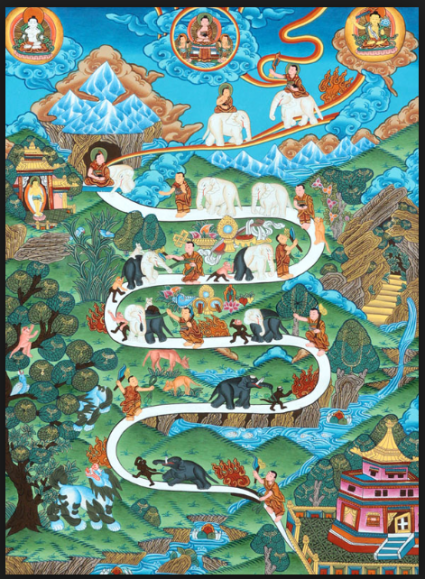
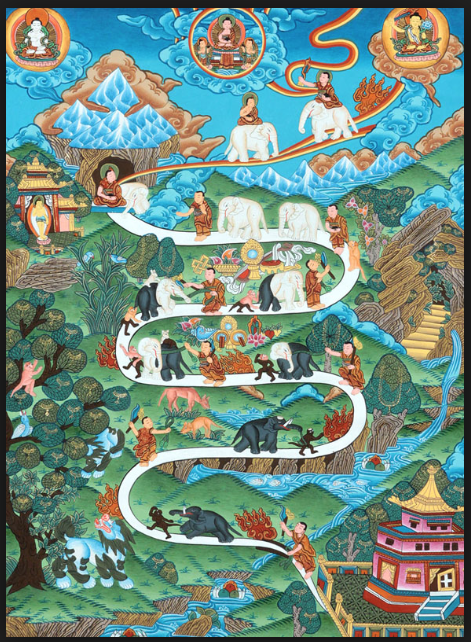
“Mindfulness and awareness-consciousness are the antidotes for scattered attention and torpor (sleepiness) respectively. The diagram represents an aspiring meditator. This person is following the path of meditative stages which ends in the accomplishment of calm abiding and the beginning of the practice of insight meditation.
screen-shot-2016-10-13-at-11-32-31

“At the bottom of the page, we see the practitioner who holds a rope in one hand, and a hook in the other, chasing after an elephant led by a monkey. The elephant represents the meditative mind; a wild and untrained elephant can be dangerous and wreak enormous destruction but once an elephant is trained, it will obey commands and do hard work. The same holds true for the mind. Any suffering that we have now is due to the mind being like a wild, untamed elephant. The elephant also has very big footprints; these symbolise the mental defilements. If we work hard to improve our mind, it will be able to do great work for us in return. From the suffering of the hells to the happiness of the Buddhas, all states are caused by the behaviour of the mind.

“At the start of the path, the elephant is black, representing torpor, or sinking of the mind. The monkey, who is leading the elephant, represents scattering of the mind. The monkey cannot keep quiet for a moment – it is always chattering or fiddling with something, and finds everything attractive. In the same way that the monkey is in front, leading the elephant, our attention is scattered after the sense objects of taste, touch, sound, smell and vision. These are symbolised by food, cloth, musical instruments, perfume and a mirror.

“Behind the elephant is a person who represents the meditator trying to train the mind. The rope in the meditator’s hand is mindfulness, and the hook is awareness. Using these two tools, the meditator will try to tame and control the mind. Fire is shown at different points along the path; this fire represents the energy necessary for concentration. Notice that the fire gradually decreases at each of the ten stages of shine meditation, as less energy is needed to concentrate. It will flare up again at the eleventh stage, when it starts practising insight meditation.

“In the beginning, just as the elephant following the monkey pays no attention to the person chasing behind, the practitioner has no control over his or her mind. In the second stage, the practitioner who has almost caught up with the elephant, is able to throw the rope around the elephant’s neck and it looks back; this is the third stage, where the mind can be restrained a little by mindfulness. Now, a rabbit is on the elephant’s back, symbolising the subtle torpor. Previously, this state might have seemed to be the state of concentration, but now it can be recognised for the harmful factor it is. In these early stages, we have to use mindfulness more than awareness.

“At the fourth stage, the elephant mind is more obedient, so less pulling with the rope of mindfulness is necessary. By the fifth stage, the elephant is being led by the rope and hook; the monkey is now following behind. At this point, we are not much disturbed by scattering or distracted attention; we mostly have to use awareness instead of mindfulness. In the drawing, the sixth stage of practice is depicted with the elephant and the monkey both following obediently behind the practitioner who does not look back at them. This means that the practitioner doesn’t have to focus continually on controlling the mind, and the absence of the rabbit shows that the subtle torpor that appeared at the third stage has now disappeared.

“Upon reaching the seventh stage, the elephant can be left to follow of its own accord; the monkey takes leave at this point and so the practitioner has no more need to use the rope and hook because scattered attention and torpor occur only mildly and occasionally.

“At the eighth stage, the elephant has turned completely white, and follows behind the practitioner; this shows that the mind is obedient and there is no sinking or scattering, although some energy is still needed to concentrate.

“At the ninth stage, the practitioner can actually sit in meditation while the elephant sleeps peacefully nearby; it is at this point that the mind can continue to concentrate without effort for a long period of time – days, weeks, or even months.

“The tenth stage, where we see the meditator sitting on top of the elephant (which has now turned white, or become clear) signifies the real attainment of calm abiding. At the last – the eleventh – stage, the meditator is sitting on the elephant’s back, holding a sword. At this point, the practitioner begins a new kind of meditation, called ‘higher vision’ or insight meditation.

“If we practise the calm abiding type of meditation, we might use an image of the Buddha as the object of concentration. The first thing we do is look at it very thoroughly. Then we start meditating. We do not look at the object with our physical eyes, but focus on the mind’s eye. At first, our memory of it will not be at all clear, but, even so, we should not try to force it to become clear – this is impossible at the start. The important point is to keep our attention focused on it, clear or otherwise. The clarity will eventually come naturally. At the beginning, concentration is very difficult; the mind always flow this way and that. When we persist in the practice, however, we will find that we are able to keep our mind on the object for one or two minutes, and then three or four minutes, and so on. Each time the mind leaves the object, mindfulness has to bring it back.

“Awareness has to be used to see if disturbances are coming or not. If we carry a bowl full of hot water along a rough road, part of our mind has to watch the water and part has to watch the road. Mindfulness has to keep the concentration steady, and awareness has to watch out for disturbances that may come. As we saw in the drawing, we do not need to use mindfulness so often after the initial stages but then our mind, tired from fighting the scattering of attention, produces some torpor.

“After a while, there comes a stage when the meditator feels much happiness and relaxation which is often mistaken for the true state of calm abiding; in fact, however, it is the subtle torpor which makes the mind weak. If we continue our practice with energy, this subtle torpor will also disappear; when we have removed the disturbance, our mind becomes clearer and more awake, and thus the object of our meditation is seen more clearly. As our perception of the meditation object increases is clearness and freshness, the body will be sustained by our peace of mind, and we will not have hunger or thirst. Eventually, a meditator can continue like this for months at a time. The feeling experienced in the mind at this stage cannot be described.

“If we look at a piece of cloth with just our eyes, we can see it, but not in great detail. But a person who has concentrated on it well with the mind’s eye can see it very clearly in all details. When we die, our mind becomes weaker but if we practice meditation, then our mind, at that time, will actually become fresher and clearer. Normally, dying people experience delusions and fears which lead to a bad rebirth. If we have meditated well though, then during the death process, our mind will concentrate on the Buddha, Dharma and so on; this helps very much for the next birth.

“The scriptures say that in the ninth stage of the practice of calm abiding, even if a wall crashes down next to the place where the meditator is sitting, the person will not be disturbed. As the meditator continues to practice, the body and mind experience special pleasure; this feeling marks the accomplishment of the final goal of calm abiding. The meditator’s body will feel light and tireless; this is symbolised in the drawing by the person flying.

“The body has become very supple, and the mind can be turned to any meditation, like the thin copper wire in an electric flex which can be turned in any direction without breaking. The meditator feels as though the object and the mind have become the same.

“Although at the ninth stage of calm abiding we feel very happy and peaceful, this is not the real end of meditation. Firm concentration on the object is still not complete achievement. Now the meditator can combine concentration with an examination into the real nature of the object of meditation. After continuing simultaneous practice of both types of meditation, a special pleasure arises from the seeing into the object. ‘Seeing the object’ involves seeing whether an object is suffering, seeing if it is permanent or changeable, and looking for the highest truth to be found about the real nature of the object. In Tibetan, the name for this meditation with insight is “Lhag-Thong”; ‘lahg’ means more or higher and ‘thong’ means to understand or realise. By this kind of meditation, the mind attains more understanding of the object than with simple concentration; when this practice has been perfect, the mind can turn to anything. The perfection of Lhag-Thong gives great spiritual satisfaction, but if one is satisfied merely with this, it is like having an aeroplane built, ready to fly but left on the ground.

“This mind can be turned to deeper and higher things. It has to be used on the one hand to overcome karma and defilements, and on the other to attain the virtues of a Buddha. For this, the object can only be emptiness or shunyata; other meditations prepare the mind for this final object. If we have a very good torch which can show up anything, we have to use its light to find out what is important. The root cause of all our trouble is ignorance. We have to use our knowledge of emptiness to dispel ignorance. We must use our mind, purified by calm abiding and special insight, to cut the root of the tree of ignorance.

“In the drawing, at this stage, the practitioner is holding a sword, symbolising the realisation of emptiness to cut the two black lines symbolising the two obscurations; the defilement obscuration and the knowledge obscuration. The knowledge of emptiness is essential to remove ignorance. Once we come close to a thorough understanding of emptiness, we are on the way to the perfection of wisdom – the complete comprehension of emptiness.”

Posted in Uncategorized | Tagged | 2 Comments

THE GRADUATED PATH TO LIBERATION

The Graduated Path to Liberation

There are comprehensive explanations of the Stages of Calm Abiding online: this is an extract from ‘The Graduated Path to Liberation’ by Geshe Rabten.

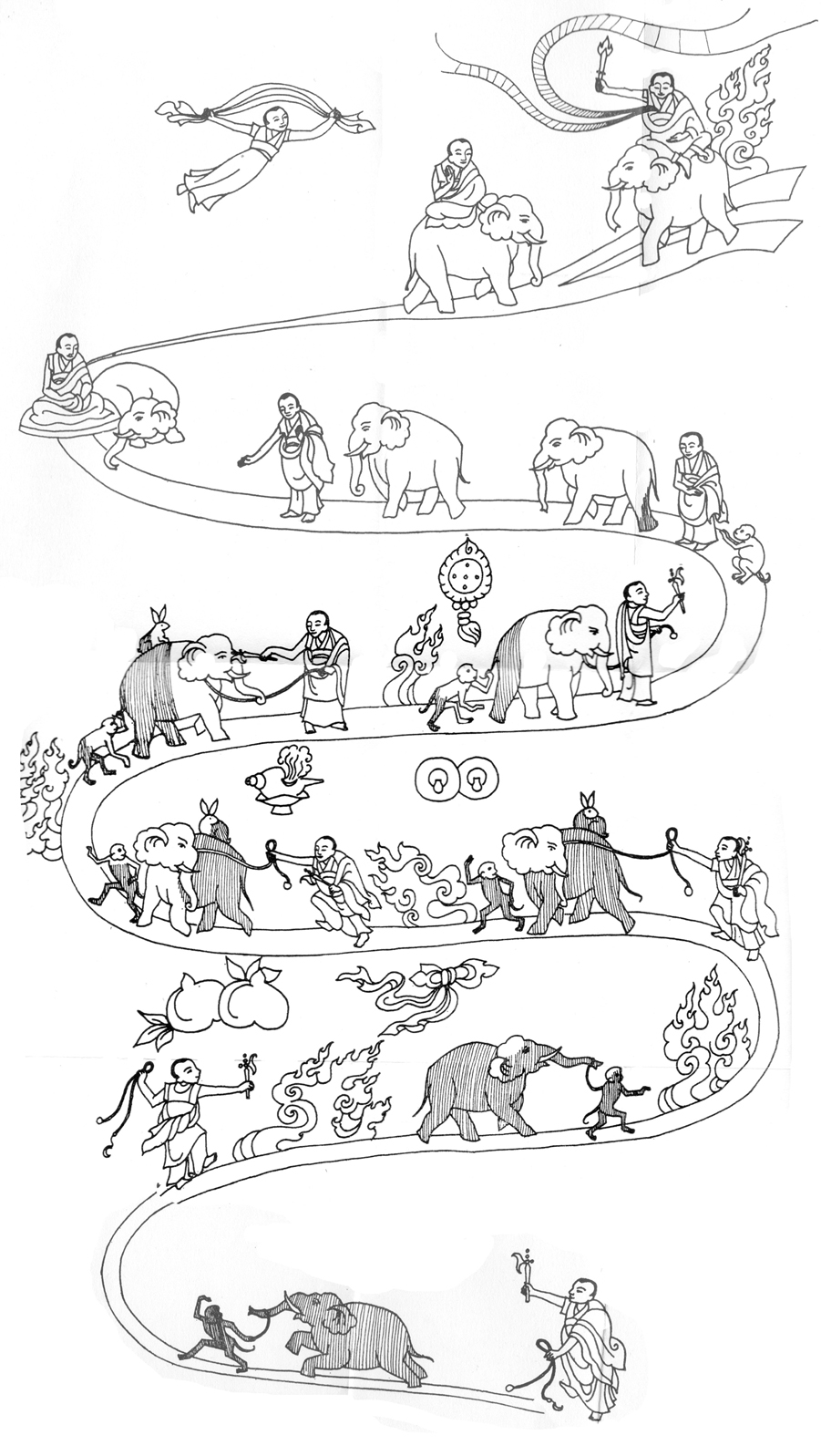
The image is a pictorial representation of a person who is following the path of meditative stages, ending in the accomplishment of calm abiding and the beginning of the practice of insight meditation. Once the mind is calm and controlled, then it can do great work, investigating itself.

gradual-path-1

“At the bottom of the page, we see the practitioner who holds a rope in one hand, and a hook in the other, chasing after an elephant led by a monkey. The elephant represents the meditative mind; a wild and untrained elephant can be dangerous and wreak enormous destruction but once an elephant is trained, it will obey commands and do hard work. The same holds true for the mind. Any suffering that we have now is due to the mind being like a wild, untamed elephant. The elephant also has very big footprints; these symbolise the mental defilements. If we work hard to improve our mind, it will be able to do great work for us in return. From the suffering of the hells to the happiness of the Buddhas, all states are caused by the behaviour of the mind.

“At the start of the path, the elephant is black, representing torpor, or sinking of the mind. The monkey, who is leading the elephant, represents scattering of the mind. The monkey cannot keep quiet for a moment – it is always chattering or fiddling with something, and finds everything attractive. In the same way that the monkey is in front, leading the elephant, our attention is scattered after the sense objects of taste, touch, sound, smell and vision. These are symbolised by food, cloth, musical instruments, perfume and a mirror.

“Behind the elephant is person who represents the meditator trying to train the mind. The rope in the meditator’s hand is mindfulness, and the hook is awareness. Using these two tools, the meditator will try to tame and control the mind. Fire is shown at different points along the path; this fire represents the energy necessary for concentration. Notice that the fire gradually decreases at each of the ten stages of shamata meditation, as less energy is needed to concentrate. It will flare up again at the eleventh stage, when it starts practising insight meditation …

“ … The tenth stage, where we see the meditator sitting on top of the elephant (which has now turned white, or become clear) signifies the real attainment of calm abiding. At the last – the eleventh – stage, the meditator is sitting on the elephant’s back, holding a sword. At this point, the practitioner begins a new kind of meditation, called ‘higher vision’ or insight meditation …

“ … At this stage, the practitioner is holding a sword, symbolising the realisation of emptiness to cut the two black lines symbolising the two obscurations; the defilement obscuration and the knowledge obscuration. The knowledge of emptiness is essential to remove ignorance. Once we come close to a thorough understanding of emptiness, we are on the way to the perfection of wisdom – the complete comprehension of emptiness.”
Posted in Uncategorized | Tagged , | 3 Comments

BEING HAPPY

Being Happy
is how we manage our lives.

We all seek happiness. This means different things to different people. It could refer to outer achievements, inner achievements or a little of both. Achievement is about managing our activities; it’s how we channel* our energies, and it’s what guides us, our code of conduct, our personal behaviour.

This is a reflection of our inner state – the state of our mind. There are two aspects to mind: pure empty awareness, and the contents in that pure empty awareness.

So, what is happiness?

Well, it’s that state of pure, empty awareness. It is the feeling of ultimate contentment, being totally at peace. Complete, unchanging satisfaction. There is no conflict, and no sense of anything to defend. However, the word ‘happiness’ has been hijacked by the idea of pleasure, which is never satisfying and has no lasting inner peace. So happiness can be understood in two ways.

We all get frustrated and dissatisfied – that’s life. This can either bring us down, or make us look more closely at the problem. If life brings us down, then we get more of the same – although we may spend our life justifying it, thereby turning an illusion into delusion and remaining unhappy. But, if life is seen as patterns of behaviour that control us, then we have the possibility of seeing and recognising our true potential; we can change our attitude – and that is an important step towards freedom. That is the state of permanent happiness that no outside force can destroy.

Happiness is a feeling of ‘rightness’, and in that, there is satisfaction which brings inner peace. When something is right, we know, and we don’t need praise or recognition. When we complete an activity – even a simple one of clearing the table – there is a feeling of rightness. In facing something we have put off, there is a feeling of rightness; to overcome procrastination is satisfying.

The important point is knowing that we have overcome our fears, which are merely ideas in the mind. This right conduct is the continuity of meditation, and the realisation of pure awareness. Pure awareness is never wrong because pure awareness is ultimately right; happy for no reason.

There is now spiritual energy in everything we do, which builds a conducive atmosphere to manage life.

*The original of the word ‘conduct’ is conduit, which meant ‘to channel’

Posted in Uncategorized | Tagged , , , , , , | Leave a comment

THE OPPOSITE TO FREEDOM IS CAPTIVITY

The Opposite To Freedom is Captivity
The question is, “What are we being captivated by?”

The answer is thoughts – our thoughts and the thoughts of others. Thought underlies actions. Thoughts are preconceived ideas from the past, and these same ideas are projected into the future: it’s a continuum of preconceptions. We are captivated by preconceived programming – the origin of ‘programme’ is ‘before written’ – and are so accustomed to this that we become dependent upon it. We do not have an original thought. We have accepted this programming: ‘self’ is a programmed projection, and that is why we are suffering, ill at ease, dissatisfied, disappointed.

We can try to blame others, but it is we who accepted the appointment, the arrangement, the position we are in now. So, what to do? How do we get out of this captivity?

Don’t give it another thought.”
😀
Meditation is freedom from dependency and addiction!

First, we see what is happening in the mind. Then we don’t give it another thought. Thoughts will arise by themselves due to karma. If we react to a past thought, we merely keep the programme running.

Thoughts are karmic products from the past: we note them but do not hold on to them. Now we are free … sort of. Until enlightenment – which means to be completely free from any agenda – we will have desires and aversions, but gradually they grow less. Freedom is fun because we don’t take anything seriously. enjoying every moment and letting it go, as there is the next moment.

“We may not have an original thought” … but we can put these thoughts together in an original way.

Posted in Uncategorized | Tagged , , | 2 Comments

CLEARING THE DARKNESS OF IGNORANCE

Clearing The Darkness Of Ignorance
Anyone can do this 😀

There is only one key that can unlock the door in the darkness of ignorance – and it’s therefore the very same key that keeps it locked. And that key is awareness.

Ordinarily, in this conventional world of conformity, awareness keeps us bound and imprisoned to this material life, because awareness is unclear of its true nature (in this context, ‘awareness’ means the faculty of consciousness). As it is not clear, it relies on memories and judgements of previous material moments (our karmic programming), and is thus impure consciousness. Therefore, awareness is relative, conventional truth which is constantly relating. True, as sentient beings, we have to eat and find shelter, but not to the extent that this entertains us, and occupies our entire life. If we are spiritually inclined, then we know when we have enough, and so we have time to be spacious.

From a spiritual point of view, awareness keeps us interested in and distracted by activities, and so we become inattentive to our true nature. Awareness can also make us fearful, tormented and worried – and awareness can also become so ordinary that we don’t see what is going on.

Do you notice that this has just described the three poisons? Desire, aversion and indifference! This is normally where our awareness goes, and so, we remain in the dark.

How do we turn the light of clarity on? It’s already on! It is awareness itself. When awareness stops looking outwards and looks into itself, what does it find? Nothing really, nothing truly, no reality but itself. It’s absolutely empty of anything but awareness. That is the clarity of pure consciousness.

The light of clarity is available to all sentient creatures if they can hear and understand the teachings. Before we start looking for the light in the sky, look for the light within. We have been told this for thousands of years. When are we going to have confidence in this extremely simple reality?

We do not need a strange name or special title to realise our true nature: it’s what people have in common.

Awareness is relative truth.
Emptiness is absolute truth.
The unity of these two is pure awareness, pure consciousness.

Posted in Uncategorized | Tagged , | Leave a comment

HUMANS – MONKEYS OR LIZARDS?

Humans – Monkeys or Lizards?

Homo sapiens means ‘wise man’ … or perhaps the attempt to appear wise – clever monkey!

Actually, most of us have more in common with a dinosaur, which means ‘terrible lizard’ as we are mainly governed by our primitive, reptilian brain. “Hmm…freeze, fight or flee?” This is our ‘normal’ human response – ignore it, desire it or fear it. Either way we react, we could be called ‘sapient-saurs’ – clever reptilians with monkey minds.

We assume that we are the pinnacle of evolutionary development, but we, as individuals and collectively, allow others to investigate life for us, not realising that scientists think of us as machines. But who controls these scientists? The answer to this will depend on how we have been programmed.

We can become homo sapiens – wise humans – when we drop the monkeying around with our reptilian instincts, clever though it is. At the moment, we are the ‘missing link’ to our full potential of becoming enlightened beings. If I was an alien looking at humans, I’d definitely think, “They have something missing!” 😀

If we were enlightened, no one could control us. At the moment, we are still living in the illusion of ‘monkey see, monkey do’, copying others’ hopes, fears and indifferences.

The wisdom of the Buddha’s teachings are the most precious in the entire, limitless universe, and should not be taken for granted as mere philosophy. Until we wake up, we will remain in monkey minds and lizard brains.

Realise Your Predicament:
Realise how important knowledge of your predicament is.
Realise how valuable the Buddha’s teachings are.
Realise how much we take these teachings for granted.
Realise how much we get wound up!

https://www.youtube.com/watch?v=idbnUdO2zJU

Grrrrr…..!

Reptilian mind is enlightened mind.
Not many people know this.
Not many people will explain this.
https://buddhainthemud.com/2013/07/27/videos-for-reptilian-brain-beauty-and-the-beast/

Posted in Uncategorized | Tagged , , | Leave a comment

WISDOM IN A THINKING MIND

Wisdom In A Thinking Mind
We have to be honest about our capacity.

This is about seeing the obscured, programmed mind, and using this very programmed obscuration to realise wisdom. “The programme shall set you free!” 😀

When we first start to meditate, we have to tame the mind. It’s a little like boot camp in the army; train, train and train some more. This is so that we recognise what is happening in the mind and how much we cling to, hold and fixate on those thoughts that turn into negative emotions, traumatising us and creating a personality that sentences us for life. So we sit and watch the breath, and cut through these thoughts arising, breaking out of this ensnarement.

Once we become familiar with this process and technique, we are now in control, but this isn’t wisdom yet. This practice – called shamata – is still an antidote, a temporary measure, as thoughts and emotions will return, and we have to watch the breath again. So far, so good.

Now that we are familiar with what is going on, we can relax the ‘boot camp’ approach, but return to it when the mind is overtaken by thoughts. The nature of thoughts is emptiness: they have no inherent existence of their own, but are just memories, projections and judgements. They arise within the nature of mind which is emptiness – aware but empty, being pure and uncontaminated.

Wisdom is the realisation that both thoughts and the nature of mind are empty. The moment a thought (or emotion) is recognised in the emptiness of mind, that ‘clang!’ reminds us of the empty space in which empty thoughts arise.

We are now using the programmed mind to acknowledge emptiness.
Nobody can pull the wool over our eyes ever again!

Here is what Tilopa said.”It is not by appearances that you are fettered, but by fixation on them.”

Khenpo Karthar Rinpoche: “It is not what you experience that causes confusion; it is your fixation on the experience as being inherently what it appears to be. Therefore, only this fixation need be relinquished, not experience itself.”

The nature of thought is the dharmakaya (emptiness). If we are capable of looking directly at the essence of thought, then whatever thought arises is self-liberated. If we can put this into practice, there is no need to try and remove thoughts or abandon them in any way.”

The paragraph below is from the instructions of Gampopa, and is followed by a commentary by Khenpo Karthar Rinpoche, concerning the ten things not to be abandoned:

… “The fourth thing not to be abandoned applies mainly to those with realisation. Mental afflictions are the indication of wisdom, and therefore need not be abandoned. The presence in our experience of stupidity, aversion, pride, desire and jealousy indicates the presence in our continuum of the wisdom of the dharmadhatu, the mirror-like wisdom, the wisdom of equanimity, the discriminating wisdom and the wisdom of activity. Since the mental afflictions are merely the display of the wisdoms that are their essence, someone who has the realisation to experience these directly need not abandon them.

“It is important to analyse this statement because it might seem very strange on the face of it. Just a few minutes ago, you were told that you must definitely abandon mental afflictions, and now you are being told that you don’t have to abandon them. This is not a contradiction, but a demonstration of the difference in the maturity of practitioners at various levels of the teaching.

“The approach for beginners, in which it is necessary to abandon mental afflictions, is like the need for stairs. Someone who doesn’t have wings and who wishes to get to the second floor must walk up a set of stairs. The process of walking up the stairs is like the process of subduing mental afflictions. Someone who has wings, like a bird, doesn’t need to use stairs but can fly directly to the second floor. Having wings corresponds to having the realisation to be able to implement the profound wisdom of secret mantra. Thus, these two pieces of advice are not contradictory, but are directed towards individuals at different levels of practice.”

It’s clear to see that we have need of a teacher to take us from one level to another, to be able to see the differences clearly.  Their role is not just to teach us ‘something’ , but to help us refine our understanding, experience and realisation. Doing this on our own would be extremely difficult, and is not without the risk of arrogance.

It is for this reason that, in Tibetan Buddhism, the teacher is so important.

Posted in Uncategorized | Tagged , , , , , | 1 Comment

ULTIMATE TRUTH WILL BLOW YOUR MIND

Ultimate Truth Will Blow Your Mind …

Ultimate truth is our very own pure awareness, our pure nature – not someone else’s.

If we accept that ultimate truth is our very own pure awareness, then that is the place where everything starts. Anything else turns us aside, diverting attention.

We have been diverted.
Wow!!!

All religions divert attention towards appearances.
These manifestations that we cling to
separate us from our true nature.
Bigger Wow!!!

We are treated like four year olds in nappies.
Even Bigger Wow!!!

Treat others like babies;

they will assume the role of a baby.
Ouch!!!

Treat others like Buddhas;
they will be Buddhas.
!

Don’t give your intelligence away.

Posted in Uncategorized | Tagged | 1 Comment

WHAT IS ONENESS?

What Is Oneness?

Wikipedia has a brilliant overview:
https://en.wikipedia.org/wiki/Nondualism

Ultimate, oneness is not two parts.
Oneness is pure awareness.

Pure awareness is not aware of other – or itself.
Pure empty awareness is nondualism.

Whatever we then call this is just words and concepts: clarity, pure awareness, consciousness, God, God consciousness, Brahman, light, love, luminosity, bliss,
harmony, union …

Clinging to names is diversity = to turn aside, to divert attention.
We are oneness, but we don’t all realise this at the same time! 🙂

Posted in Uncategorized | Tagged , , , , | Leave a comment

A VERY DIFFICULT SUBJECT


A Very Difficult Subject

Confusing or conflating our awakened essence
with religion, culture and politics
can make a mystery remain a mystery.

The two videos yesterday – one by Tulku Urgyen and the other by Mingyur Rinpoche – reveal that the Buddha’s teaching is all about awareness; resting in pure awareness. There is nothing more than remembering this.

It is not about adopting another’s culture, religion or politics. It is all about the true nature of mind which is beyond language. We do not have to learn Tibetan, Greek, Hebrew, Pali or Sanskrit to know our true nature.

Of course, if we are interested in languages, cultures and politics that’s fine, but we must be aware of conflating – mixing two or more elements that can obscure the objective, which is realisation.

Adopting another’s religion and culture is our choice, but we have to be aware that this isn’t essential. If it helps us to recall and remember, that is wonderful, but other cultures may have grander ideas than our own: we only have to walk into a monastery to see what it takes to build such a splendour.

To support Tibet is an admirable ideal as this country held the tradition of the Buddha’s teachings, but Tibetans were forced to flee and set up elsewhere in the world. Tibetan teachers have to maintain their tradition and culture, which includes monasteries, monks and nuns, supported by lay people. The Tibetan culture is grand, lavish and colourful and creates a living for artisans and shop keepers. This is the same with theistic traditions; they too are full of art. Teachers are always coming up with new projects: the Buddha’s teachings, however, are about the nature of mind.

A mystic goes beyond ordinary sentient awareness, to experience and realise pure awareness, the pure consciousness of being. Then it is no longer a mystery, as the mystery is experiencing what we are.

Mystery: something that is difficult or impossible to understand or explain.

Mystic: a person who seeks by contemplation and self-surrender to obtain unity with or absorption into the Deity or the absolute, or who believes in the spiritual apprehension of truths that are beyond the intellect.

Conflation happens when the identities of two or more individuals, concepts, or places, sharing some characteristics of one another, seem to be a single identity, and the differences appear to become lost. In logic, it is the practice of treating two distinct concepts as if they were one, which produces errors or misunderstandings as a fusion of distinct subjects tends to obscure analysis of relationships which are emphasized by contrasts. However, if the distinctions between the two concepts appear to be superficial, intentional conflation may be desirable for the sake of conciseness and recall.

Posted in Uncategorized | Tagged , , , , | 1 Comment

URGYEN TULKU – DESCRIBING THE NATURE OF PRIMORDIAL MIND

Urgyen Tulku – Describing The Nature of Primordial Mind, Dzogchen

Tulku Urgyen Rinpoche (1920–1996) was a master in the Dzogchen tradition of Tibetan Buddhism. The Great Perfection.

This is a rare film of Rinpoche explaining how simple recognition is.
All we have to do is remember.

Note. Thank you Marcel for finding this film.

Posted in Uncategorized | Tagged | 4 Comments

WE BECAME TIMEMEN INSTEAD OF SPACEMEN

We Became Timemen Instead Of Spacemen

We learn to calculate this to that. We learn to become fascinated, judging, creating and destroying.

Phenomena, having a beginning and an end, has a time limit. Time only exists because phenomena is impermanent.

If phenomena was fixed and constant, it would be permanent, and so would have no time limit. All things – including planets and solar systems – seem real, but will be destroyed by time (and the energy from destruction is the source of the next creation). As we all have our collective blinkers on, we give this no significance, and therefore we live in a collective illusion of accomplishments.

Space is not a thing. It is neither created nor destroyed. It just is. In space, there is no time. Time only exists when WE occupy space. Time is finite. Space is infinite.

Time is associated with the thinking mind; what we call ‘me’. This thinking mind is always calculating, weighing up and judging … tick … tick … tick …

Space is associated with the infinite nature of the mind itself … uncontaminated silence.

Time is a relative reality. Space is ultimate reality.

As we are sentient, time and space are seen as a unity. Because of ignorance of our true nature of luminous space, we embody a form of limited time to realise this enlightened nature … tick … tick … tick …

When we’re young, we’re told what to do.
When we start work, we’re told what to do.
When we grow old and tired, we’re told what to do.

And so there is never time to rest in space.

Finding time and space just to be,
free from others’ limitations,
is the most precious thing in life.

Posted in Uncategorized | Tagged , , | 3 Comments

CHANGING OUR ATTITUDE

Change Our Attitude
change our karma

“Atisha said, ‘Aim your mind at the Dharma. Aim your Dharma practice at simple living. Aim at simple living your entire life, and aim your death at solitude.’

“Atisha also told us to ‘keep a low seat’, meaning a low profile. Don’t strive to be high and important. Wear simple clothing, not fancy expensive garments; wear whatever you come by. Moreover, he said, ‘Be your own teacher. Be your own guide. Do not remain in a situation where you must take orders from others. Live in a way that allows you to rely on yourself. If you live like this, you have the possibility of becoming a pure practitioner.’

“So, if we want to practise, we should make up our minds how to do so. It’s best if we can be perfect, pure, wholehearted practitioners. If not, at least try to embody half of what has been mentioned, or at the very least, take to heart a single piece of this advice and truly live it.”

from Rainbow Painting
by Tulku Urgyen Rinpoche

from Wikipedia: Atisha was a Buddhist Bengali religious leader and master. He was one of the major figures in the spread of 11th-century Mahayana and Vajrayana Buddhism in Asia and inspired Buddhist thought from Tibet to Sumatra.

Within the whirl of our karmic existence,
we can remember our still centre
and remain in solitude

Posted in Uncategorized | Tagged , , , | 3 Comments

CAN BUDDHISM BE TAUGHT SEQUENTIALLY?

Can Buddhism Be Taught Sequentially?

Not really, but it is received sequentially.
That is to say, it is we who join up the dots.
Lots of enlightened moments!

Of course, there are subjects to consider, such as the four mind changes … the four noble truths … the twelve links of dependent origination … the six realms … the six perfections … the list goes on and on.

Basically, we consider something that we’ve read or heard, and then we can ask questions. In this way, the teachings become experiential and we develop knowledge, and then see what is behind it all – and that is wisdom. What is this wisdom behind it all? Pure awareness!

Too often, we go to teachings and receive answers before we have formed the question. We are loaded down with information, which can make us arrogant (seen that, heard that!).

Although there are nine levels or yanas*, they do not seem to be taught in any particular order, and we have to bear in mind that new people are turning up all the time. I assume that when a teaching is given, the level at which it is received and understood will depend on the individual student.

“It is emptiness” or “We are pure awareness” may seem like strange ideas that don’t register as there are many obstacles that obscure our understanding, and so such statements go over our heads. We have to look for and acknowledge these veils, and recognise their influence on us. It’s not a matter of just obeying; it is a matter of seeing.

We could easily start with the question, “Why am I not happy?” The answer that we are already happy may not be recognised – and in fact, it could prove irritating. We need to see and we need to be convinced. This will take time for most of us, as we have to break free from our past obediences. A good teaching will do this, a good teacher will reveal this, and a good student will see this.

The more open we are, the more sequentially the teachings are revealed and we start to join up the dots.

“Slowly, slowly, catchee monkey mind!”

screen-shot-2016-10-13-at-11-32-31

Notice that, in the illustration, the monkey (concepts)
is leading the black elephant (mind).
As we progress, we see that the white elephant is free of the monkey.

*We could call this the nine levels of compassion:
http://www.rigpawiki.org/index.php?title=Nine_yanas

1. Shravakayana

2. Pratyekabuddhayana

3. Bodhisattvayana

4. Kriya Tantra

5. Upa Tantra

6. Yoga Tantra

7. Mahayoga

8. Anuyoga

9. Atiyoga

Posted in Uncategorized | Tagged , | Leave a comment

ULTIMATELY, TEACHING IS ABOUT JUST ONE POINT

Ultimately, Teaching Is About Just One Point

Tulku Urgyen Rinpoche said …

When I give teachings, I speak about just this point
and when I give another teaching, I speak about just this point.

It is like the chirp of a small sparrow.
A sparrow chirps in the same manner every day.

My teaching is always the same.
I chirp one day and on the following day,
I make the very same chirp.”

And what is this point?

Conviction beyond doubt simplifies everything, and we gain liberation.
We are pure awareness: without this nothing would be known. Even when thinking,
“I do not know,” pure awareness is always present.

Recognise pure awareness.
Decide on pure awareness.
Gain confidence in pure awareness.

Pure awareness is liberation from everything.

Posted in Uncategorized | Tagged , , | Leave a comment

MEDITATION HASN’T MADE MY LIFE BETTER…”

Meditation Hasn’t Made My Life Better …”
…nothing has changed

It is possible that we feel this way. We are still feeding the beast – those concepts about ourself, and how we think we ‘should’ be.

There are two aspects on the road to enlightenment, to finding out ‘what it’s all about’.

One is realising that our unchanging, pure nature is pure awareness, nothing more and nothing less. The other is purifying the mind’s habitual tendencies that obscure that pure nature. We cannot have one without the other. It is those obscurations that are difficult to remove. It’s not about making ourselves feel better, which would only further ensnare us. We are not paupers who want to become ministers and then kings and queens: we are yogis breaking out of the human, collective, mistaken view that limits our experience. Realising this is the reason we are here.

Meditation is merely being aware of awareness – nothing more, nothing less. Resting there, realisation occurs that this unconstructed, empty space has a knowing quality. That’s all. That’s us.

Whether the mind is feeling good, excited, bad or fed up, this unconstructed, knowing space is ever-present. It does nothing but be aware. Once this pure knowingness is recognised and established, then whatever we do is a reflection of this realisation.

We are so used to ‘doing’, ‘feeling’, ‘acting out’ in conventional habitual ways that we just do not notice this ever-present, pure awareness. Even being a clever human being, playing ever more complex games, is not without its mental disturbances.

People around us look human and talk like humans, but they are just human, and don’t notice this pure, aware life-force, and so they gossip about histories and geographies; places they have been and what they did there.

We acquire an appearance, dressing this life-force up in a habit, in clothing. ‘Habit’ comes from habere ‘to have, to consist of, dress, attire’. This clothing is karma, and is that which has to drop away for naked awareness to be. We are not being something … something special. We are not being important. We’re merely being.

Then we can just ‘chop wood’, ‘fetch water’ and ‘sit’. And stop worrying how it ‘should’ be.

Posted in Uncategorized | Tagged , , , , | 1 Comment

THE TIBETAN BOOK OF THE DEAD

The Tibetan Book Of The Dead
read by Richard Gere

All appearances are products of the mind: we dream up appearances and need to recognise that they are merely projections of our own mental predisposition. Our culture and understanding will both have an influence on that which is said to happen after death: the Tibetan Book of the Dead offers us some valuable, detailed insight, and it’s up to the reader to decide its value. I can say, from personal experience, that being too eclectic doesn’t provide any real foundation or guidance.

Note: the word ‘bardo’ means ‘gap’ or ‘between’.

THE SIX BARDOS

“KYI-NE
Now when the bardo of birth is dawning upon me
I will abandon laziness for which life has no time,
Enter undistracted the path of study, reflection and meditation
Making projections and mind the path and realise the three kayas;
Now that I have once attained a human body
There is no time for the mind to wonder.

“The bardo of this life, the bardo of birth:
Co-existent with arising and birth is passing and death. On the subtle level everything is constantly momentarily arising and passing – moments, thoughts, emotions, events. On a more gross level, all the necessary conditions and circumstance come together for us to be born – conception and the accumulation of the five kinds of elements: earth, water, fire, wind and space. Since the moment we were born we are passing, our life moves towards completion then disappears. The idea of 70 or 80 years seems like a long time, but in terms of the universe it is very short. On the macrocosmic level is the arising and passing of planets and stars which support our life, which will also eventually disintegrate.

“MILAM
Now when the bardo of dreams is dawning upon me
I will abandon the corpse-like sleep of careless ignorance,
And let my thoughts enter their natural state without distraction;
Controlling and transforming dreams in luminosity,
I will not sleep like any animal
But unify completely sleep and practice.

“The bardo of dreams:
The whole of cyclic existence is like a big dream – our ignorance is like sleeping and we are dreaming, but we take it so seriously. We grasp after all these things we see as real and this is where our suffering comes from. Our sleeping dreams reflect what is happening in our lives which is why we need to take our daytime practice seriously and continue being mindful and aware when going to sleep. If we do this, then when we die, it is the continuation of the nature of our mind. Our child luminosity will dissolve into the ground luminosity and we will be enlightened in the dharmakaya form.

“SAMADHI
Now when the bardo of Samadhi-meditation dawns upon me
I will abandon the crowd of distractions and confusions
And rest in the boundless state without grasping or disturbance,
Firm in the two practices; visualisation and completion.
At this time of meditation, one-pointed, free from activity,
I will not fall into the power of confused emotions.

“The bardo of meditation:
Here we are talking about purifying our mind of the cloud of disturbing thoughts and emotions, not by force but by resting in our natural mind, dharmakaya. Meditation isn’t something solid, or a place to go. It just means being aware in the present moment in a simple way and letting things be, which is actually quite difficult. Bardo literally means ‘between’, and in between the subsiding of one thought and the arising of the next, that is the bardo of Samadhi.

“CHIKHA
Now when the bardo of the moment before death dawns upon me
I will abandon all grasping, yearning and attachment,
Enter undistracted into clear awareness of the teaching
And eject my consciousness into the space of unborn mind;
As I leave this compound body of flesh and blood
I will know it to be a transitory illusion.

“The bardo of the moment before death:
All our elements dissolve back to the external world – earth, water, fire ,then air, as we stop breathing. At that point, the inner dissolution begins. We can have many different experiences here, depending on the kind of life we have led. The important thing is to know, in the confusion of what is happening, that everything we see is a projection of ourselves, and that it is a vision of the bardo. In order to be able to do that, it is important to practice now. There is a glimpse of ground luminosity – if we can recognise this from the stability of our practice then there is an opportunity to achieve realisation.

“CHONYI
Now when the bardo of dharmata dawns upon me
I will abandon all thoughts of fear and terror,
I will recognise whatever appears as my own projection
And know it to be a vision of the bardo;
Now that I have reached this crucial point
I will not fear the peaceful and wrathful ones, my own projection.

“The bardo of dharmata:
What happens now depends on individual circumstances. For a normal person dying peacefully, this can last for a few days and we may not be aware we have died. The important thing is how we are programming ourselves in our lifetime, so that we can remain calm and clear and aware of what is happening. We should remember our teacher and any deity we feel a connection with.

“SIPA
Now when the bardo of becoming dawns upon me
I will concentrate my mind one-pointedly
And strive to prolong the results of good karma,
Close the womb-entrance and think of resistance;
This is the time when perseverance and pure thought are needed,
Abandon jealousy and meditate on the guru with his consort.

“The bardo of becoming:
This can last 7 weeks and again, what happens depends on our karma and mind training. Pure perception and sacred outlook are needed here if we are not to get carried away by anger and jealousy which could lead to a birth in the lower realms. We are at the mercy of karmic winds and look for refuge wherever we can which leads to conception outside our control. If we can maintain our awareness there may be the opportunity to chose our rebirth in auspicious circumstances in the aspiration to help sentient beings.”

Posted in Uncategorized | Tagged , | Leave a comment

FREEDOM FROM THE CONCEPTUAL MIND

Freedom From The Conceptual Mind
…the programming with which we identify

Because of our early environment, we acquire a type of self-image which affects the choices we make in life. Unless we make an effort to change, we become bound by nurture.

However, when we are born, it is clear that we have individual predispositions.
This is because of actions in previous lives – we brought the programme with us!

Predisposition: a liability or tendency to suffer from a particular condition, hold a particular attitude, or act in a particular way.

The Tibetan Book of the Dead gives us some insight into our own psychology that leads to freedom from the conceptual mind that controls us.

Posted in Uncategorized | Tagged , , , | Leave a comment

A LITTLE HOPE AND A LITTLE FEAR

A Little Hope And A Little Fear

What if ““Enlightenment”” – with all those supernatural powers – wasn’t a reality,
and there are merely little enlightenments?

It is said that, up until ““enlightenment””, we will have some desires and aversions, because we are still bound by a little ignorance. We haven’t totally let go.

The reality of our enlightened nature – pure empty awareness – still stands, but there is no proof of supernatural powers that are of any more use than pure awareness itself. There are exotic stories from the culture of the past which have been taken literally, and actually create big hopes and big fears. These ideas control our minds, blinding us and encouraging us to indulge in wishful thinking, while fearing where we are now and hoping to be better in the future.

We can still be enlightened about our true nature, and the fact that all phenomena is an empty, impermanent illusion. Becoming supernatural beings, however, may not be a reality, save that there may be existence after death. Have you met anyone with extraordinary powers? One that wasn’t a projection of your own mind?

We can be happy and intelligent now, which paves the way for enlightenments. If we accept that, as we progress, we will have little hopes and little fears, then hopes and fears will not rule our life – and, most importantly of all, we need not feel guilty.

Of course, if we limit ourselves to the hypothesis that there is ““enlightenment”” in the future, we may live in big hope and big fear, which will cause all sorts of problems, such as entering into a nihilistic, depressing state where things seem pointless (been there, done that 😉 ). So, we have to wind back from this extreme.

On the other hand, if we say that “”enlightenment”” is nonsense, then we believe we are merely a collection of chemicals, thoughts and emotions. This, as we know, creates suffering, so we have to wind back from this approach too.

Winding back from both sets of ideas, we find that we are in the middle-way: “Not too tight and not too loose.”

If we go chasing after ““enlightenment””, we will never be satisfied now, and will always be looking to the future. And (sorry to say), this longing – which is natural – may be used by those who have grand ideas about their spiritual set up.

We have – or rather are – pure empty awareness, now. For a practitioner, merely resting in contentment with the moment is no big deal. It is our life we are talking about, and in that contentment we can help others, student helping student to realise little enlightenments.

We all have awareness, and when we look into this awareness, we find nothing but awareness. It is empty of considerations. This empty awareness is what we are. This is pure consciousness. We have now moved from impure consciousness to pure consciousness. Good isn’t it!? That is an enlightenment.

Of course, our physical life may not improve dramatically, because of all the havoc we have created in the past (been there, done that 😉 ) – and we also have to put up with the havoc others have created, and are still creating 😀 😀 😀

As we progress and process, we attain more enlightenments.

We must take our life in our own hands.
‘Spiritual’ teachers are too busy to deal with our spiritual welfare.
We endow them with qualities which we already are.

We are little Buddhas.
Enlightenment is now.
It’s yours, now.
It’s not someone else’s.

If we think that enlightenment is something else,
we will merely live in great hope and great fear.

Of course, it would be wonderful to be proved wrong 🙂

Isn’t it the little things in life that make it amazing?

Posted in Uncategorized | Tagged , , , , | Leave a comment

SOVEREIGN SUPREME RULER POSSESSING ULTIMATE POWER

Sovereign Supreme Ruler Possessing Ultimate Power

The royal seat of the kingdom within.
The uncontaminated, pure emptiness
that no outside force can control.

It is our essential nature:
there is no Buddha elsewhere.

Be careful not to give away this supreme power
by being distracted:
distraction leads to an illusory, mental dungeon.

Posted in Uncategorized | Tagged | Leave a comment

WHO IS THE BRINGER OF LIGHT?

Who Is The Bringer Of Light?

Lucifer? God? Buddha?
Is this easy to answer?

Is it?
There are many views.
It doesn’t matter what books say:
what effect does this have on the mind?

Is this about goodness or badness?
What is good? What is bad?

Is ‘goodness’ actually beyond good and bad?
Is ‘badness’ actually beyond good and bad?

Is goodness – the light of clarity – before judgement of good and bad?
Is badness – the darkness that cares for neither good nor bad – only confusion?

That which seems good may create confusion and sleepiness.
That which seems bad may create clarity and wakefulness.
All that is sees all without judgment:
This is absolute reality within conventional reality.

Is good, light?
Is bad, darkness?
Seeing and not seeing are before judgement.
Do we see?

It does not matter whether
Lucifer, God and Buddha are good or bad.
The question is,
“Do they bring light or darkness? Clarity or confusion?”

It is not a matter of what we are told.
What do we see?
What sees?

Light is clarity.
Darkness is lack of clarity.

Who is the bringer of light?
The bringer of light is the messenger:
we are the light itself.

Posted in Uncategorized | Tagged , | 1 Comment

I WANT TO BE CONNECTED TO DZOGCHEN…

I Want To Be Connected To Dzogchen…
…what a joke!
You are Dzogchen!

Shabkar Tsokdrug Rangdrol.

“Some people put their hope into the view of mental fabrication.
Though they have learning, it is only of dead words.
Though they have understanding, it is only concepts.
Though they claim realisation, it is only boasting.
Though they meditate, it is only mental fabrication.
Though they analyse, it is only dualistic fixation.
Though they accomplish, it is nothing but samsara.
People who intellectualise dharma certainly have no
karmic connection to the innermost essence of the Great Perfection.

There is no need for action: the Great Perfection is never
accomplished by deeds.
It is beyond the reckoning of both doing and non doing.
In this non meditation beyond meditation, if you meditate
it would only be spoilt.
In this non-view beyond viewing, what is there to look for?
In this non-searching beyond searching, there is no finding.
Awareness is utter openness.
But people without connection to the Great Perfection
don’t listen even when this is explained – what a joke!”

Posted in Uncategorized | Tagged , , , | Leave a comment

FIRST WE IDENTIFY THE PROBLEM

First We Identify The Problem
…then we can solve it.

Spiritual teachings give us an overall view,
but it is in the moment now
that the problem is personal.

We work with our own clarity of perception.
Then we get it!

The world is mad,
I react,
I am mad.

Once we see the madness
everything makes sense!

Posted in Uncategorized | Tagged | Leave a comment

FREEDOM TO THINK THE UNTHINKABLE

Freedom To Think The Unthinkable

Meditation is Mind Control
Political Correctness is Mind Control
Know the difference

And then, there is spiritual correctness.

There is no benefit in parroting the statements of others. Question everything.
Look up the Asch Experiment of conformity:

Solomon Asch Conformity Line Experiment Study


https://www.youtube.com/watch?v=qA-gbpt7Ts8

Conclusion:
Why did the participants conform so readily?
When they were interviewed after the experiment,
most of them said that they did not really believe their conforming answers,
but had gone along with the group for fear of being ridiculed or thought “peculiar”.
A few of them said that they really did believe the group’s answers were correct.”

Although this experiment was to show how we can conform to a untruth,
even conforming to a truth does not mean that we experience the same truth.

We merely learn answers.

We must look, question and experience for ourselves, and then unshakeable realisation takes place and we gain confidence. Without this, whatever we say may create subtle doubts in others as our speech is just hearsay; it may lack compassion benefit.

Spiritual conformity and spiritual correctness create fear.
We must be free to think the unthinkable.

Posted in Uncategorized | Tagged | Leave a comment

TRANSVERSE ALL THE PATHS AND LEVELS

Transverse All The Paths And Levels

… When you have meditated in this way, and many thoughts arise,
you don’t need to feel depressed, thinking “I can’t meditate!”
The mind is empty, whether it moves or is still.
Since all that arises is a continuity of awareness,
rest freely in the unfabricated innate state,
without negating or affirming, accepting or rejecting.
Thus, thoughts will certainly be spontaneously freed.

When people of lesser capacity cannot remain in a natural state,
they should alternate between analysing and resting,
like at the time of the pointing out instruction.
Or, they should push thoughts to their breaking point,
generating desirable and undesirable thoughts;
in various ways, one after another,
until their minds become exhausted.
Finally, not desiring to continue this further,
they should rest loosely.

“ … To elaborate or examine is nothing but adding concepts.
To make effort or to cultivate is only to exhaust oneself.
To focus or to meditate it but a trap of further entanglement.
May these painful fabrications be cut from within … “

from The Flight of the Garuda
by Shabkhar Tsokdrug Rangdrol Rinpoche

Posted in Uncategorized | Tagged , | Leave a comment

STILL THINKING YOU DON’T KNOW?

Still Thinking You Don’t Know?
We are knowingness itself.

Here’s the catch: We think we have to learn all ‘outside’ information meticulously in order to find our true nature – what we are. We don’t. That which is looking and seeking for that which we are is knowingness itself – awareness – cognisance. We are knowingness by nature, our absolute reality!

So why the confusion?

Because of the mystique surrounding this absolute nature, we become dependant and reliant upon ‘those who know’. We hang on to every word, and miss the experience beyond words and meanings. We queue up to participate in this dressed-up secrecy that surrounds truth, making it both impressive and baffling to those without specialised knowledge. We continually doubt our knowingness, and therefore the realisation of our natural ability to be aware of being aware.

Without clear instructions, we become poverty-stricken hungry ghosts, paupers hanging on to everything we are not. That is confusion. Clear instructions should clarify, not create doubt and vagueness.

Have you ever found yourself sitting still in meditation or chanting mantras – and wondering what you’re supposed to be doing? Have you ever found yourself going through a series of practices, making sure you are doing everything right and keeping it all in the correct order? We are still programming ourselves to be needy, but the moment our boat gets us to the shore, we no longer need the boat!

The whole point is to be aware of awareness, aware of knowingness, aware of consciousness. These are faculties to realising that – in their pure state of emptiness – awareness, knowingness, consciousness is what we are!

“But I have to know Madhyamika … Dzogchen … Mahamudra … the Kayas … Abhidharma … Mudras … Empowerments … I have to do a three year/six year/nine year/twelve year retreat … ” The list goes on and on. The point of practice is all about knowing, as opposed to not knowing. ‘Knowing’ is recognising that the light is on. ‘Not knowing’ is not recognising that the light is on.

I’ve heard many lamas laugh at westerns for their mantra, “I know, I know.” This is spiritual confusion – and it’s damaging. We do all know. We just don’t recognise it.

Pure knowingness is the path with no name.

Posted in Uncategorized | Tagged | 1 Comment

THE PATH WITH NO NAME

The Path With No Name

Are you still looking for that perfect answer? That one, simple, key point? Elaborations can cloud the key point. Recognise the path with no name.

Perfect awareness
Without perfect awareness, no thing would be known.
Awareness, aware of itself,
finds nothing but perfect awareness.
Perfection sees nothing but perfection.
Buddhism

The Perfect Prayer
“That is perfect; this is perfect; perfect comes from perfect.
Take perfect from perfect; the remainder is perfect.
May peace and peace and peace be everywhere.”
Isha Upanishad

That is perfect; this is perfect; perfect comes from perfect.”
All things arise out of causes and conditions.
Take perfect from perfect; the remainder is perfect.”
The result of causes and conditions is karma, which is perfect.
Take away the the karma, and that which is left is perfect awareness.
May peace and peace and peace be everywhere.
May compassion and compassion and compassion be everywhere.

“But when that which is perfect is come,
then that which is in part shall be done away”.
Corinthians 13:10

Is that all?
That is all.
All that is, is that.

Posted in Uncategorized | Tagged , | 1 Comment

SMILE FOR NO REASON

Smile for No Reason

Smiling and being happy has a magical healing effect; the muscles and mind relax, and this will reflect onto anyone with whom we come into contact.

Happy for no reason? Well, there is a reason: we are in neutral spaciousness. We acknowledge all the games being played and the engines being revved-up, and we remain unmoved in neutral, sustaining pure awareness – rigpa.

We no longer rely on conditions in order to be happy: there is merely acknowledgement of things and emotions coming and going.

Even if we don’t feel like it, smiling sees a smile coming right back.

Posted in Uncategorized | Tagged , , | Leave a comment

GENTLE ON MY MIND

Gentle On My Mind
…and on everyone else’s!

A sign of progress.

Everything comes in its right order. Before we can be carefree, we have to be careful. If we try to be carefree without being careful, we may end up being careless.

Violence starts in the mind. We mustn’t take the word ‘violence’ to mean only outer manifestations: it all starts in the mind. As we progress, these feelings become less and less hidden. The conduct of non-violence is the result of understanding, experiencing and realising emptiness. We may still notice violent conduct, but not be captured by it: if the mind is captured, then it becomes reactive.

I used to find Buddhists ‘wet’, and told my lama so. He said, “It’s OK to be wetty!” It has taken me a long time to realise that my mind was aggressive, due to previous experiences. This realisation is a personal matter, and not something we can tell others to do. At street level, criticism and judgement are everyday occurrences – even some humour can have violence hidden within it – but when we are considering our absolute nature, then such behaviour has to be dropped. It doesn’t mean that we don’t see, but we find an intelligent way of dealing with such things.

I still see carelessness, but the question is, “Am I careless? Is inner violence being created in my mind?” In Tibetan Buddhism, this approach is known as trekcho: cutting through the arising of concepts.

We may have the realisation of the nature of everything, but if we aren’t mindful of our conduct, we may lack the inner peace we seek. This is ‘wisdom and means’.

In the beginning we have to study, learn and perfect. Then genuine confidence arises and we become carefree. A simple statement may be dismissed as being ‘wet’, when in fact, it is profound:

Simply let experience take place very freely,
so that your open heart is suffused with the tenderness
of true compassion.”
Tsoknyi Rinpoche III

Posted in Uncategorized | Tagged , , , , | Leave a comment

TSOKNYI RINPOCHE III

Tsoknyi Rinpoche III

For authentic teachings, go to:
http://www.tsoknyirinpoche.org

Tsoknyi Rinpoche Ngawang Tsoknyi Gyatso (b. 13 March 1966) the third Tsoknyi Rinpoche was recognized by His Holiness the sixteenth Gyalwang Karmapa as the reincarnation of Drubwang Tsoknyi Rinpoche.

He is a renowned master of the Drukpa Kagyü and Nyingma traditions and the lineage holder of the Ratna Lingpa Lineage and the Tsoknyi Lineage.

Since 1991, Tsoknyi Rinpoche has been teaching in the Dzogchen tradition, communicating from the ancient teachings into the modern mind, and is one of those rare teachers whose lighthearted yet illuminating style appeals to both beginners and advanced practitioners.

His main teachers were Khamtrul Rinpoche Dongyü Nyima, his father Tulku Urgyen Rinpoche, Dilgo Khyentse Rinpoche, Nyoshul Khen Rinpoche and Adeu Rinpoche.

Posted in Uncategorized | Tagged , , | Leave a comment

SOMETIMES, THE WORDS RUN OUT

Sometimes, The Words Run Out
Some feelings or experiences cannot be expressed in words

There is a longing within us all for clarity, unity and love. We can either sit in silence and rest in these qualities, or use sound – or rather, mantra, where there is silence within the sound.

There are two approaches to the method of using sound. One is where we invoke an outside source that we regard as being more powerful than us, and the other is to invoke our own inner essence. Within those two methods, there are another two: one is audible speech and other is repetition in the mind. Both of these methods start out with a feeling of something ‘other’, which reduces to being what we seek.

The problem with devotion arises when we see others displaying their devotion, and thinking we should be like them. Devotion is a private, individual process so don’t be put off.

Traditionally, we call on the lama/teacher/guru from afar; this could be a name, a lineage, or a deity-attitribute. Mantras are usually sounded in Sanskrit as they carry ancient, enlightened qualities; all mantras have a meaning, but getting the gist – the essence, the substance – is enough. This process could said to be psychological, but is nonetheless beneficial, depending on how a person approaches it.

To repeat, this is not merely mechanical chanting to an outer source (although for some, this approach is satisfying enough) This is a short cut to non-duality.

We call for ‘blessings’ – “Teacher bless me. Lama bless me. Guru bless me.” It is heard because essence hears it. We are renouncing our own limited, intellectual understanding and have entered longing, ecstasy, delight, joyousness, bliss. This is the opposite to misery! We are not asking for something from someone else: devotion is a matter of opening up to our own innate qualities.

It is rapture, in the sense of expressions of intense inspiration.

This is what Guru Yoga is all about. This is what Tantra/Vajrayana is all about. It’s what Tibetan Buddhism is all about. In fact, isn’t it also what theism is all about? … “God bless me.”

It’s nice when the words run out.
That perfect silence.
It may be just for a moment,
and during that moment,
we no longer have to hold it all together.
We can let go … totally.

Posted in Uncategorized | Tagged , , | Leave a comment

WHAT RULE SHOULD I LIVE BY?

What Rule Should I Live By?
What can guide me?

“I need no rules!”
Happy, are you?

All the time?
“Well, no.”

Why is this?
“Annoying things keep coming up.”

Those annoyances are our guide.
“I don’t like that idea at all.”

Those annoying things
are caused by our actual view of those things:
we deem them to be annoying.

That is called ‘karma’; our re-occurring reactions, which create the ‘style’ of our karma – the accumulation of reactions in our previous, confused state. Everything around us was created by our past actions. Our spiritual path to happiness is recognising that our suffering is due to the confusion in our own minds. When we stop reacting, we put an end to that confusion and stop creating more karma … and the happier we will be.

When sitting in meditation, as these annoyances arise, note that which is aware of these annoyances. These annoyances are not us; they are ideas in the mind – an annoying programme that we believe to be real. We imbue annoyances with reality, and every time we note them and don’t react, the annoyances lose their power, and we gain release.

The more annoying it is, the more we learn.
This is the teacher of experience.
That is how we reduce karma.
That is how we become enlightened.

And that’s why experience is our guide,
and our rule to live by.

We cannot escape experiences,
but we can escape our reactions,
thereby reducing those experiences.

Posted in Uncategorized | Tagged , , | 2 Comments

THE MORE WE SIT IN SILENCE …

The More We Sit In Silence …
… the more change occurs,
and the longer the realisation lasts.

Meditation
Meditation promotes relaxation of body, speech and mind, builds life force energy (prana) and develops compassion, love, patience, generosity and forgiveness etc. The more we practise, the more effortlessly we sustain single-pointed concentration, meant to enable the practitioner to enjoy an indestructible sense of well-being, while engaging in any life activity.

It’s worth while trying.

Posted in Uncategorized | Tagged | Leave a comment

STOP PUSHING YOUR REPLAY BUTTON

Stop Pushing Your Replay Button

We repeatedly replay the past in the present, which has an effect on the future, and so we worry and suffer. The replay button becomes an addiction. Could it be that, by replaying, we hope this will make ‘it’ better? Are we keeping our pain alive as a forfeit, because we feel inadequate? Could we be cherishing our suffering?

Interestingly, we don’t replay the nice things as much as the bad things. There were events in the past that we wish we could change, but what happened in the past was all we could do then.

We are here to learn and evolve into what we truly are; pure consciousness. To do that, we need to drop the emotional attachment to everything and everyone. Then we can love! The thing that keeps us in ignorance is the continuity of a previous moment of impure consciousness. Impure consciousness is full of emotions that bind us, and give rise to a contaminated love.

Why do we keep pressing that button? Guilt, anger, fear, pride, jealousy. All these stem from ignorance of what we truly are, which is pure, uncontaminated consciousness. Pure, uncontaminated love. This is the only constant throughout life, but we dwell on the impermanent to try and make it real, when all things and people must pass. That is the illusion in which we live.

That replay button could be us getting caught up in a guilt trip, an experience of feeling guilty about something; such guilt is self-indulgent and unjustified. Could I have done more? We acted – or didn’t act – in the past because that was how we were in the past. That was our capacity at that time, and we fear that our present and future will be the same. We are eternally suffocating ourselves because we don’t live up to our idealised sentiment of perfection.

Guilt is close to remorse, and remorse is close to regret. Regret isn’t a bad thing – if it stops us doing it again.

Stop pressing that button.

Pure consciousness is the only reality, now. When we think about the past or future, this is a contamination of the present, where the past and future do not exist. Emotions arise from past experiences and are carried in the subtle body: we project these into the future, and we freeze up. There is no fear right in the present moment: we only have to be mindful. Such is my experience when going up a ladder … 😀

Posted in Uncategorized | Tagged , , , | Leave a comment

HAVING THE ABILITY TO SUFFER

Having The Ability To Suffer
In that, we are not alone

We, as sentient beings, suffer. Recognising this, we seek knowledge and wisdom to alleviate that suffering: we meditate, by sitting quietly, watching the breath and noting thoughts and emotions arising in the mind, cutting through them by maintaining mindfulness of the breath. This is mind training. We then move on to awareness of the mind itself, which is awareness of awareness – pure consciousness, merely resting there, short moments many times.

Sometimes, when sitting quietly in meditation, we drift off. We know we should be resting naturally in pure awareness, but we become a little too carefree. It may be that we think we are on our own, so it doesn’t matter once in a while … in a while … in a while … 🙂  That is how a habit is formed.

To sharpen us up after so much relaxation, we should be aware of two factors: sentient beings who are suffering, and the sapient who are free from suffering. We commit ourselves to practise in order to alleviate the suffering of others, and we engender devotion – a deep appreciation – to those Buddhas and Bodhisattvas who achieved enlightenment and leave us tokens, which are tangible facts to follow.

Compassion and devotion moisten our journey by bringing the darkness to light!

A Buddha: a person who has attained full enlightenment.
Bodhisattva: a person whose essence is perfect knowledge. In Mahayana Buddhism, someone who is able to reach nirvana but delays doing so through compassion for suffering beings.
Sentient: capable of feeling, living, conscious, aware, responsive, reactive – having the ability to suffer.
Sapience: wisdom – the ability to think and act using knowledge, experience, understanding, common sense, and insight.

Posted in Uncategorized | Tagged , , , , | Leave a comment

DON’T LET RELIGION RULE YOUR LIFE

Don’t Let Religion Rule Your Life
Let it be the true spiritual content of religion

In truth, there is no religion.

Perhaps enlightenment is very simple; as Buddhists, we say, “Until enlightenment, I go for refuge in the Buddha, the Dharma and the Sangha”. The same could be said for any religion, whether theistic or non-theistic: “Until union, I go for refuge in the teacher, the teaching and the community.” The word ‘refuge’ is synonymous with protection. This is what religion does; it holds and protects the teaching.

The important word, however, is ‘until’.

All Buddhist practices are concerned with the realisation of emptiness; simply realising non-dual, pure awareness beyond thoughts and images. That is the important point. In pure awareness, there is no Buddha, no Dharma, no Sangha – nor even enlightenment. There is merely pure, conscious awareness. Pure knowingness. The word ‘until’ is a projection into the future that vanishes into the spontaneous present ‘now’. We have gone, gone, gone beyond. That is it, pure and simple – enlightenment of our true nature, although perhaps not yet stable.

Of course, when we forget or become distracted, we have to rely again on the teacher, the teaching and the community to inspire us.

Could it be like that?

If we are wanting “The Great Enlightenment”, perhaps we’ll be waiting and hoping for a very long time, and will therefore never find happiness now. This hoping or desiring brings about fear, pride, jealousy, ignorance. Maybe a little enlightenment is enough. It’s all in our own hands. Could it be that for some, this is too much to handle? And so we rely on someone else to tell us what to do. Maybe we are a little lazy and have become too reliant on the external, which is now our new habitual persona – but we’re still caught up in believing.

The word ‘religion’ comes from the Latin word religare, meaning to bind or live under monastic vows. As householders, we have to know what we are binding ourselves to. The objective is to bind ourselves to a method that frees us from conventional clinging. If our feeling of religion enslaves us, then it’s not doing its job, is it? Being in an institution, we can easily become institutionalised. If the institution loads us down with guilt, pride, anger, fear, ignorance and jealousy, then that is an extra weight we have to carry – for life!

Enlightenment: having attained spiritual knowledge, insight and awareness, which frees a person from the cycle of rebirth

…which frees us from going round in circles!

Once we break out of our habitual cycle of existence, we break out of the illusion. This brings insight … an enlightenment. Maybe not “The Great Enlightenment” of a full Buddha, but workable nonetheless. We can now control our environment because we’re not acting in the same old way – we jumped out of the programme! Being free from the old personality, life is fruitful and happier. We become generous and confident, and have no need to condemn others who think in a religious way.

This isn’t making up our own spiritual path; it’s utilising our circumstances to the best. The alternative is that we are kept dangling like puppets, hoping that others will pull the right strings.

Religion divides people.
Love cannot.
Our spirituality journey
is to find ourself in ourself,
… and …
find no thing there!

We’re all making the same journey
to no thing and no where.

Posted in Uncategorized | Tagged , , | Leave a comment

VALUING MEDITATION TIME

Valuing Meditation Time
in this precious human life.

Our meditation period is our set time for concentration, inner peace and clarity, recharging our energies of body, speech and mind. Then, throughout the day, we remain mindful, which sustains this inner peace. Even more importantly, this inner peace has a beneficial effect on others with whom we come into contact. This will change the world … well, our world at least, because we are considering others before our self.

Demons (our and others’ likes and dislikes) want us to lose our inner peace as they hate it. Aren’t there times when we’re so worked up in emotions that we want others to be as crazy as us?! Our demonic side feeds off negative emotional energies. Outer gossip and inner gossip are a bit like that. Silence silences demons. They depart, and find someone else who is easier and weaker to annoy.

So that our practice isn’t self orientated, we dedicate our efforts to all sentient beings – even those demons. If we realise that their activities originate with us, we see that these demons have no real strength, except by our own consent. They cannot steal our inner peace unless we are tempted to participate in their activities.

It is useful to find a prayer at the beginning of a meditation session, one that reminds and inspires us, and that is more powerful then we are at this moment. A dedication prayer at the end commits our inner peace to all.

The world can change in a instant. Real Magic!

Posted in Uncategorized | Tagged , , | Leave a comment

GAINING CONFIDENCE

Gaining Confidence
Practical confidence, not theoretical.

Traditionally, it goes like this: Garab Dorje’s “The Three Words Striking The Vital Point” condenses all the teachings of the Buddha into this quintessential meaning;

Recognise your essence.
Decide on this point.
Gain confidence in liberation.

First, recognise true essence. Without that, we cannot decide on it or gain confidence beyond doubt. If we cannot decide upon that as the ultimate, we will never gain confidence in liberation, free of emotional limitations.

Recognising the essence of our own mind simply means recognising what we already are, which is pure, uncontaminated awareness. We just hadn’t noticed it before.

We may study and learn, but our understanding remains an idea, a separate object held in mind. Essence has to be recognised, experienced and realised. We do not recognise our essence through the dualistic act of one thing looking at another. If we take that approach, we fixate and cling to a mistaken view that covers and obscures true essence. That’s why we suffer.

The Buddha said, “Don’t take my word for it.” When we experience and realise the Buddha’s teaching, we can then decide that this is it and there is nothing else, and thus, gain confidence.

As an example: at art school, we do our art. But it isn’t exactly our art, is it? The teacher comes round to check what we are doing, guiding and correcting us. Any work we display from art school isn’t totally ours. We cannot show it to others and say “I did this”; it just reveals potential. We have to do our own work, in our own time. Only then do we understand it; having decided that it is complete, we gain confidence in our ability. Of course, all understanding can be refined!

But here is an essential point.
We do not know if our work – or understanding – is good or correct until we interact with others and note both their reaction, and our reaction to them. If we have the courage, this tests our understanding – can we let what we find go in order to increase our sense of objective inner space? This is putting the teaching – and our realisation of pure awareness – to the test. Are we happier, more contented, clearer? Can we neutralise the arrows of demons from adversaries and flowers from admirers? If not, can we recognise the situation we are in?

Gaining confidence, we rest in unconditional love,
because we need no conditions to love.
Now, that is confidence.

When we realise the nature of mind, it can be a shock – and a disappointment. “Is that all? What have I been doing until now? What have I been chasing? Why have teachings been made so complicated?”

The growth of confidence is an ongoing process, but we need confidence in the foundation of our understanding.

What more can one want than happiness?
Happiness for everyone!

Posted in Uncategorized | Tagged , , | 2 Comments

WHAT ARE YOU LIKE?

What Are You Like?
Or, to which Buddha family do we belong?

Much has been written about this complex topic. There are five Buddha families or wisdom energy types, each of which have certain attributes. Accompanying these are five neurotic aspects that we acquire in order to survive in the world.

The point is that we are a certain type, which is different from another’s type. If we recognise this, we won’t be so quick to want to make others like us, when they are, in fact, of another family. This isn’t fixed as we adapt to situations, and so can change track, but we do all have certain flavour. It’s important to be able to get along.

Trungpa Rinpoche suggests that we look for our main neurosis in order to find our Buddha family. Knowing that we, as individuals, come from different stand points is imperative in order to respect others, providing that first step to giving someone space, rather than condemning them – and when I say ‘giving them space’, this could mean giving them a wide berth – steering clear! It sometimes feels as if we come from different planets 😀

I have found the identity of a neurosis more valuable than identifying the wisdom: from a personal perspective, it’s in that “There I go again” moment.

The following is from “The Secret of the Vajra World” by Reginald Ray

“The question, “To what Buddha family to I belong?’ ot “To what Buddha family does so-and-so belong?’ can be difficult to answer. One way to determine which Buddha family is to look at the predominant neurotic style of the person, which is ego’s way of trying to handle the primary wisdom. Sometimes, however, the neurotic stye is a complex mix of habitual patterns relating to several Buddha families, which can be hard to sort out. In some people, one of the Buddha family styles is so pronounced as to be self-evident. In many people however, there may be two or even three energies visible. A person with one energy predominant will tend to rely on this approach in every situation. People with more than one energy will tend to shift gears, depending on what is called for. Thus a Ratna-Karma person might be very warm, accommodating at home, but cold, active and competitive in the work environment …

“… This leads to an important question. If the five wisdoms are inherent in the Buddha nature of each one of us, then why do we differ in the energies that we manifest? The answer has to do with our karma, with the particular way in which we, as sentient beings, have evolved. But why this way and not another? Karma, as understood in Buddhism, is both past-orientated and future-orientated; it is individual, and also connected with all other sentient beings. Thus we could say, “I am the way I am because of what happened to me in the past”, but this is only part of the answer. We can also say, “I am the way I am because of what I need to be in the future, and this is related to all other sentient beings, and to what the world needs of me down the road.” Seen from this point of view, each of us has a particular gift to bring to the limitless realm of being, and this gift is reflected in our primary Buddha family, and in our particular configuration of the five wisdoms altogether.”

Buddha family

Buddha

Vajra

Ratna

Padma

Karma

Wisdom

All-encompassing space

Mirror-like

Equanimity

Discriminating

All-accomplishing

Enlightened style

Spacious and accommodating

Clarity and precision

Generosity

Selfless appreciation and love

efficiency without ambition

Defilement

Ignorance

Anger

Pride

Passion

Envy/paranoia

Neurotic style

Spaced out, stupid

Aggressive, irritable

Territorial, suffocating

Clinging, grasping, poverty-stricken

Competitive, pugnacious

Realm

God, animal

Hell

Hungry ghost

Human

Jealous god

Primary function

Being

Thinking

Consuming

Relating

Doing

Type of suffering

Insentient, no feeling

Freezing

Suffocating

Wishful thinking

Struggling

Posted in Uncategorized | Tagged , , | Leave a comment

SO, THE ILLUMINATI WANTS TO KILL NEARLY 6 BILLION PEOPLE

So, The Illuminati Wants to Kill Nearly 6 Billion People
It’s not a statement one can ignore

As spiritual students, we cannot turn a blind eye to the suffering of others, although many choose to stick their heads in the sand.

Setting the scene:

As you can imagine, that statement has upset many people. Is it true? If we live in this world consciously, we should know what potentials exist. It may not be true. It may be put into the public domain to confuse people. It may be an elaborate prank. Maybe it is just meant to cause chaos to make money and power. Some believe that the world is over-populated. Are the Georgia Guide Stones merely a stunt? Is ‘Agenda 21’ earth sustainability the plan for mankind?

I’m not saying any of this is ultimately true or not; it is just important to be aware of the subtle influences on humanity. Tibetans believe that modern people are speedy and intense – and possibly a little stupid. What if we have been made that way?

Has control of the earth population been going on for thousands of years? Is taxing the people a way for the elite to be able to spend this massive wealth in whatever manner they like, while we are oblivious because we’ve been given toy war games to watch and play, while they are engaged in the real thing?

It is obvious that communities who once lived in harmony have become divided by whispering serpents. If we look carefully, we could even say that World War 3 has already started, without the majority even noticing. Wars kill a lot of people – but not the instigators. There is an idea that the super-rich want the planet as a playground for themselves. People’s lives are becoming more and more restricted, aren’t they? Austerity is making the rich, richer: money can be made out of any calamity.

As spiritual students, we cannot turn a blind eye to the fact that people are suffering by the hands of those in power. Although we hope we are doing the right thing, we are being harmed by unhealthy food, medical drugs, poor education and addiction to technology: our brains are being pumped full of drivel by the ‘news’, and we are becoming less skilled, as robots take our place.

It’s not a pretty picture, is it?

This, according to the Mahabharata, is the Kali Yuga – the Iron Age. The Age of Strife. The Age of selfish Demons. Its predictions are amazing and visible.

Okay, let’s put this picture right!

I have heard that these instigators believe they will acquire no bad karma for their actions, because the people consented to their own actions and inactions. This is totally wrong, as people are being misled, and karma comes from intention.

Everything in the universe is impermanent, as no thing lasts. This Iron Age just a dark cycle in Earth’s history; according to ancient scriptures, there was a “Bronze Age”, a “Silver Age and a “Golden Age”. All have run their cycle, but all will return. This is powered by spiritual development, decline and rebirth.

The very good news is that people are waking up … twice.

Once is to the manipulations occurring in the physical and mental world, and once is waking up to spiritual awareness. Consciousness is growing. The observation of the suffering in the world is the spur to find the cause and cessation of that suffering.

Truth will always conquer, and outlive untruth.
As beings with increased awareness reincarnate,
living a lie will become more difficult to sustain
– whatever that lie might be.

Posted in Uncategorized | Tagged , | Leave a comment

IT IS EASY TO FALL OUT OF LOVE…

It Is Easy To Fall Out of Love
but difficult to fall out of hate.

We all ‘fall out of love’ with someone, something or some idea at some time. A small irritation occurs and is exaggerated and so, we fall out of love and move on to another love. But when we dislike someone, something or some idea, that dislike sticks; it can turn to hatred, and seem impossible to shift. We’re stuck with it, and we sentence that person or that idea and, by doing so, we sentence ourselves – probably for life! That’s how we are programmed – love and hate – like and dislike.

Do we hate more than we love? Was that ‘love’…love? Or merely an emotional attachment? Let’s take it that our conventional love is a flighty thing, here today and gone tomorrow, and so we continue to look elsewhere for something to love.

Hate sticks with us because we refuse to look at it, making it a no-go area. Our dislikes cling and seem to last for ever. If we can look at this and investigate, we may find that we are actually on the road to real love, which is freedom. Funny, that.

What is it about the person, thing or idea that we hate? The list will be endless 🙂 In fact, the list will probably describe the whole world! There is nowhere to go … so, now we are getting somewhere. All these dislikes are within our own mind. We have a ideal which limits us, and nothing matches up to it.

It is at this point that we can move from the conventional truth to the absolute truth.

The Buddha’s first noble truth is to admit that we are suffering. Once we admit this, we can take that deeper look. The more honest we are about our feelings, the more clearly we see. It is all about the ‘I’ – a conventional identification with this human existence – merging with feelings about ideas that causes us grief. Whatever captures the attention of essence (pure awareness/consciousness), that becomes the identification, the ‘I’: that is the illusion. This is the same as watching a movie and identifying with the emotions projected by that movie, and that is why we are so easily led – and misled.

That is how essence is captured. Everyone’s ‘I’ is in the same boat. In terms of conventional truth, everyone loves their ‘I’, but on closer inspection, they are suffering because they are quick to defend themselves and to attack others. By the practice of seeing it in others and then reviewing it in ourselves, we see that we are also imprisoned by the same delusion. When it comes down to it, we hate this smug ‘I’: we hate our feelings.

These feelings are not us; they are feelings, which we will not let go of. It’s what life – our karma – threw our way. Who is feeling these feelings? The identifying of essence with ideas about our life. Essence, our true cognitive nature, merely acknowledges these comings and goings.

Once we recognise that these comings and goings are of a temporary nature, we become free.

Posted in Uncategorized | Tagged , | Leave a comment

FITTING THE RIGHT TEACHING TO THE RIGHT STUDENT

Fitting The Right Teaching To The Right Student

It is said that a teacher must not give high teachings to low students, and low teachings to high students, as this may cause them to step off the path: one will feel overwhelmed, and the other, dissatisfied. There will also be problems for both teacher and student in later lives, so it is said.

This blogger is not a teacher, but just a student who writes spontaneously. In addition, it’s so expensive to go to teachings, and so this blog offers a taste of the essence of Buddhism. In fact, it throws light on other spiritual paths at the same time! Although it is based on the Tibetan approach of Dzogchen, is it not about the cultural aspects of thrones, thankas, dorjes, rupas, bells, prayer wheels, protection cords, dharma names, special seeds, empowerments, monasteries, long pujas, etcetera; these are wonderfully colourful and interesting, and give work to craftsmen and women, but they also contribute to the expense through culturally involvement. We may become Dharma Tourists, and this can turn one’s home into a museum 😉 Artefacts and rituals are available as a ‘valuable’ reminder of the teachings, but we can just as easily use the space we are in.

This blog is about teachings that have been received, reviewed, reflected upon and expressed. It is not publicised, so people find it only by synchronicity (karma) or word of mouth; it’s a continuation of one’s own endeavours.

Are these writings are ‘high’ or ‘low’? The hope is that they are reasonable.

Secret teachings are ‘self secret’, which means that a reader may not find them suitable, and will not understand the words. This is because they haven’t been ‘warmed up’ first; the hope is that this blog will warm you up – or set you on fire!

There is a mystery concerning spiritual teachings. One wonders if they are kept a mystery so that people keep coming back in the hope of being ‘ready’ at some time in the future. All we have to do is understand the pointing out, remember, experience, practise and then realise – and know.

It is also said that a student should have a good look at the teacher, and likewise, the teacher should have a good look at the student, before they commit to each other. This is especially important in Vajrayana, and takes many years, but if one then decides, “No, this teacher is not for me”, one may feel that time has been wasted. I was with one teacher for 11 years before he dismissed me: that dismissal led me to discover Dzogchen, so it wasn’t a waste at all.

I haven’t been to teachings for four years, and I’ve learnt so much by reviewing everything and practising mental kinesthetics, recognising movements in the mind. At some levels, these movements are seen as obstacles, whereas at other levels, they are wisdoms: that’s Dzogchen for you!

This brings us on to the mystery of ‘a guiding hand’ … I’ll have to talk about that another time.

Now, is that a trick to bring you back for more?! … 😀 😀 😀

Posted in Uncategorized | Tagged , , | 1 Comment

THOUGHT PROVOKING

Thought Provoking

We need to provoke our own thoughts
to eliminate our doubts and fears,
opening up the mind
rather than relying on limiting, fixed ideas.

Do good?
What does that mean?

Do no harm?
What does that mean?

Tame the mind?
What does that mean?

What is God?
What is pure consciousness?

If we do not provoke our own mind
in order to see our weaknesses,
then someone else will provoke it for us,
creating doubts and fears
and limiting our understanding.

Provoke: from Latin provocare ‘to challenge’, from pro- ‘forth’ + vocare ‘to call’.

Posted in Uncategorized | Tagged , | 1 Comment

THE TEACHER OF EXPERIENCES

The Teacher Of Experiences

“Once we attain stability in the correct body posture, it does not matter how we sit. In fact, we should try to seek out what is difficult. Go to a scary place, or an uncomfortable place, a situation where you are not at home or comfy, maybe somewhere crowded with many people, a place with all sorts of turmoil, a place where we get flattered, criticised, have pleasant or unpleasant experiences – all different types of places.

In doing this, we should take support of the symbolic master of experiences who is teaching us at that very moment, because, in those situations, we can recognise mind essence and still be free. The liberated quality of the experience at that time is ‘the true master of natural knowing’.”

from “Fearless Simplicity” by Tsoknyi Rinpoche
The Dzogchen way of living freely in a complex world.

Posted in Uncategorized | Tagged , , | Leave a comment

EARTH: SCARY PLANET CONTROLLED BY HYPNOSIS

Earth: Scary Planet Controlled By Hypnosis
and a good place for spiritual practice!

There are two ways of approaching our spiritual goal. One is where we hope to achieve enlightenment through peaceful means, and the other is through wrathful means, where we fear the consequences if we do not achieve enlightenment.

The latter isn’t for the faint hearted.

In the Vajrayana practices of Tibetan Buddhism, there are deities, known as ‘yidams’: each of these has two aspects, one peaceful and the other, wrathful. These two sides are important: one is more intense than the other, and a Buddhist practitioner recognises that they represent the compassion within each of us, which stems from empty awareness.

This is part of the after-death experiences of the Bardo practice: it is not a method for everyone.

Peaceful and wrathful deities help us through their representation of compassion. If recognising our true nature doesn’t work with the peaceful deities, then their wrathful aspect comes to enliven us! If that doesn’t work either, then we take on another embodiment, created by our karma, and so we go round again, until we are so dissatisfied that we look for the cause of this dissatisfaction, which is our clinging to ideas about me and mine. We are the God-creator.

In Tibet, advanced practitioners go to scary places, such as graveyards at night, in order to sit and practise, and face their fears. In the east, they believe in ghosts: we in the west have the whole damn planet to test our fears! 😀

Most of the time, we only hear about the peaceful approach to spirituality: love, compassion, the beauty of the Earth and how everyone has a heart of gold. This is the safest, surest route, but it may not work for everyone. All actions are to please the teacher, which okay but this doesn’t help us face our fears. Some (including this blogger) find that that approach doesn’t really work; I tried for many years, and somehow, it felt false, and not quite right for me. Actually, that’s putting it mildly; it was driving me crazy, and I wasn’t waking me up.

Fear focuses all our attention, producing the shock needed to heighten our awareness, achieving clarity and freedom.

From a wrathful point of view, this planet is still beautiful; humans do have a heart of gold, and there is still love and compassion – but we are aware of something else too … the place full of hypnotised zombies! 🙂 When ‘touched’ by them, we become one. It’s a crazy virus – the globalisation of humanity! (I said this wasn’t for the faint-hearted).

When our attention becomes caught and held, “that is the induced state of consciousness in which a person apparently loses the power of voluntary action, and is highly responsive to suggestion or direction.” That is the definition of hypnosis!

How on earth can the two candidates running for the American presidency really be the most intelligent people to run the western world? How can such fragile people be given so much power? They are the people’s choice? Of course not. The magicians in the background are pulling the strings, putting the whole population into a hypnotic state of hysteria via the media – and this is going on in every country on the planet. It’s politics.

Politics: a particular set of political beliefs or principles.

We need to live in peace and not be terrorised by social engineering.

The point is that we have to see what is going on around us, and how this is influencing our minds – everyone’s minds – day in and day out. Spiritually speaking, ‘wrathful’ means intense love, and it’s not scary at all. Smacking a child lightly if it runs across the road is love; one will often see older monks bonk a young boisterous monk over the head. In fact, in Tibet bonking heads together is a greeting. The PC (politically correct) manipulators would have something to say about this, I’m sure; their motto seems to be “FEAR EVERYTHING.”

Wrathful deity practice counters fear: it’s all about focusing the mind as it wanders in its desperate search for safety. People we encounter are in an induced hypnotic state, and every day we plug in to the collective, zombie-like virus.

Zombie: Animated corpse. A person who is or appears lifeless, apathetic, or completely unresponsive to their surroundings.

‘Surroundings’ could be seen as the obscurations that surround our nature of pure consciousness. It is only in the stillness of meditation that freedom comes. We disengage from the obsessive. hypnotic state of the closed minded, and emerge into the light.

Even though a few may recognise the state of the world, the rest are happy to applaud at anything. This why the madness continues.

Who looks outside, dreams.
Who looks inside, awakens.”
Carl Jung.

If the human race survives, future men will, I suspect, look back on our enlightened epoch as a veritable age of Darkness. They will presumably be able to savour the irony of the situation with more amusement than we can extract from it. The laugh’s on us. They will see that what we call ‘schizophrenia’ was one of the forms in which, often through quite ordinary people, the light began to break through the cracks in our all-too-closed minds.”
R.D. Laing.

Posted in Uncategorized | Tagged , , , , | Leave a comment

DISCIPLINE IN MEDITATION

Discipline In Meditation

To be most beneficial, meditation should be at a regular time, and for a set period. We need discipline to counter the habits of our busy, wandering mind. We are exchanging the mind’s addiction for a better one, and that’s meditation.

“Oh, I’ve got no time to meditate!”
“Do you have time for sanity?”

It is surprising how easy it is to change our programming. All we need is to be aware and carefree.

We have to be mindful, however, that the meditation can become a little sloppy. It may feel good and energising but afterwards, we quickly go into the old routine of rushing around. We need to take the continuity of the meditation experience around with us.

If we are not careful, we may find that we are half-hearted about the clarity of enlightenment; it’s just a nice idea. If we are not sustaining empty awareness, enlightenment remains a vague idea rather than immediate experience. This isn’t full enlightenment, but just the light of clarity and awareness, no longer controlled by emotions.

There are many gurus who tell us that we have a higher self, and that we are one with the universe. If we keep holding onto ideas like that, we may not bother about what we are actually doing, wandering off to some mental place. We will never know our true potential unless we are more accurate in our practices.

The discipline of deep relaxation brings a true inner peace, where we are less touchy and more generous, and allow everything to unfold naturally. Concentrating – looking more closely – is so much fun. The little things are interesting, fulfilling, and satisfying.

Posted in Uncategorized | Tagged , | Leave a comment

WHOM CAN I BLAME…

Whom Can I Blame…
for my life?

My parents?
My teachers?
Myself?
Nature?
The Committee of 300?

Blame is assigning a wrong to someone or something else. Blame is a judgement; it’s good v bad. Of course, there are things that are detrimental to a happy, healthy life, but that is the way of this conventional world, which is one of human degeneration. It is the Age of confusion, the Age of demons, the Age of ‘me first’, where we have complicated the simple.

Acknowledging suffering is the first step to freedom from suffering. But whom do I blame for my suffering?

On a conventional level, we all blame something – “Bloody weather!” That’s just the way it is. “That person is so critical”. That’s the way they are. “The world is run by psychopaths”. That’s how things are at this moment. Hell, isn’t it?!

All this worry will affect our minds and bodies – but it needn’t. It can never affect our essential nature. Pure consciousness merely acknowledges what is going on. It is when pure consciousness is realised that something can be done about all this selfish behaviour to which we consent.

In many aspects of our lives, we never seem to arrive at a conclusion: we are kept hanging on, addicted to coming back for more while always being conditioned for ‘the future’. We are continually preparing … getting ready for that moment of … “Eureka! Got it!”

Actually, we can blame everything and everyone for our eureka moment! When things are right in our face, we see them with intensity, and then parents, teachers, self, nature and the Committee of 300 are our educators; they become the symbolic teachers of all phenomena.

Posted in Uncategorized | Tagged , | 2 Comments

NO EGO, NO KARMA

No Ego, No Karma
Know ego, know karma.

It’s important to accept that we have to live through that which we have already created, but the effects can be reduced. Our every reaction is a product from our past, which creates the situation now. Clinging to reactions gives rise to further reactions – karma – which creates suffering. The word ‘karma’ is used to mean the residue left in the mind, which is the cause of our programming, our perpetual state of confusion.

But my past has created who I am now!” Exactly.

We should be grateful to the past, but let it go.
If we hold onto the past, we will merely go round in circles, evolving into a fixed personality, a predictable robot.

As ordinary people, we need a little ego, a warm ego, to get along with others. But we also need to be mindful of falling into the trap of emotions such as pride, annoyance, etc.

Being an ordinary bloke, I sometime feel low. However this ‘feeling low’ is being recognised! “Recognised by whom?” By pure conscious awareness, which doesn’t feel low – never has and never will. Feeling low is a product from the past, and will pass.

We just ride out karma for this lifetime. Maybe the next life (if it exists) will be better. Maybe it will be worse. But whatever occurs, pure conscious awareness will see it through … or see through it!

Posted in Uncategorized | Tagged , | Leave a comment