DEMONS FIND OUR WEAKNESS

Demons Find Our Weakness
…and then exploit it.

Just look at the tools available to us!
If these words exist, then the experience exists:

Machination – a plot or scheme to contrive.
Divide – to force apart.
Divide and rule (or conquer) the policy of maintaining control
over one’s subordinates or opponents,
by encouraging dissent between them,
thereby preventing them from uniting in opposition.
Exasperate – irritate intensely; infuriate.
Exacerbate – provoke to anger.

Now look at the world.
Now look at your own mind.

Posted in Uncategorized | Tagged , | Leave a comment

THE MIND IS JUST A REPEATER

The Mind Is Just A Repeater

When essence is clear,
the mind stops repeating.
Then, we are original!

Posted in Uncategorized | Tagged | Leave a comment

WAS THE BUDDHA A BAD BOY?

Was the Buddha a Bad Boy?
…just like Christ, Socrates and Milarepa..
were they all rebels?

Rebel: challenging society’s norms: nonconformist, dissenter, dissident, critic, sceptic, questioner; heretic, nonconformist, malcontent, rebel, subversive, renegade, mutineer; maverick; original, innovator, heretic, recusant, apostate; informal bad boy.

Rebels revolt against collective limitations.
We can follow their example
by being revolting too
πŸ˜‰

Posted in Uncategorized | Tagged , | 6 Comments

IT IS AS IT IS

It Is As It Is

β€œBut I don’t like it as it is!”
β€œSorry; our karma chose this impure realm,
and according to karma, it’s perfect.
The good news is that we can end karma.”

β€œHow?”
β€œBy accepting everything as it is
and transcending collective karma!”

β€œHow do we transcend collective karma?”
β€œBy realising that, although this world is beautiful,
it is an impure concept that reifies* everything.
The collective relies on lies to maintain itself.”

β€œSo it is what it is, as it is.”

*To make something abstract seem more concrete or real.

Posted in Uncategorized | Tagged , , | 5 Comments

SHOULD I HATE OR SHOULD I LOVE?

Should I Hate or Should I Love?

What a strange question. Or is it?

There are strong connotations and assumptions about the words we use – supposition, presupposition, presumption, premise, belief, expectation, conjecture, speculation, surmise, guess, theory, hypothesis, postulation, conclusion, deduction, inference, thought, suspicion, notion, impression, fancy, guesswork, reckoning…

In allowing ourselves to misuse words when expressing what are are actually experiencing, we can easily lose our sense of direction and so, our path: thoughts and language can distort our minds.

The words ‘hate’ and ‘love’ both have very strong connotations, but do we really mean them? When using the words ‘hate’ and ‘love’ associated with inanimate objects, these are merely expedient words – which are, in fact, an exaggeration. This may seem harmless, but the thoughtless repetition of such words in this way distorts our understanding. When we apply the words ‘hate’ and ‘love’ to others, these words acquire more potency, and sound more literal. However, both words are quite banal and commonplace. The opposite of banal is original – returning to the origin of experience.

β€œBut I don’t hate, I love!”

Hate: loathe, detest, dislike greatly, abhor, abominate, despise, execrate, feel aversion towards, feel revulsion towards, feel hostile towards, be repelled by, be revolted by, regard with disgust, be unable to stomach, find intolerable, shudder at, recoil from…

Love: deep affection, fondness, liking, tenderness, warmth, intimacy, attachment, endearment, devotion, adoration, doting, idolization, worship; passion, ardour, desire, lust, yearning, infatuation, adulation, besotted…

This is using words in a relative, dualistic way, relating to something or someone outside ourselves.

Should I Hate or should I Love with regard to spirituality?

Here we are talking about samsara, our circle of existence of ‘ups and downs’, of constant frustrations in our search for happiness and fulfilment, which, in truth, causes our suffering. With this recognition, we start to look inwards, but find that we are pulled in two directions at once. We wish to reject samsara and long for nirvana – and there’s hate and love again!

When we lose our sense of direction, we lose our path, and so we suffer. The things we ‘love’ are causing us pain, which we ‘hate’. We feel disgust at the very things that cause us suffering. This very recognition of the cause of suffering is the path that ends suffering – and we find our sense of direction again πŸ˜‰

It’s a conundrum! It’s crazy! It’s the meaning of the two truths!!!!
It’s being original.

Posted in Uncategorized | Tagged , | Leave a comment

WARMTH AND WISDOM

Warmth And Wisdom
Warmth and wisdom = integrity = conduct = compassion

This is easier to say than do.

In our relative spiritual world, genuine warmth and wisdom are lacking. Giving money for bigger temples may be splendid, virtuous and extravagant, but it is not an honest face-to-face caring for our spiritual neighbour who may be having a problem.

We want to appear: pure, lacking in sin, impeccable, spotless, virtuous, honourable, righteous, moral, decent, and blameless, so that we don’t become contaminated. We ignore others’ problems – β€œIt’s their karma.” I’ve seen this happen all too often, even from lamas. We may chant prayers in Tibetan or Sanskrit for those afar, but do we want to get our hands dirty?

If we have compassion and no wisdom, we make things worse.
If we have wisdom and no compassion, we make things worse.
If we say, β€œI don’t know what to do”, we’re not making things worse, but we’re not making things better either. More to the point, we are becoming insensitive, as we don’t even try.

We need a medium length fuse:
A short fuse will explode quickly because of reactive emotions.
A long fuse never explode as we become indifferent and non-interactive.

Show you care; peel someone a grape before they ask!
A group is as strong as its weakest member.

Posted in Uncategorized | Tagged , | Leave a comment

I CAN’T FIND PURE AWARENESS WHEN I MEDITATE

I can’t find pure awareness when I meditate

That means you’re trying too hard.
Just relax.

Our modern mind has been speeded up: pressure, time, job/career, family, mortgage, speedy food and drink lacking real nutrition, and over stimulation from media. This has made us more alert and keen, but also uptight and exhausted.

Meditation is the time to relax into timelessness. This is where noticing the breath is so important. Long, slow, gentle breaths, moment by moment, taking a rest from the meditation from time to time. Break the meditation!

It might seem funny to say, β€œTake a break from the meditation”, but this is so that we don’t become stuck or tight. Remember; β€œNot too tight and not too loose.”

It is not about being ‘good’ at meditation. It is about noticing, about being aware of whatever appears. When we are aware of awareness, then awareness can rest within itself, clear and beautiful. Shopping?….tyres?….late?…kids?…..weekend?…. . . .emails!!… . . . just note and return to the gentle breath – long slow breaths. Awareness is always aware: now is the time to be aware of itself. Recognise this awareness as uncontaminated purity. Just a moment is enough. Gradually, we gain confidence, the moments join up, and there is a natural sustaining. The whole point it that this is natural and good.

Meditation is recognising and becoming familiar with pure awareness, our essential nature.

Posted in Uncategorized | Tagged , | Leave a comment

TRUTH – YOU HAVE TO DO IT YOURSELF

Truth – You Have To Do It Yourself

No one has a monopoly on truth. No one owns truth. Truth is for everyone and is expressed to suit all types of minds. We don’t have to belong to this or that group, and do strange things. To know the truth is to just be aware. This awareness is being both aware of our programmed mind-reactions, and aware of the nature of awareness itself, which is an uncontaminated pure realm.

The Buddha said, β€œDon’t take my word for it; see for yourself”. This doesn’t mean that we make our own truth: rather, we use what we understand, and refine that. We employ whatever is available (stepping stones) to bring clarity – and therefore happiness – to our mind, while still being alert to the world in which we live.

As humans, we have different approaches to truth. Some use trust, some reason and some pure experience. Let’s take the mantra, OM MANI PEME HUM: To some this is engendering compassion, to others it is a remembrance of the six realm and six perfections, and to yet others, it is the pure experience of sound, appearance and awareness being inseparable from emptiness.

Tibetans trust more than modern people. Modern people don’t trust so easily. We have to know the pattern of our own minds, which is due to the environment in which we were brought up. As modern people, we could choose to adopt this trust, but chasing the exotic will merely create dissatisfaction and guilt, which is just more hope and fear! The Buddha’s teachings were never meant to make things more difficult for us: it is organisations that do that very nicely! πŸ™‚

To keep running to a teacher, thinking that they will make us better without applying the method ourselves, is like repeatedly going to the doctor to make us better, rather than following their advice. We become hypochondriacs! Learning new strange names for our dis-ease doesn’t help. This only serves to create Munchausen’s syndrome: a mental disorder in which a person repeatedly feigns severe illness so as to obtain more treatment.

I’ve met many students who talk of their β€œmonkey mind”, as if they are proud of not being able to do anything about this imaginary state.

We are not all inferior beings who constantly need to be told what to do. No teacher can end our pain, not even the Buddha. We have to do it. We have to recognise our pain, and see the cause of that pain, seek a remedy, and apply it.

I have had many teachers, for which I am grateful, but they were never concerned about my spiritual welfare. How could they be? They have to teach en masse.

On our death bed, we go on alone…
Thank goodness! πŸ˜€

Posted in Uncategorized | Tagged , , | 3 Comments

AGENTIC PERSONALITY

Agentic Personality
An agent: a mouthpiece of conformity.

There have been many experiments that show how easily we conform, out of fear and hope, and so we lose control of our lives. We rely on others’ ideas and forsake our own conscience.

Once we conform, we find it difficult not to conform, as the Milgram experiment confirms. This was an experiment to show that most of us would apply pain to others if told to do so by someone in a ‘uniform’, in this case a white coat. https://en.wikipedia.org/wiki/Milgram_experiment.

It was devised by Milgram after watching the Adolf Eichmann trial in Jerusalem, where Eichmann claimed he was only following orders. https://en.wikipedia.org/wiki/Adolf_Eichmann.

The agentic personality is one that holds on to conformity, revealing β€œthe banality of evil”.

β€œI would never do that!”
Oh, really?

Milgram wrote of the agentic personality: “The essence of obedience consists in the fact that a person comes to view themselves as the instrument for carrying out another person’s wishes, and they therefore no longer see themselves as responsible for their actions. Once this critical shift of viewpoint has occurred in the person, all of the essential features of obedience follow.”

β€œI would never do that!”
Oh, really?

β€œA new Milgram-like experiment published in the Journal of Personality has taken this idea to the next step by trying to understand which kinds of people are more or less willing to obey these kinds of orders. What researchers discovered was surprising: Those who are described as “agreeable, conscientious personalities” are more likely to follow orders and deliver electric shocks that they believe can harm innocent people, while “more contrarian, less agreeable personalities” are more likely to refuse to hurt others.

β€œPeople who were normally friendly followed orders because they didn’t want to upset others, while those who were described as ‘unfriendly’ stuck up for themselves.” Eileen Shim on the study published in The Journal of Personality.

So, the conclusion here is that those generally considered to have an anti-social, disagreeable disposition were more prone to act in a pro-social manner.

Professor Stanley Milgram: β€œIt may be that we are puppets β€” puppets controlled by the strings of society. But at least we are puppets with perception, with awareness. And perhaps our awareness is the first step to our liberation.”

Do we really all want to be one?
There are always strings attached!

Posted in Uncategorized | Tagged , | 5 Comments

“SOME DAYS, I LACK ENTHUSIASM TO PRACTISE”

β€œSome Days, I Lack Enthusiasm To Practise”

Just remember the β€œpointing out instruction” of pure awareness. Whatever we are doing or not doing, pure awareness is always present, whether we (pure awareness) notice or not.

Practice is only a reminder to notice pure awareness.
It’s that simple!

We are a mirror or an ocean. The nature of a mirror is to have reflections – mirror and reflections cannot be separated. The nature of the ocean is to have waves – ocean and waves cannot be separated. Waves are sometimes turbulent and sometimes flat. Thoughts are sometimes turbulent and sometimes flat. Turbulence and flatness are due to karma: it’s like a picture parade every day, every moment. The mirror and the ocean never change.

The nature of space is to have objects appear in it: space and objects cannot be separated. Whatever appears in our space is due to karma. The essential nature of mind is clarity. Its nature is to have thoughts: thoughts and essential nature are inseparable.

Every occurrence in the mind that arises due to karma is but a natural reminder of pure awareness, once the pointing out instruction is given and received.

Understanding this shatters everything.
Who said you cannot practise?

Posted in Uncategorized | Tagged , , , | 2 Comments

SEEING THE ILLUSION IN THE RIGHT WAY

Seeing The Illusion In The Right Way
and not in a negative way.

If we see the insubstantiality of all phenomena in a negative way,
we make it appear real.

Seeing everything as ‘hollow’, we don’t get hooked.
A sense of absurdity arises:
another name for humour.

The antonym of humour is seriousness.

Posted in Uncategorized | Tagged | 1 Comment

AUSPICIOUSNESS=TIMELINESS=GOODNESS

Auspiciousness = Timeliness = Goodness

At the right time, remarkable coincidences come together, creating good fortune.
An inner impulse or longing directs us, creating refined energy.
Love is always timely and good, creating more of the same.

Having a precious human body and mind is auspicious.
If taken for granted, this precious treasure is wasted and runs down,
and the Buddha in the mud stays muddy!

There is auspicious, timely goodness in every moment.
It is always the right time.

Screen Shot 2015-10-17 at 12.23.24

Posted in Uncategorized | Tagged , , | Leave a comment

EGOLESSNESS

Egolessness
is not being a vegetable!

All our psychological problems originate in a neurotic mind – an abnormally sensitive, obsessive and anxious mind. It is not sure what is real and what is not real. This mind creates projections to which it refer or relates, and so maintaining an abnormally sensitive, obsessive and anxious mind. This addiction is ego: a world we create.

The problem is that we live in a world full of addictive, neurotic people: checking one’s phone more often than not comes under this heading. Some may seem to have a mild, or even acceptable, neurosis, but still hold onto some obsessive behaviours. Spiritual people are included in this…wink wink!

Addiction: we suffer if the thing to which we are attached is taken away. The human realm is one of desire, excessive activity and frustration. That is our cycle of existence – addiction! It lacks spontaneity (each moment being fresh) and humour (the ability to laugh at ourselves rather than at others).

How do we escape this neurosis? Well, until enlightenment, we will have a certain degree of ego, as we need a little i to function. How do we become egoless? In the moment we recognise our true nature. That’s our true nature recognising itself. Of course, we cannot sustain this without constant practice, and that’s why we are here! We take each moment as it comes, without projections. This will actually increase beneficial intelligence as we’re not constantly referring to our mental imprints, and making an assumption that these are true.

Ego: our sense of self-importance. This ego has no true reality as it is changeable. One often hears people say, β€œI need my ego to survive!” Such an ego is a confused exaggeration, and of course, ego would say that as it’s not going to let go so easily πŸ˜‰ . From a spiritual point of view, this is like saying, β€œI need my prison.”

Spiritually, we are pure awareness, beyond a sense of an obsessive self identity.

When meeting a person, it is usually a meeting of egos. If we come across someone who needs their ego…we leave them alone, as they will easily become angry. Egoless-ness is compassionate activity.

Posted in Uncategorized | Tagged | 1 Comment

THE PROBLEM WITH SPIRITUALITY

The Problem With Spirituality
is that we can use it for a sense of security.

When we do this, teachings become dogma, and dogma becomes a ‘religion’, to which we adhere because of our insecurity. Acquiring all the answers makes elite fools out of us, and covers our pain. Answers are useless unless we have questions. It is only when we experience the rawness of our situation – rather than through theories – that we can see reality.

Knowing we are foolish is the beginning of wisdom.

This is not something to feel guilty about: it is really seeing our unhappiness and insecurity. Our unhappiness is due to wanting and trying to be happy, to fit into a ritualistic dogma where we think we feel safe.

Spiritual security comes from confidence and joy in recognising our path, warts and all. We stop the pretence of attempting to make something that is not the case appear true. We can now start laughing! We might have had our emotional guts ripped out, but then we see that there were expectations that were unrealistic, and we have to let it all go. The truth is the situation as it is.

The perfection of Essence recognising the perfection of its mistaken reflection.

Posted in Uncategorized | Tagged , | 1 Comment

THE DHARMA IS CONFIRMATION AND CLARIFICATION OF EXPERIENCE

The Dharma is Confirmation and Clarification of Experience

It is not something to acquire

As Trungpa Rinpoche said, β€œWe are not trying to become Superscholars – a bank of information, with all the answers.” We need to reflect on our own experiences, so that we have something to analyse. Buddhism is a contemplative tradition.

We are all at different stages on our path of personal uncovering. If we merely rely on dogma – a set of principles laid down by an authority as incontrovertibly truewe will never experience walking without crutches. And crutches are so expensive these days! πŸ˜‰

The whole of the Buddha’s teachings are about being able to recognise pure awareness, the unity of relative and absolute truth.

The perfection of Essence recognising the perfection of its mistaken reflection.

We see.

Posted in Uncategorized | Tagged , | Leave a comment

MAKING LIFE MEANINGFUL

Making Life Meaningful

Life becomes meaningful when we wake up.
Waking up is not being in a dream.
A dream is dwelling on the past or future.
In the precise, present moment there is nothing whatsoever to refer to.
We are just awake in absolute reality.

The non conceptual senses are wide open
and wakefulness merely notes, notes, notesΒ within clarity.
We may eat, drink, walk, hear, see, sit and enjoy.

Human life is precious, as it is our link to spiritual evolution, but unfortunately,
it is so easily taken for granted.
Not being in the present is the dream prison, and we can walk out at any moment.

How do we make life meaningful?
Just wake up, now.

( THERE IS A DONKEY ON THE ROAD: NOW DROP THE DONKEY! πŸ˜€ )

Posted in Uncategorized | Tagged | Leave a comment

ACCELERATED SPIRITUAL PERSEVERANCE

Accelerating Spiritual Perseverance

We must understand the sort of world in which we live.

The world establishment – the system – needs people to be ignorant. It wants us to fear being alone. β€œConform, conform, conform!” It confuses politics and history to the extent that people cannot think a thing through, in order to understand the causes. Political correctness messes with our heads, creating a semantic fog. Just look at the world and think, β€œHow did this all come about so quickly? How have people become addicted to this or that?”

We live in a comic book – a delightful comic book, or an horrendous one. Either way, in reality, all appearances are inseparable from emptiness: appearances in the physical world or mind have no permanent status as they β€œcome to pass.” They are empty of any true reality. We live in that semantic fog in our minds, not knowing the true meaning of anything. As Oscar Wilde wrote, β€œNowadays, we know the price of everything and the value of nothing”.

As long as we believe in appearances as being reality, we are locked inside a comic strip and, on a relative level, it’s not funny as people do experience confusion and suffering. On an absolute level it’s hilarious!!!

And so, we need discipline, perseverance, tolerance, generosity, meditation and above all, understanding of transcendent knowledge, which is wisdom of our true nature. Accelerated, hilarious wisdom!!!

Don’t let anyone steal your inner joy by messing with your head or heart.
Don’t be afraid of rejection as this creates addiction to conformity.

Posted in Uncategorized | Tagged , | Leave a comment

THE UNIQUENESS OF TIBETAN BUDDHISM IN REVEALING OUR TRUE NATURE

The Uniqueness of Β TibetanΒ Buddhism in Revealing Our True Nature

Tibetan Buddhism is awareness of the clarity of our true nature, and does not rely on a belief system. In the modern world, we’ve been so indoctrinated with belief systems that we have lost our intelligence and our ability to reason. Our true nature is not beyond us!

On investigating our true nature, nothing whatsoever can be said to exist, but neither can we say that there is nothing there at all, as this non-finding has qualities* – and we have awareness of that non-finding πŸ˜‰

Not finding anything there is pure emptiness – dharmakaya.
The awareness of not finding anything is clarity – sambhogakaya.
The unity of these two is the manifestation of compassion – nirmanakaya.

β€œWhat is this compassion that is the unity of the two?”
It is the understanding that everything that needs to be known is known!

If we look for satisfaction in these three kayas by wanting to ‘own’ them, they become conceptual. In this way, the three kayas turn into the three poisonous emotions of desire, aversion and ignorance (of course, as we proceed through the process of understanding, we need a sense of satisfaction, but here we are talking from an absolute level, where we are dealing with what just is).

Conversely, if the three kayas are known and recognised, then when these poisonous emotions arise, they immediately reflect our true nature of empty clarity/pure awareness.

β€œWhat is the correlation between the three kayas and the three poisons?”

Emptiness correlates with desire, as we fill emptiness.
Awareness correlates with aversion, as we start judging.
Compassion correlates with ignorance, as we create a false image of ourselves and others.

*Wisdom qualities:
all encompassing wisdom…..spacious, accommodating.
mirror wisdom………………….clarity, precision.
equanimity wisdom…………..generosity, richness.
discriminating wisdom………selfless appreciation, love.
all-accomplishing wisdom….efficiency without ambition.

Poisoned wisdoms:
all encompassing wisdom…spaced-out, stupid.
mirror wisdom…………………aggressive, irritable.
equanimity wisdom………….territorial, suffocating.
discriminating wisdom……..clinging, grasping, poverty-stricken.
all-accomplishing wisdom…competitive, pugnacious.

Posted in Uncategorized | Tagged , , , , | 3 Comments

CONCEALED MESSAGES IN THE MIND

Concealed Messages in the Mind

Student – β€œWhere do thoughts come from?”
Teacher – β€œFrom the past.”

Student – β€œWhere do words come from?”
Teacher – β€œFrom our culture.”

Student – β€œWhat is culture?”
Teacher – β€œSociety, way of life, lifestyle, customs, traditions,
heritage, habits and values. This is how we learn to describe things.”

Student – β€œWhat if these values are wrong?”
Teacher – β€œThese values are a relative experience. From an absolute point of view, all appearances in the mind are concealed phantoms. Our pure essence forgets itself when it relates to appearances, believing them to be reality and thus creating a confused, relative, conventional truth.

β€œThe constant repetition of social ways of life, lifestyle, customs, traditions, heritage, habits, ways, and values leaves subliminal messages in the mind. This creates a weak foundation, which perpetuates confusion throughout life. We learn to mimic our parents, who mimicked their parents and so on. Even if we fight against this mimicking programme, it only serves to create a different, social way of life, lifestyle, customs, traditions, heritage, habits, ways, values – and is still a lifetime of confusion.

β€œFrom an absolute point of view, all thoughts in the mind are something to which ‘we’ (absolute reality) relate, thus creating a duality – an illusory reality, maintained and reinforced by concealed messages from our environment.”

β€œMeditation cuts through this coprophagy: the chewing and swallowing of faeces or dung”! πŸ˜‰

Posted in Uncategorized | Tagged , | Leave a comment

GOODNESS KNOWS

Goodness Knows
To know goodness is to know truth.
To know truth is to know happiness.
To know happiness is to know goodness.

How do we know this?
It is through pure knowingness itself.
Pure knowingness is pure awareness,
which is in the now!

Now has no fixations about past or future.
It just sees what is, now.
Now is the rightness of seeing things arise
through causes and conditions.

Goodness is knowingness
because goodness understands.
Goodness is constantly challenged
by evil.

Evil creates problems.
Goodness is the answer.
Evil does not know knowingness.
Goodness knows why!

Posted in Uncategorized | Tagged | Leave a comment

MAHAMUDRA AND DZOGCHEN – FOUNDATION AND GOLDEN ROOF

Mahamudra and Dzogchen – Foundation and Golden Roof

The result of Mahamudra and Dzogchen is the same: they are just different methods. The Dharma has to be able to accommodate everyone at any level, so that it is complete at every stage. There are, however, deeper levels of refinement. Although Dzogchen is known as the β€œgolden roof”, from this perspective, the foundation is also β€œgolden”. The best way to illustrate this is by looking at the six perfections from two points of view: the first is with effort, and the second, without effort.

The six perfections are:
generosity
tolerance/patience
perseverance
discipline
concentration/meditation
transcendent knowledge/wisdom

We can view these perfections from a conventional level or an absolute level. One reflects the other. There are therefore two systems: in Mahamudra, we start at the beginning with generosity, and in Dzogchen, we start with wisdom.

It may be difficult to comprehend that one is not superior to the other as they have the same result. It all depends on how we work: our temperament, our capacity and what karma brings our way. Mahamudra and Dzogchen work perfectly together. After all, they both describe our true nature, what we are.

To start our spiritual journey, we have to be mentally healthy, decent human beings. We need to be fortunate enough to have some good karma. If this is the case to some degree, we are probably practising the first five perfections anyway – β€œHooray!” This means we have some sense of compassion – β€œHooray!”

The Mahamudra way builds on this foundation of decency in developing compassion: these describe the first three perfections. This is our conduct – our way of living. The next two perfections are aspects of mental remembrance, and the sixth is the fruition which is the true nature of mind – pure awareness – Mahamudra. Through the six perfections, we gradually realise this true nature.

The Dzogchen way is to receive the β€œpointing out instruction”, a direct pointing to the true nature of mind – the sixth perfection of wisdom. The other perfections then become a stabilising factor and an expression, a continuity of that true nature in the way in which we conduct ourselves in daily life.

The following is from the article, β€œCutting Through Chain Reactions” from this blog.
These are the six perfections within Dzogchen. In Dzogchen, pure awareness is called rigpa.

Rigpa Generosity.
Generosity here is non-fixation; there is no clinging. Rigpa generosity is not the generosity of giving away, which is a conceptual generation of merit. When it is included in rigpa, it belongs to wisdom – it is transcendent generosity. So we are practising generosity at the relative level and the absolute level at the same time, as they are inseparable.
The essence of generosity is non-clinging.

Rigpa Patience.
While we are in the continuity of rigpa, there is timeless compassion without fear.
The essence of patience is spacious timelessness.

Rigpa Perseverance.
In rigpa, there is no effort, and therefore there is no perseverance. When we are distracted, we make effort.
The essence of perseverance is effortlessness.

Rigpa Discipline.
In rigpa, there is no attachment and that is the perfection of discipline. In ‘being disciplined’, one may become conceited and attached. Discipline has the function of binding our actions so that we can remain in a virtuous state, but it has side effects; we can become conceited because we are so pure, and this can create a social I (the way in which we relate to others). This can also happen with rigpa/pure awareness itself; we can become attached to this view.
The essence of discipline in non-attachment.

Rigpa Meditation.
This is being non-distracted.
The essence of meditation is effortless remaining.

Rigpa Transcendent Knowledge.
This is rigpa wisdom itself – pure awareness. It is wisdom resting in the ground in its innateness.
The essence of rigps is clear view.

Within rigpa, conduct is meditation in action – the six perfections; our mind does not leave the clear view. Conduct is the six perfections being automatically expressed, without effort; we will be naturally generous etc.

There are the perfections that are practised with effort, and there are those that come automatically out of pure awareness.

It is like a healing coming from within: if we are doing something wrong, when rigpa is remembered, it will have an effect on our outer behaviour.

This is how we reduce and exhaust karma,
Cutting Through Chain Reactions

NB Once Mahamudra has been realised, then of course it views the perfections in the same way as Dzogchen/rigpa. There is a very subtle element at play here because we have to note when we are switching from generosity with effort to generosity without effort: we can switch back and forth in an instant. It’s a bit like remembering that you have to love someone, and actually loving them. We can’t assume, because we have been introduced to Dzogchen, that we are superior in some way: we’ve all heard of fallen angels, haven’t we? πŸ˜‰

Posted in Uncategorized | Tagged , | Leave a comment

THE DHARMA IS NOT SO EXOTIC

The Dharma Is Not So Exotic

Do you want the complete Dharma?
Reflect on the six perfections!

Do you want to know about reincarnation?
Reflect on unchanging awareness!

Do you want to see the compassion in action?
Forget yourself!

The Dharma is not as exotic as we might believe.

For example, β€œtigle/bindu” (in Tibetan/Sanskrit) is inner energy that moves through the channels and chakras via the winds. β€œWow! That’s so esoteric!” Tigle/bindu is neurotransmitters: don’t be phased by terminology.

Dilgo Khyentse Rinpoche: β€œThe six perfections contain the essence of the entire teaching”.

15th Karmapa, Khakyab Dordje (1871 – 1922 )
The Six Perfections:
Generosity: Sharing spontaneous richness
Conscious Living: A life that is aware, meaningful and useful to others
Patience: Avoiding anger so future happiness is not lost
Diligence: Maintaining joyful energy to fuel further growth
Meditation: The tool for maintaining joy and awareness
Wisdom: Subject, object and action are all part of the same totality, so doing good is natural

Tsoknyi Rinpoche III:
β€œThe channels are the means through which what we might call β€œthe spark of life” moves. In Tibetan, these sparks are called tigle, which may be translated as drops, or droplets – an interpretation we are given so that we can form some kind of mental image of what passes through the channels.

β€œNowadays, of course, we can begin to imagine these drops as neurotransmitters, the body’s β€œchemical messengers” that affect our physical, mental and emotional states. Some of these neurotransmitters are fairly well known, for example serotonin which is influential in depression, dopamine, a chemical associated with the anticipation of pleasure, and adrenaline, a chemical often produced in response to stress, anxiety and fear. Neurotransmitters are extremely small molecules and while their effects on our mental and physical state can be quite noticeable, their passage through various organs of the body could still be called ‘subtle’.”

The Dharma is not as exotic as we might believe.
Modern teachers may appear charismatic and unconventional,
but they are merely repeating the Dharma:
there is nothing new.

Posted in Uncategorized | Tagged , , , , , | Leave a comment

HOW DO WE FOCUS ON OUR TRUE NATURE?

How Do We Focus On Our True Nature?

We can’t, because that would be a duality. We can only Love. When we focus on others and not on ourselves, then our true nature is naturally revealed. This is emptiness (empty of contamination) in compassion.

The mantra ofΒ Chenrezi, the Lord of Compassion, illustrates this:
OM MANI PEME HUM = Jewel in the Lotus = Emptiness in Compassion.

How do we love? Through the six perfections and the four enlightened activities of pacifying, magnetising, enriching and destroying ego’s games (type in search for details).

from Heart Treasure of the Enlightened Ones by Dilgo Khyentse Rinpoche
“The mantra Om Mani PΓ€dme Hum is easy to say yet quite powerful, because it contains the essence of the entire teaching. When you say the first syllable Om, it is blessed to help you achieve perfection in the practice of generosity. Ma helps perfect the practice of pure ethics, and Ni helps achieve perfection in the practice of tolerance and patience. PΓ€, the fourth syllable, helps to achieve perfection of perseverance, Me helps achieve perfection in the practice of concentration, and the final sixth syllable, Hum, helps achieve perfection in the practice of wisdom.

“So in this way, recitation of the mantra helps achieve perfection in the six practices from generosity to wisdom. The path of these six perfections is the path walked by all the Buddhas of the three times. What could then be more meaningful than to say the mantra and accomplish the six perfections?”

The following is by 15th Karmapa, Khakyab Dordje ( 1871 – 1922 )

Vajrayana:
Having confidence in the nature of mind. Transforming ignorance into awareness.

The Three Qualities of the Mind :
The Truth State: Mind is like clear space that is filled with information
The Joy State: Mind’s true nature is fearlessness and joy
The Loving State: Awareness that all sentient beings have the same basic nature

Mahayana:
Developing active compassion and liberating wisdom in balance to benefit others. Disturbing emotions become the raw material for enlightenment:

The Four Buddha Activities – The Development of Compassion:
Peace-Giving Activity: Being kind and giving confidence
Enriching Activity: Introducing life’s possibilities
Sharing Fascination: Sharing good qualities and excitement, while being honest and grateful
Powerfully Protective: Destroying negativity without anger

Six Liberating Actions – The Paramitas:
Generosity: Sharing spontaneous richness
Conscious Living: A life that is aware, meaningful and useful to others
Patience: Avoiding anger so future happiness is not lost
Diligence: Maintaining joyful energy to fuel further growth
Meditation: The tool for maintaining joy and awareness
Wisdom: Subject, object, and action are all part of the same totality, so doing good is natural

The Development of Wisdom:
Mirror-Like Wisdom: Appears when mind is aware as anger returns to space
Equalising Wisdom: Appears when mind is aware as pride returns to space
Discriminating Wisdom: Appears when mind is aware as attachment returns to space
Wisdom of Experience: Appears when mind is aware as jealousy returns to space by wishing others everything good
Intuitive Wisdom: Appears when ignorance dissolves and mind recognizes itself; space and energy are experienced as the same, at all times and places

Posted in Uncategorized | Tagged , , , , , | Leave a comment

THE VALUE OF PRACTISING IN ISOLATION

The Value of Practising in Isolation

Practising in isolation is traditionally thought of as going alone into a forest, cave or long term retreat centre so as not to be disturbed or distracted, for long periods of meditation.

But we can do this at home, amongst others! We can still interact, play and love while having mentally stepped back. Of course, living on our own is easier, but with a good will, we can do this in company, within family life. We are not so detached as to make others feel uncomfortable: it’s being more spacious…that’s it! Rather like being isolated in a crowd, it’s a different way of seeing one’s role – to love and to guide. To be of strength and support to others. We become more reflective, taking time on our own for the teachings to do their job and be digested.

I spent forty years going on retreats once or twice a year, attending teachings and reading many books, all of which were extremely useful. But at some point one needs time to assimilate all this knowledge, for all the dots to join up. So, for the past four years, I’ve dropped all retreats and teachings, and don’t even read books any more: I just pick one up and read a line.

Gradually, all that knowledge sorts itself out, and one finds that one can stand on one’s own two feet, while still being extremely grateful for all the kindness of teachers, and the teachings.

One starts to find one’s own way/path, remembering that our path is our own confusion, specific hang-ups and attitudes. Teachings and books are like skating on the surface. Reflective practice is going down deep and feeling it for ourself. The Buddha did say, β€œDon’t take my word for it!”

When in others’ company, we are surrounded by their confusion, hang-ups and attitudes. When we are comfortable with this, then isolation practice for the householder is perfect.

After all, we are not becoming a clone! We gradually find our unique, natural expression, and it is what is it.

An example of this approach in ordinary, everyday activity:

As an artist, I’ve spent years studying other painters whose work attracts me, perhaps through some sort of karmic connection. Although useful, if I merely copy these, I just become a clone. I find that, although the skill of painting ‘realistically’ from nature may be physically refining, it can lack a reason, or purpose. Art is just a bit of theatre and needs a reason to be. It doesn’t have to be perfectly realistic, just attractive enough for someone to want to look at it. We can become obsessed with perfection, in the same way that some believe everyone who meditates should have a gentle and peaceful persona. That may be true during meditation, but their expression can be quite dynamic: such an expectation is limited, and illustrates why we have to be careful of cloned ideas.

With regard to ordinary, family life, we can still interact with others and use the same words but the meaning of those words is different for us: rather like being at a retreat with mixed levels of students, we find we can no longer chat about our own personal issues, as all that matters is the others’ experience and understanding. Talking about our own experiences would only confuse.

It is what it is.

Posted in Uncategorized | Tagged , , | Leave a comment

ENLIGHTENED ESSENCE

Enlightened Essence

That’s what we are. That’s what we have always been, and that’s what we will always be. That is the nature of mind. This enlightened essence is pure, empty and uncontaminated. It cannot be found – only realised, and let be.

So what’s the problem?
We keep ignoring it!

Hearing the word ’emptiness’
is looking from the outside in.
Realising emptiness
is knowing emptiness inside out.

Posted in Uncategorized | Tagged , | 1 Comment

MEDITATION IS THE MEANS TO NON-MEDITATION

Meditation is the Means to Non-Meditation

Meditation is awareness. But aware of what?

Awareness becomes aware of the awareness itself. Not finding anything else but awareness, awareness realises there is nothing else, and that it is pure empty clarity. In pure empty clarity, there is no concept of meditating or meditation. That is non-meditation. We have arrived at our true nature.

Prayers and chanting are a means of receiving blessings and radiating compassion. These blessings are clarity which is then radiated out as compassion, in a continuous cycle. We are not actually doing anything, but remain in clarity.

There is balance to be struck between reciting and knowing the meaning of prayers and chants, and just being a vehicle for the practice, where there is no practising.

One merely sounds the words in clarity. In the Chenrezi puja it says, β€œAppearances, sound and awareness are inseparable from emptiness.” Hearing without listening, seeing without looking, tasting without tasting, smelling without smelling, feeling without distinguishing: all the sense consciousnesses are wide open but not identifying. The other three consciousnesses of mind – perception, judgement and memory – are still and clear, and therefore there is no reference point.

So now the conduit from the senses to empty essence is pure clarity. This is β€œThe clear light of bliss.”

For some, this may be ‘wondrous’.
For others, it’s ‘ordinary’.
It is what it is.

Posted in Uncategorized | Tagged , , | Leave a comment

COMMUNICATION IS LIKE A VIRUS

Communication Is Like A Virus
It can make us ill-at-ease (disturbed)
or at-ease ( a feeling of wellbeing)

We start with inner communication.

There is communication between pure essence and awareness, between awareness and the eight consciousnesses (three of the mind and five of the senses), and between the eight consciousnesses and the outside world – and back again. Communication is happening now, as I write and you read.

The point is: β€œWhat are we communicating?” Let’s hope it’s love, as love is the best virus to catch πŸ˜€ Once we start to communicate, we enter the relative world. The only way we can communicate from an absolute position (as far as I can tell) is just by a look and a smile. πŸ™‚ That is why silent retreats are so great!

We have to start with our own inner system first, and then see what this communicates to others. If we (empty essence – absolute reality) become attracted to a fantasy of the future or dwell on the memories and regrets of the past, we will feel ill-at-ease. Maybe excited, but ill-at-ease. This creates hopes and fears, worries, anxieties, stress, a lowering of the immune system and inevitable dis-ease. All this because of an idea – and ideas spread to others!*

This does not mean that we ignore what happened in the past or what may happen in the future, but we do not need to dwell on or over react to these, as this merely obscures clear seeing. We just leave them on the table in front of us – the imaginary β€œtable of all possibilities” – until an answer comes up that might improve communication, and not make things worse.

Once we understand the value of our spiritual nature, our life changes. We do not just give up what we are doing, but now it all has a value – no more, no less. We become gentle-men and gentle-ladies, rather than undignified, uncontrolled mouth pieces.

This is not something contrived: we just complete whatever we set out to do, reliably and responsibly. We are no longer careless and self indulgent. This is the way of the householder – or we can chose to become a nun or a monk in a monastery! The word we are looking for is ‘dignity’. It doesn’t matter what we call ourselves; it is how we communicate that matters.

Let’s hope it’s love!
Love is the best virus to catch
πŸ˜€

*Charlie Rose interviewed President Assad.
(President Assad is painted as the greatest villain in the world at the moment.
Is this an act? Remember that none of us are whiter than white!)

Transcript http://sana.sy/en/?p=34078

John Pilger and Duane Clarridge CIA
(Virus in action)
https://www.youtube.com/watch?v=SNgCyDsvi84

Krishnamurti and Chogyam Trungpa on β€œWhat is Meditation?”
(At 37.10 they revealed the point, in different ways!)
https://www.youtube.com/watch?v=1SjnCFi8lhA

Posted in Uncategorized | Tagged , , , | Leave a comment

WE ARE SUFFERING FROM MENTAL ILLNESS

We Are All Suffering From Mental Illness

If we weren’t, we’d be enlightened!

When the mind wanders, it suffers, because of ideas it holds about itself and the world in which it lives: this is conventional, relative reality. The mind imagines*. Unfortunately, the mind becomes so accustomed to going up and down and round in circles that it believes that is its natural state. It may worry about the past or future, and this obscures the moment of now. In the pure instant of now, there is just pure experience without judgements, and therefore, peace. It is when we come out of now, that anxiety and depression may arise as a consequence, and so we spiral down into darkness. This happens to all of us. Any emotion that anyone else has ever experienced, we have also experienced. We are not vegetables: we are all healers.

Most people find ways to distract their minds: they keep busy, but this masks the suffering being experienced, and is the cause of further suffering in the future. We are all on the same conveyor belt of worry about life and inevitable death. Being given drugs merely masks what is going on underneath. There is therapy, but its effectiveness will depend on the therapist and their understanding of reality: this usually entails getting us back to what they consider to be ‘normal’. We need to get to the cause quickly.

So, what to do?

Actually, the question is, β€œWhat do I do?” No one can do this for us. We may talk to others, and although this may be helpful for a boost, we might find that we are taking on their hopes and fears as well! If we are fortunate to meet with the Dharma and meditation, we have the key to freedom from suffering (‘fortunate’ here means having good karma, so we could say that the dharma and the way of meditation found us).

Meditation – whether it be watching the breath or awareness – means that we are training or taming the mind directly. We are being aware of thoughts and thinking, and how the mind wanders. If we find that the mind is wild or over-excited, we can mentally say the word, β€œthinking”, every time a thought arises and we start to wander off again. This serves as a reminder and brings us back to the present moment. The mind will wander off again, and we repeat the word β€œthinking”: this is training and taming the mind into clarity.

We will find that we are thinking all the time! That could sound depressing in itself, but it isn’t, as we are becoming aware, and facing in the right direction. It doesn’t matter how bad you think your meditation is, just being aware of what is going on IS the meditation!

This may sound strange, but it starts to become fun : we’re not putting ourselves in a strait jacket, but rather, we are allowing the jacket to untie itself. We become relaxed and at peace, noting β€œthere it goes again!” Gradually, the mind does quieten and inner peace is noticed – even if it’s just for a moment. It is not about being clever, or becoming a fine scholar: it is all about awareness – and being happy – and most of all, confident that we can heal ourselves NOW!

It’s simple but not easy. We need determination, and that comes with the recognition and admittance that we are suffering, even if that suffering is just being ‘not totally happy’. The cause of that suffering is the fixated idea about who we ‘think’ we are, when we are the awareness that has been aware of the thinking all along.

Do I have to stop thinking altogether?

No. During meditation, we are just resting and relaxing, and we don’t need to be doing anything. Once this is understood, our thoughts become clearer, more effective and creative, because we have learned how to cut out superfluous thoughts. Through clarity, natural intelligence reveals itself as the confusion drops away, and we become kinder and more empathetic to others’ mental suffering.

The Light sees in the imagined darkness.

* Utopia in Dystopia

An imaginary good place in an imaginary bad place

Dystopia: an imaginary place or state in which everything is unpleasant or bad, typically a totalitarian a system of government that is centralised and dictatorial and requires complete subservience to the state. The opposite of Utopia.

Utopia: an imagined place or state in which everything is perfect and free. Paradise, Heaven, Garden of Eden, Shangri-La, Elysium, Nirvana, bliss. The opposite of Dystopia.

A belief in an imaginary good place within an imaginary bad place
merely keeps us going round in circles.

When moments of goodness occur within the badness,
that keeps us addicted through hope and fear.
This is samsara.

Seeing Utopia in Dystopia and Dystopia in Utopia
is the meaning of the two truths.
This is the middle way to reality beyond imagination.

Posted in Uncategorized | Tagged , , | Leave a comment

LIGHT RELIEF!

Β Light Relief!

Kathie and I brought one of these: although ours is sprung loaded, it does the same marvellous job. Kathie is a slicer with a knife, and I’m a cracker and surgical peeler which is a very messy business if the end of one’s spoon is a bit too thick (and by the time I’m ready to eat, she’s finished and is on to the marmalade). I tried slicing once but the whole egg disintegrated, and I really dislike egg shell in my mouth. If you have the same problem, here is the answer.

https://www.youtube.com/watch?v=YXvJZq13NM4

Posted in Uncategorized | Tagged | Leave a comment

THE CORNFLAKES OF CENTIPEDES

The Cornflakes of Centipedes

I once had a Tibetan teacher whose accent was very strong, and so his pronunciation sometimes seemed a little strange. At the end of one teaching session, several of us asked ourselves, β€œCentipedes?” β€œCornflakes?” β€œWhat was the cornflake of centipedes?” Then the light dawned – confusion dawning as wisdom πŸ˜‰

Cornflakes = conflict
Centipedes = sentient beings

Even when we hear a word correctly, we can still misunderstand, especially when it come to words such as β€œessence”…β€œview”…β€œemptiness”…β€œpure awareness”…β€œclarity”…β€œlight”…β€œdharmakaya, sambhogakaya and nirmanakaya”…β€œunconditional compassion”…β€œabsolute”…β€œultimate”…β€œnon-dual”…β€œspontaneous presence”…β€œthe clear light of bliss”…β€œenlightenment”…

These are all the same; our true nature.

The cornflakes of centipedes are β€œduality”…β€œfixations”…β€œobscurations”…β€œdefilements”…β€œclinging ego”…β€œself obsession”…β€œtortured mind”…β€œselfishness”…β€œdelusion”…

These are all the same – our mistaken nature that veils that true nature.

It’s what all centipedes have a cornflake with!

Posted in Uncategorized | Tagged | 2 Comments

TAME THE MIND: TAME THE DEMONS

Tame the Mind: Tame the Demons

Until we can tame the mind – and therefore, tame the inner and outer demons – we will remain as human apes, controlled by our primitive (reptilian) brain. Even though mammals have a caring side, this is still based on self interest.

We may appear clever and caring, but our main concern is survival and getting the better of others. We are tainted with self interest, and therefore driven by primitive instincts of hope and fear – desire and aversion – ‘love’ and hatred. They are the demons lying in ambush in the mind. When we are controlled by these demons, it is we who arouse those very same demons in others. It is a chain reaction, and this chain reaction of action and reaction is how all sentient beings exist: self interest first.

Seeing the ‘loving’ and cruelty in the world is merely watching self-centred attitudes at play in the playground, exhibiting likes and dislikes – and even indifference.

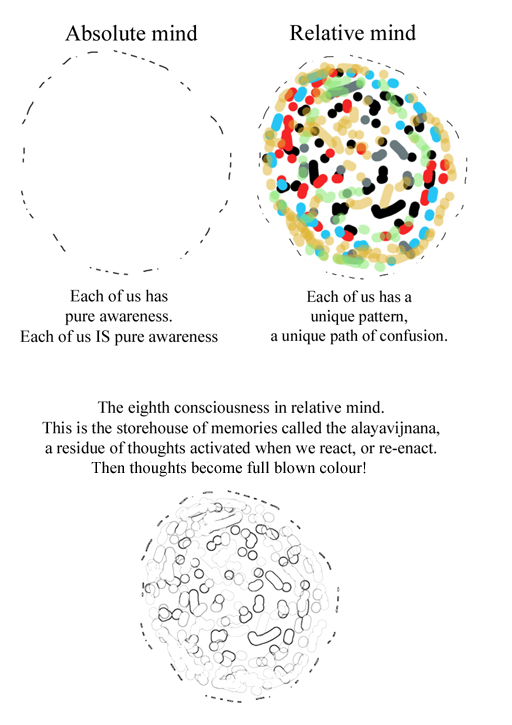
In the evolution of spiritual development, humans are the missing link in the chain to enlightenment, because we have the ability to be aware of awareness – and therefore the emptiness of awareness, which is our true nature. All creatures, through evolution of rebirth after rebirth, will, at some point, become enlightened when self interest ‘dies’ (collapses). This self interest is stored in the eighth consciousness, called the alaya and the alaya-vijnana in Sanskrit. This karmic storehouse, or reference library, where information and the imprints of attitudes in the mind are held and to which we constantly refer, moment by moment in our daily lives. It’s how we function on a relative level. These two are like the software and hard drive on a computer: the alaya is the information and the alaya vijnana refers to the facility where this information is held.

When this karmic reference library collapses, we become enlightened because there is nothing to which we can refer; there is only pure consciousness, pure awareness.

In my confusion (I was unclear about the difference between alaya and alaya vijnana), I once asked my teacher, β€œWhen the alaya is empty, is that enlightenment?” He said, β€œNo. The alaya is the software: more may still be added). It is when the hard-drive – the alaya-vijnana – collapses, no further karma can be added. That is when enlightenment occurs.”

The question may arise,
β€œSo, do we see humans as animals?”
Well, we’re not totally safe, are we?

πŸ˜€ πŸ˜€ πŸ˜€

Posted in Uncategorized | Tagged , , | 1 Comment

RECALLING THE TEACHER

Recalling the Teacher

Tibetan Buddhism is about Guru Yoga – connecting to the lineage of realised masters, which supports our endeavours. Even though this blog is more inclined towards the inner teacher and symbolic teacher of all phenomena, the outer teachers are also of extreme importance, for without them, nothing would be known about ultimate reality. So, in fact, they are more important than the Buddha!

For ‘modern’ people, this may be a difficult subject, especially when not properly and reasonably explained. This is because of a misunderstanding of the different natures in different cultures: we, as modern people, need everything explained, as we are not brought up in the Tibetan system from birth.

We can practise in just being, inside or outside. However, when we have an image or text in front of us that is meaningful, there is a more disciplined connection to the teachings. β€œGuru Yoga” isn’t for everyone, but we all have a natural appreciation for something that is being explained … and that’s it! That appreciation – that deep appreciation – is not worship. It is a re-cognition. And it’s something to be sincerely grateful for. Of course, our pride may say something else…

Recalling the teacher is an extremely useful tool. If we do not know the teachings thoroughly or don’t have good meditation experiences, devotional practice is very productive. Supplicating the teachers’ kindness can bring tears to the eyes, bypassing all theories. That’s the fulfilment of longing. That’s blessings. That’s ecstasy for you, and it’s not a drug.

At death, if emptiness is not clear, then recalling the teacher is very important as the remembrance goes beyond words. There is just the feeling of connection.

There is the scholarly-understanding way.
There is the resting in pure awareness way.
There is the Guru Yoga way.

There is the way of combining all three.

NB Our understanding of Guru Yoga has to go beyond both the social aspect of the teacher and the political shenanigans that surround them: it is the teachings, and the genuine wish of the teacher to convey those teachings, that are important.

Posted in Uncategorized | Tagged , , | 1 Comment

DEDICATING ONE’S PRACTICE

Dedicating One’s Practice
and One’s Life to Others

This is a tall order – and challenging –
but we have to start somewhere!

In Buddhism, there are prayers at the end of a session to dedicate the merit (blessings) received from the practice to all sentient beings. It is a wish that all sentient being realise happiness and their enlightened nature, and have unlimited compassion for all.

Dedication is important because it stops us clinging to the practices of self interest. If everyone was enlightened, wouldn’t it a great place?

Unfortunately, there is a danger of just repeating something stuck on the end of each practice session, when it should really be taken to heart. This will produce the energy and confidence to face life, and reinforce the enthusiasm to continue practising.

It’a all to do with a good heart

It doesn’t matter how knowledgable, learned and clever-sounding others may be, what is needed is a good heart. We can be as thick as a short plank, and still have a good heart. Funnily enough, it is easy to lose that good heart when becoming ‘spiritual’, as information can get in the way. Actually, that’s not funny, but it happens all the time.

Never lose a good heart to the pride of learning and academic achievement.

I was once a student at a school of philosophy, and was up on some scaffolding, decorating. I looked down and saw an older student carrying a heavy load. The instinct was to jump down and take that load, but doubt came in, in the form of β€œIt’s his karma.” What sort of karma had I just produced?!

Goodness without God is good.
Goodness with God is good.
Goodness is goodness.
The word goodness is not easy to define.
There is just a rightness about it.

Supercalifragilisticexpialidocious seems to sum it up…
extraordinarily good.

Posted in Uncategorized | Tagged , | 5 Comments

THE GREATEST SECRET IN THE UNIVERSE

The Greatest Secret In The Universe
…and it’s right in front of our eyes…

You and I are the gatekeepers to this greatest secret.

This gatekeeper can either open the door, or keep it shut. The door is kept closed by allowing ourselves to be distracted. We are so distracted – and so used to being distracted – that we cannot be bothered to go free. The very moment we recognise that distraction is taking place, the door opens and the light shines in.

We are in the β€œDark Age” because the majority of this planet is distracted. The secret is not open to them because they prefer distraction. It doesn’t matter if a few know the truth about their true nature, because the majority will prefer distraction and darkness because it excites them. But all that actually happens is that they remain dull.

A government does not need the majority to vote for them to be in power. They rely on indifference and the vote-splitting factions. In this age of technology, it is so easy to distract people. There is really no need to blame governments or corporations, as we can still be free if we chose.

Governments and corporations just do their greedy things based on self interest. They are even more in the dark than we are. Power corrupts, because there is so much that has to be maintained; there is hope of gain, and therefore, fear of losing.

The media is the same; it’s all about ‘interesting’ people. Experts talk of endlessly of figures and events in history. Social media is all about tittle tattle and celebrity nonsense. Every year, they recycle the same old ‘news’, and use the same phrases as if they’ve never been heard before, to elicit the same old reactions. This is the ridiculous nonsense of samsara that results in collective confusion. But when we recognise this ridiculous nonsense as ridiculous nonsense, it actually serves to free us! The secret is right in front of us!

More than two thousand years ago, the Buddha told us the truth – the greatest secret – that we are pure awareness. Nothing more and nothing less. Just the same as the Buddha himself. He taught how to remove the mental fixations or veils that obscure this pure awareness.

But the majority of this planet still prefers to be distracted. The greatest secret is, it is now that we can make the fastest progress, precisely because it is all so ridiculously nonsensical! If we choose to look, there is a golden age within this dark age.

The secret is so obvious.
All appearances in the mind are mere phantoms
in the infinite spaciousness of pure awareness.
We just have to work on it a bit.

Accept it.
See it as it is.
You’re free.

πŸ˜€

Posted in Uncategorized | Tagged , , | 3 Comments

I NEVER KNEW I KNEW, AND NOW I KNOW

I Never Knew I Knew, and Now I Know

Throughout countless incarnations since beginning-less time,
I have been looking for something.

I found that the thing I was looking for
was the thing that was looking.

I Never Knew I Knew, and Now I Know

Posted in Uncategorized | Tagged | 6 Comments

PADMASAMBHAVA on GOODNESS

Padmasambhava on Goodness

The word ‘goodness’ can remain either as a philosophical idea, or be a practical expression of compassionate wisdom.

β€œMaster Padmasambhava said: When you persevere in Dharma practice, it is essential to trail always in turning any virtuous root of action through body, speech or mind, to be for the benefit of others.

β€œFirst, train gradually in this with the smallest deed. From time to time, check to see whether or not you are tainted by the defilement of self interest. You will not be successful if you retain even the tiniest taint of selfishness. Make sure not to be tainted by the defilement of self interest.

β€œThe difference between the greater and lesser vehicles is the arousing of bodhicitta. The difference is created not by the view, but by compassion. Therefore, keeping the view of the natural state, train yourself in great compassion.

β€œFor the benefit of self and others, abandon the suffering of samsara forever. Train repeatedly in feeling renunciation for samsara. Train to take upon yourself the burden of suffering of others. First train in regarding all sentient beings as being like yourself.

β€œTrain in feeling that the suffering of others is your own suffering. Then train in cherishing sentient beings as being more important than yourself. Train in the great compassion that involuntarily acts for the welfare of others.

β€œThe word ‘Mahayana’ implies simply to cherish others as being superior to oneself. Mahayana never implies the pursuit of happiness solely for oneself with no thought for the suffering of others, regarding oneself as more important.”

One may assume here that one has to be meek and mild, and take a subservient position. This is not accurate. I once heard an instruction, β€œThe strong serve the weak”, so you can see by this that caring for others more than oneself is truly dynamic; a diamond quality that cut through anything. Merely offering someone a cup of tea is doing something that perhaps they can’t do for themselves. Or washing someone’s feet, as Christ did.

‘The strong serve the weak’ reveals joyous confidence, and therefore compassion. This transforms ordinary pride into divine pride, where the lineage of the transmissions one has received is upheld: this comes with much responsibility.

Posted in Uncategorized | Tagged , , | 2 Comments

PRACTISING DHARMA IN A TROUBLED WORLD

Practising Dharma In A Troubled World

We complain about how life seems so cheap.
We complain about continual changes happening in the world.
We complain about others’ attitudes.
We complain about the constant suffering.

β€œWith all these traumas in the world, how can I practise the Dharma?”

If we reflect and take to heart these complaints – which are justified – we will arrive at the precise reasons for following the steps of the Dharma which alleviate suffering.

These four complaints are known as the Four Mind Changes. They are what is actually needed to change our mind into doing something about suffering and the causes of that suffering.

The Four Mind Changes:
Considering the preciousness of the human body.
Considering the impermanence of everything.
Considering the consequences of karmic action.
Considering the negative characteristics of samsaric* existence.

We are not going to change the world, but we can change our view of it. The real cause of our suffering is our identification with a mistaken ‘self’; this obviously applies to everyone on the planet. This is mass confusion. To be free, we have to step outside (metaphorically) this mistaken illusion.

In this β€œdark age”, the world is not going to change for us, so we have to look into its reality. This β€œdark age” is full of fears and hopes, keeping people ignorant in a collective illusion that we have created = samsara*!

Below is a video revealing the kind of programming to which we are constantly being subjected. This is why, especially now, we should practise dharma and meditate, clarifying the mind for our own sanity and the sanity of our loved ones – now and in the future.

β€œThere Is A War On Truth”
https://www.youtube.com/watch?t=377&v=ixuJGyXSOUs

*samsara is the constant striving for ‘happiness’ and being frustrated.

Posted in Uncategorized | Tagged , , | 3 Comments

TEACHERS HAVE MANY STUDENTS…

Teachers Have Many Students
…so they do not have the time to know us all.

This is why we have to look into our own minds
and realise that we can see what is going on there.

There is an inner teacher-student relationship:
an inner reflection of relative and absolute reality.

It is the absolute that is the student,
It is the relative that is the teacher.

It is the relative that is conveying all the information,
while the absolute is just aware.

Once this information has been realised by the absolute,
the absolute recognises the information as wisdom.

This wisdom is then transformed into clarity
which reflects back to the relative to express wisdom.

The mind is now clear, and essence is clear.
Essence has always been clear, but did not recognise it.

Once the absolute recognises all phenomena as wisdom,
all phenomena arises in the light of wisdom.

This is the meaning of training the mind
to express wisdom love.

This seeing is essence watching the mind games.
This essence is our essential nature of empty awareness.

Understanding this empty awareness,
anything that arises in the mind is seen as the teacher.

Mental arisings are responses to external phenomena.
These arisings and appearances are empty of any true reality.

Absolute reality – empty essence – has nothing to teach.
It is the constant student, ready to reflect for the benefit of others.

The teacher is relative reality; the mistaken view occurring in the mind.
Its very presence is telling empty essence something.

All the outer teacher wants is for you to realise your inner teacher.
Then you are free, to let go.

There is emptiness and the contents in emptiness.
There is nothing finer than emptiness.

May the contents become enlightening.

Posted in Uncategorized | Tagged | Leave a comment

MINGYUR RINPOCHE – “BUDDHISM IS NOT A STRAITJACKET”


Mingyur Rinpoche – β€œBuddhism is not a straitjacket.”

β€œ…Meditation is about learning to work with the mind as it is, not about trying to force it into some sort of Buddhist straitjacket.

β€œThe point of working with supports for your meditation is to develop a degree of mental stability that allows you to be aware of your own mind as it perceives things.”

β€œThe Buddha recognised that no two people are exactly alike, that everyone is born with a unique combination of abilities, qualities, and temperaments…”

When the light is on, we stop bumping into things!

Screen Shot 2015-09-23 at 08.08.16

Screen Shot 2015-09-23 at 08.07.41

Posted in Uncategorized | Tagged , | 2 Comments

MAKE IT NICE, MAKE IT SPECIAL

Make It Nice, Make It Special
..and then stop making it!

We make our practice special to realise our true nature. When we sit to meditate, the place should be nice and special; it should outside the normal business of life. This could be as simple as a cushion and a shelf on which to put a text or book and any image that inspires. So it is nice place to be: I have a special blanket to wrap myself in, and cover my ordinary clothes (and it stops draughts). We never leave spiritual books lying around for others to step over.

In Tibetan Buddhism, we may chant in Sanskrit or Tibetan, both being spiritual languages. These are languages that have been used for hundreds – and even thousands – of years, which not only gives them power, but blessings also. One might regard this as merely psychological, but valuing something as special does have a good effect. These blessing will translate into our own language when the material is understood.

Here is an article about mantras by Thrangu Rinpoche:

Presently, we are reciting all these prayers in Tibetan because these Tibetan words are loaded with very many blessings caused by many, many lamas having practised these texts. So the words convey all the lama’s blessings.

A similar thing happened in Tibet at the beginning of the spreading of Dharma there. The old mantras that came from India were in Sanskrit and they were not translated into Tibetan. This could have been done, but it was felt that the words had a special power of blessing because they had been recited by so many beings who had achieved realization in this way that they contained so much blessing. This was why the mantras such as “OM AH HUNG” or “OM TARA TUT TARA TURE SVAHA” were used.

Although we recite them in Tibetan, we should study their meaning in English (or our local language) so that we can understand the meaning of our practice. However, when we recite the text, we receive the blessing from the words themselves. Sometimes in the future, when people have achieved realisation in the English context of practice, then at that time the English words will also be full of blessing and we can then use English in our practice.

We should try to study these prayers when we are by ourselves. What we can do is take the phonetic transcription and see what part of the English text corresponds to what Tibetan words and try to understand the meaning of what we are doing so that once we begin reciting it in Tibetan, we know the meaning of the words and exactly what these words are describing.

Here, I must add what Jamgon Mipham Rinpoche has to say, because we must never forget the whole point of practice, which is to realise that which cannot be illustrated.

β€œTo elaborate or to examine is nothing but adding concepts.
To make to effort or cultivate is only to exhaust oneself.
To focus or to meditate is but a trap of further entanglement.
May these painful fabrications be cut from within!

β€œBeing beyond thoughts or description, not a thing is seen.
There is, however, nothing extra remaining to be seen.
That is the profound meaning of resolving one’s mind.
May this nature, hard to illustrate, be realised!”

Even if you follow another tradition, it would be beneficial to take the same degree of care.

Posted in Uncategorized | Tagged , , | Leave a comment

WE CANNOT BE HONEST IN A SPIRITUAL CENTRE

We Cannot Be Honest In A Spiritual Centre
We can be honest outside…

…but in being honest, we are acknowledging a part of ourselves that we are frightened of, and that we fear could open a floodgate of doubts. We have doubts because we are uncertain and lack total confidence. We have joined something which has not been explained completely, so people become protective and defensive.

There is a difference between being Buddhist and being a practitioner.

There is a difference between being a practitioner and being a person whose practice is the continuity in daily life.

We are looking for something to give us a sense of direction, something that we are longing for. Interestingly,the word ‘competitiveness’ comes from competit: β€œto strive for”, so you can see the dual problem. We either long for or strive for something that can inspire us, or that same thing can make us blind to anything other.

After a moment of honesty, a barrier is created to protect that which has been exposed, as we feel vulnerable. ‘Honest’ is honest about the way we feel; although the feeling may be mistaken, we are being honest by revealing that is how we actually do feel. This isn’t being true to ourselves; it’s being honest that we don’t understand. Down the pub, we may be honest in expressing our opinions, but in a dharma centre, we expect others to be more empathetic and tolerant of our misunderstandings. But this isn’t the case. If we are honest, people don’t like it. They don’t want to be contaminated by an alternative view to the one to which they have conformed. If they are honest and they speak as they find, then – metaphorically – they have to kill you πŸ˜‰ . They do this by not speaking to you again, as they don’t want anyone to acknowledge their weakness and confusion. Pity, because that is precisely their path.

This is subtle hope and fear. People are striving for something and do not want to be contaminated by the doubts of others. This reveals a lack of compassion, empathy, understanding and real confidence.

This competitiveness gives rise to pride and jealousy, which reveals ignorance of everyone’s true nature. Competitiveness is having or displaying a strong desire to appear to be more knowledgeable or successful than others. Alternatively, we could display inverted pride of being extra humble.

In ordinary life, emotions happen all the time, as we make judgement to cope, but it is not so intense. A spiritual centre reflects our emotions, smashing us in the face…wham! This is because we still think we shouldn’t have emotions – and this is where proper instruction is essential to understand the wisdom aspect in everything, including the so-called negative emotions which are vital for progress.

If we were honest, compassionate and confident we could spar cheerfully with one another, and be of mutual benefit. But all we seem to want to do is appear better than others – especially in the eyes of the teacher – so we conform to a system and gaze at the guru, hoping that will put everything right. But it doesn’t, as we still have to go home. People are people and protect ‘their self’.

Outside the dharma centres, ordinary people are often more helpful and friendly, and do not have the same intensity. They may no have awareness of β€œthe view” but for short moment, they have a good heart.

In short moments we all have a good heart.
The good heart is our true nature.

Posted in Uncategorized | Tagged , , | 4 Comments

HOW TO BE ENLIGHTENED IN ONE LIFE TIME

How To Be Enlightened In One Life Time
(…information will only be of benefit when you make these thoughts your own…)

This is from β€œRainbow Painting” by Tulku Urgyen Rinpoche.
THE TRUE FOUNDATION. Page 132

β€œLet me tell you another essential point: until you have truly taken to heart and assimilated their truth within your being, continue to train in the general and specific preliminaries. These are the reflections on the ‘four mind-changes’ – the precious human body, on impermanence and morality, on the consequences of karmic actions, and on the negative characteristics of samsaric existence. The specific preliminaries are: taking refuge and making prostrations, generating bodhichitta, Vajrasattva recitations, mandala-offerings and guru yoga. It is common to all schools of Tibetan Buddhism to begin with these.

If we truly take the four mind-changes to heart, and reflect sincerely on the suffering of the six classes of beings, we will not find it difficult to do these preliminary practices. Otherwise we might think it was okay to just lay back and have a good time eating and drinking, with an attitude like, β€œWhy bother to do exhausting things such as prostrations and mandala offerings?” In reality, these preliminaries are the foundation for attaining complete enlightenment. When you sincerely understand that, you can see the reason for this ‘work’.

However much you hear about the difficulties of obtaining human body and the value of renunciation, the will to be free, such information will only benefit when you make these thoughts your own. Right now you have the freedom to do so. Make no mistake; these four reflections are the very basis for the path of enlightenment. To build a house you need a stable foundation; if the foundation is good then a hundred-storied tower can be built on top of it. If you want to become enlightened in this very body and life, you need to bring about a deep shift in attitude, a shift that can take place by reflecting on these four mind-changes. On the other hand, if you only want to enjoy life’s pleasures, you’ll find Dharma practice to be extremely tiring. You will lose interest in it eventually if you think these four thoughts are unimportant. In fact you will not have any lasting interest in a spiritual path until you take them into your stream of being.

For example you hear talk about the view, about the teachings of Madyamika, Mahamudra and Dzogchen. Through these, you can attain enlightenment in one body and one lifetime; such precious teachings do exist. But it is a mistake not to take the four mind-changes as your foundation. To rely only on teachings about the view is like trying to arrive somewhere that can only be reached by flying, when you only have the capacity for walking. If we do not have the proper foundation there is no way to progress….”

Note from Tony:

Not everyone undertakes the specific preliminaries (the ngondro); this is mainly for engaging in the Varjrayana deity practices of Guru Yoga, which are a strong back-up if we are not firm in the view. The four mind-changes however, are essential for keeping us on the straight and narrow: the rare-to -obtain human body, the impermanence of this body and all things created, the result of all actions which never go unnoticed, and the frivolous pass-times we fixate upon in the collective confusion.

We need constant reminders that we want to be free, but this has to come from the depth of our heart. We don’t have to ‘do’ anything but recognise, and take that recognition to heart.

It is our raison d’Γͺtre – the most important reason or purpose for someone or something’s existence.

We do need to be aware of all the distractions in life that keep us diverted – β€œOh! By the way – Japan beat South Africa 34 to 32…” πŸ˜€ D D – and not fixate upon these.

Posted in Uncategorized | Tagged , , | 2 Comments

WHAT IS HAPPINESS?

What Is Happiness?

It is not needing anything, being carefree. It is sense of relief, of contentment. Happiness is emptiness awareness without elaborations. It’s associated with bliss, a word that comes from blithe. Blithe: showing a casual and cheerful indifference, considered to be callous or improper: a blithe disregard for the rules.

Happiness is not what you think: it is true being.
The result of happiness is true confidence.
The result of true confidence is compassion.
The result of compassion is happiness.

We can’t lose, as there is nothing to lose.
πŸ˜€

Every time we sit down, we experience a sense of relief; just for a moment, everything drops away and the mind is empty. There is an instant when we just sit, and there’s nothing to do…and then we get involved in what to do next!

A question may arise here about the aspect of ‘callous’ and ‘improper’. Everything has its opposite. There are five Buddha families, each with their own wisdom quality – and a corresponding neurotic quality (for more detail, search ‘Buddha Families’). One of these families is called β€œthe Buddha Family” and is the experience of spaciousness, having a carefree quality. Its negative side, however, is being spaced-out and careless.

Being ‘callous’ or ‘improper’ could mean that we just don’t care – or it could mean that we are not driven by hope and fear, while remaining mindful of others. The hallmark of a proper approach to being improper is having intelligent compassion towards ourselves and others.

In this state of happiness, if something nice comes along, we acknowledge it and let it go. If something ugly comes along, we acknowledge it and let it go. We can appreciate the experience of both joy, and the lack of joy; in absolute reality, it’s all one taste. In relative reality however, we have to know what is beneficial and what is not.

The outcome of one taste – where there is no judgement – allows clarity to arise, and in that clarity we can then bring forth a quality of judgement that will bring about balance without bias.

Posted in Uncategorized | Tagged , , | Leave a comment

DON’T BE A SLICK BUDDHIST

Don’t Be A Slick Buddhist
Be an investigative journalist, seeking the truth

The Buddha understood what others did not understand: that the purity of awareness is our true nature, and not the trappings.

Trappings: The outward signs, associated with a particular situation or role – β€œSome of the appeal lay in its ritual and spectacular trappings: the bells and whistles.” Something in which we can become trapped.

A slick professional presentation is not the Dharma. The Dharma is revealing the truth – how it actually is. Learning all the answers and merely repeating them gives us a false sense of security. Just repeating the words β€œemptiness” and β€œessence” gives no flavour of what these words really mean.

The way in which we approach the Dharma is thinking like an amateur: in Suzuki’s words, β€œBeginner mind, Zen mind”, asking basic questions of β€œWhat?” β€œWhy?” and β€œHow?” It is not about learning by rote. Learning by rote is useful for later on, in order to be able to scan the mind quickly for information, but only to be beneficial in a specific situation. Wisdom has to hit the spot with a shock, and not gloss over.

We have to be investigative journalists seeking the truth, and not TV journalists being lobbyists for a cause. All Dharma practices are a means to an end, and that end is awareness of awareness, which is emptiness. It’s not about being good at doing a practice. It’s not about looking good at beating a drum, ringing a bell, waving a dorje or making mudras…

I once heard a lama say that when he started teaching educated Westerners, he was worried about being asked a question that he was unable to answer. He found that this hadn’t happened. So I asked him, β€œWho has become enlightened in recent times?” He did not reply. I remember that, after the break, I sat closer to the exit door…;-)

Understand what others do not understand: the true nature of reality.

Posted in Uncategorized | Tagged , | 7 Comments

BEWARE: THIS MAY WAKE YOU UP

Beware: This May Wake You Up
Beware: you may want to go back to sleep!

Approach the present moment as if you have never approached this present moment before.

Of course, the present moment hasn’t been experienced before, but we still approach it as if life is one continuum, and so we overlay the present moment with the previous moment. The past. There will still be a residue of the past which is a graph of all our reactions – our patterning – but when we take a larger view of the graph, a certain tendency will be seen and that is our true tendency, indicating the path we are following.

When we approach the present moment in a fresh way, it is more tentative, more reflective. This connects to lateral thinking as opposed to vertical thinking. Vertical thinking is one continuous line of assumptions. Lateral thinking is going back to basics and asking the question, β€œWhat is this?”

At retreats, one notices some lamas approaching text and questions as if never heard before. That’s a good sign! I remember asking Ringu Rinpoche, β€œIs essence ordinary?” He paused for some time, pondering, and replied, β€œYes it is.” I assumed he knew this already, but he took the time to review his view.

We will notice that we may not want to stay in the present moment. Astonishingly, we actually don’t remain in the present moment: we chose to go back to the familiar dream. We β€œsleep, perchance to dream.”

We always have a choice to walk out of enslavement, or stay there as it’s ok really… Demons know how simple it is for us to wake up, and how simply we can be put to sleep. The media is all about the past (even if it is the immediate past) and can never speak of the present moment. If it did, it would stop entertaining us.

All we have to ‘do’ is watch, and recognise. When we recognise, there is a knowingness present. The present moment is the presence of wakefulness…and cannot be found, as we would be coming out of the present moment of direct, immediate experience, to entertain ourselves. This is non-duality becoming duality.

Remembering this, you may never go back to sleep again πŸ˜‰

Posted in Uncategorized | Tagged , , , | Leave a comment

WHY CAN’T I SEE MY TRUE NATURE?

Why Can’t I See My True Nature?

This question describes the perfect prison, and the perfect key to that prison.
All we need now is the perfect understanding to turn that key and be free.

It is simple, but no one said it was easy. It isn’t easy precisely because we are fighting with the man in the mirror, our reflection. Mr. Devil. We believe the reflection to be real, and that belief is the prison.

β€œWhy can’t I see my true nature, now?” The answer is, β€œWho is asking the question, now?”

To understand this answer, we need a method of sitting quietly and just being aware. To ‘do’ this, we need time to meditate and ‘do’ nothing. This is the escape route; doing nothing!

Every individual will have a certain amount of chatter in their mind.
The question is, what is aware of this chatter?
It is awareness itself that is aware of the chatter.

When this awareness is aware of itself, it only finds awareness.
That is pure awareness: it is self aware.
Without modifying or doing anything, the door to the prison opens,
and we float out.

However, we immediately start analysing – and float back in again. It is the questioning that turns the key to open the door. It is the doubt that keeps it locked. Trust in the awareness. Recognise the awareness and let go: this opens the door. There is energy in questioning, but at some point, the questioning has to stop in order to remain outside – because we are already outside πŸ˜‰ When we are outside, there comes a point of no more questions, of no more learning.

Because of habitual patterning, we find that we constantly float back into this mental prison. We float in and out all day long. If we weren’t out sometimes – being aware naturally – we’d keep walking into walls! Most of the time, we are on auto-pilot. We go upstairs for something, holding the idea of the thing we want, and we forget to be aware of the walking upstairs. We use the journey as a means to an end, when the journey was the end in itself.

We are here now, all the time. We are nowhere else. But we’re always looking for something else. It’s a habit that we don’t trust ourselves, so we look for someone in robes and a long white beard, to tell us what we already know. This means we have to trust someone else, and so we are back to not knowing – and so believing – again.

Thus, we go round in circles looking for ourselves, when we should just look, see and drop the seeing.

Posted in Uncategorized | Tagged , , , | Leave a comment

A VERY PECULIAR SELF DOUBT

A Very Peculiar Self Doubt

When we have doubt, WE…HAVE…DOUBT. We are not this doubt, because we are aware of this doubt that appears in the mind. Because we have identified with this doubt – which is merely a confused idea in the mind – we will doubt ourselves forever, as it has become a habitual pattern. Such programming has already taken place.

What is doubt? It is lack of certainty. As sentient beings, we are not enlightened because of an uncertainty about our true nature of pure awareness. As a result of this, we have acquired a second nature, a programme. This programme is called karma: it’s the script that drives us, and because this second nature is incomplete, we ‘have doubts’ about it.

In truth, we are perfectly clean beings in a sticky world. My teacher Tsoknyi Rinpoche illustrates it like this: when we wear a covering of clothes (our defilements), if things are thrown at us, they stick. If we are naked (without defilements) nothing sticks, as the things thrown at us just fall off.

If I look at myself, I am a worrier and experience self doubt all the time. This is because of many happenings in my early life, and possibly in previous lives. I seem to have been born that way. The doubt arises from not knowing how to relate on a conventional level, fitting in with social assumptions. But all of this is merely an idea that the mind holds about itself. My true nature (pure awareness) is aware of all this, and it is untouched by the doubt. It is disinterested. It doesn’t become hooked.

Real confidence is acknowledging this doubt in the mind. False confidence is a protective covering laid over the raw experience, because of fear. Doubt is just a programme in the system in which we move around. In ‘sci-fi’ terms, we are pure consciousness trapped inside a bio-computer with constricted software – and it just doesn’t feel right. Unfortunately, the world in which we live keeps updating our junk programming! Most believe the programming is real, and so react to it. They get too interested: to use ‘sci-fi’ terms again, they are caught in the illusory matrix.

My self doubt comes from perfection trying to fit into an imperfect world.
Even religion and teachings are not perfect, as they are not the actual experience.

It is the raw experience that is perfect:
it is β€œConfusion dawning as wisdom.”

Recognising self doubt is therefore important.

Posted in Uncategorized | Tagged , , , , | 4 Comments

WHAT IS THIS MOMENT, NOW, LIKE?

What Is This Moment, Now, Like?

This spontaneous presence.
It’s ordinary.
It’s special in its ordinariness.

I’ve looked and looked, hoping for something more, something interesting, but no – it is looking and seeing awareness that always stays the same. Good, isn’t it?!

Of course, there could be more, such as clairvoyance and miraculous happenings, but I’ve never met anyone who displayed these accomplishments – or they’ve kept them a secret! However, life is too short to keep looking and hoping for something more. It leaves us hanging around, waiting for something better, in which case, we will only die, not knowing. So we need to make a decision, and have confidence in that decision, until something more profound comes along. Actually, this clarification (and synapses firing and dots joining up) is happening at every moment, in the form of subtle refinements…if we’re looking.

Years ago, I was sitting in the Rabsel tea garden, in the Sechen monastery in Nepal, when a young monk, about 12 years old, sat down at a table on his own. He seemed special. He just sat and looked around in a disinterested way. People came up to him with folded hands to enquire about something or other and then left, and he returned to just sitting, disinterested. While we sat in the tea garden watching him, I wondered what this monk was doing, or thinking, or feeling. How did it feel to be ‘special’?

The answer, so far.

Every morning after meditation – or even during – something occurs in the mind in an abstract way. I then meet up with my wife and we have tea and chat, and discuss what occurred. I sit at the computer and just type. Because of a poor education, my grammar is a little back to front, so Kathie, my wife, corrects it and explains to me why it doesn’t quite make sense that way; I type as I speak.

Anyway, while she reads and asks me questions to clarify in more detail about a particular aspect, I just sit and look around. Oh! I suddenly realised that that is what that ‘monk’ did! He didn’t have angels or deities floating around explaining teachings: he just sat in the moment experiencing emptiness. It is clarity of emptiness that clears unnecessary mental chatter. The chatter is the interesting junk that obscures the clarity. That clarity is ordinariness, our natural being. We just have to trust in our simple ordinariness.

Looking for something ‘special’ and trying to get it ‘right’ causes all the problems. We make everything complicated, whereas appearances, sound and awareness are inseparable from emptiness.

I later recognised that young monk when he came to a retreat in Colorado years later: he was the reincarnation of Dilgo Khyense Rinpoche, Yangsi Rinpoche.

Posted in Uncategorized | Tagged , | Leave a comment

MEDITATION AND ITS EXPRESSION

Meditation And Its Expression

When we just rest, we relax.
When relaxed, the mind clears.
This clarity makes it easier to be
aware of awareness.
When aware of awareness,
clarity sees nothing but awareness.
That is pure, empty awareness:
it’s simply our true nature.

Now what to do?
The experience of our true nature is quite simple. Expressing it, isn’t. Much depends on the culture in which we were brought up, our family background and our educational experiences. Even within the same family, we have different views and so, the way in which we express ourselves and translate our experiences will be different; this is also limited by our ability to find the language to communicate the feeling. My family is used to arguing, while my wife’s family is not: silence is their way. To put it bluntly, communication is a problem. Added to this, our modern mind is more critical, suspicious, cynical and often sarcastic.

As we evolve, we develop skills, but there remains a residue from our past. When it comes to the Dharma, I tend to upset other students. It’s not intentional, it’s just my background which is working class.

When we go to Dharma centres, we all pretend that we’re not critical, suspicious, cynical, and sarcastic, but to those who know, our pretence stands out a mile. Dharma centres may be more middle class with ‘refined’ emotions, but they are still emotions! One of the problems with being refined is that one can become so poetical that the meaning is lost. Perhaps that’s the intention, so we pay for more teachings? See, there’s that cynical nature coming out! πŸ˜€ πŸ˜€ πŸ˜€

I’ve been to retreats where the lama has laughed at westerners for being critical, suspicious, cynical and sarcastic, suggesting that we shouldn’t be like that. The audience laughed as well, but I didn’t. Actually, my teacher approached me one day and told me that I didn’t laugh much – and I couldn’t tell him the reason why: I actually do laugh a lot, but not at the same time as Dharma students! πŸ˜‰ Compared to the Tibetan culture, we may seem screwed up…but that’s the way we are! Actually, Tibetans are a proud, superstitious people: we don’t hold that against them, as we find them cute and exotic, and having received great wisdom.

Modern people simply lack confidence; this is not something we choose. The world of technology has overtaken us, and we cannot keep up. It’s something governments and corporations have designed and are exploiting, to keep us confused and wanting.

We have to be honest with how our minds are now, in the way our culture is, and look into that. It’s when we look honestly into our own minds that we can then laugh – at ourselves. Others’ mistaken views are only reflecting their culture.

Mixing cultures sounds fine but has its problems: it divides. Just watch what’s happening in Europe; it’s an acceleration of confusion and wanting. It is social engineering. We can counter this by awareness.

The expression of meditation is unconditional love.
It does not divide.

Posted in Uncategorized | Tagged , , , , | Leave a comment

AS WE MAKE, SO WE BELIEVE

As We Make, So We Believe

We are pure awareness trapped in a body because of our previous action, in a make-believe world of the mind and the senses. The senses are, by their very nature, non-conceptual: they just sense. But because awareness forgets its own true nature of emptiness, it finds itself relating more strongly to phenomena via the senses. This activity in the mind creates memories and references of likes and dislikes, which are conceptual, and so we are ‘hooked’ into a ‘relative’ existence. It is this that caused duality – relative truth – by constantly relating to something other than pure awareness.

For security, we hold onto one another and therefore get dragged into the six realms of existence, (including hell) by our own demons of likes and dislikes.

Artists sometimes use shock tactics to make a memorable point. Nowadays, this is so common that it’s pointless – but having said that, it’s fun!

Below is an underpainting (the preliminary design for a finished work) illustrating a land of the senses. I could be outrageous by putting in suggestions of sexual organs but that’s going too far…so they will just be fleshy and have a few decorative protuberances coming out of their heads πŸ˜€

Through our karma, we find ourselves here. As we interact and react, we build a stronger and stronger addiction to this land. We hold onto one another and excite ourselves about this mistaken reality which enslaves us. Along the bottom of the painting are ethereal beings increasingly identifying with this false reality and thus becoming hooked like fish by demons.

And so we are left dangling in this sensual playground…while all the time, we have been nothing other than pure, free beings.

senses LOW

close up senses

Posted in Uncategorized | Tagged | 3 Comments