
We Can’t Put Others Right
We can’t put others right.
Even a Buddha can’t do that!
We can only put our selves right.
How do we do that?
That question is the beginning of enlightenment!
We Can’t Put Others Right
We can’t put others right.
Even a Buddha can’t do that!
We can only put our selves right.
How do we do that?
That question is the beginning of enlightenment!
Is The World Disheartening?
Is the world disheartening?
Have people become too judgmental?
How do we cope with others’ righteousness?
The point is that this is a divided world.
There are always opposing views.
The purpose of true spirituality is to unite us.
Unfortunately, our fixations actually divide us.
It is this that is disheartening.
What is heartening is that we experience all the emotions possible in the universe and therefore, we actually do have empathy, and are never without it.
Acknowledging this is love which heals our minds.
We all feel something or other …
feeling cheesed off
having a desire to disappear
feeling good
having the heebie-jeebies
feeling like a fraud
feeling miffed
feeling rage
being gaslighted …
As you can see, we know quite a lot as we’ve all experienced the following – so we do have the capacity for empathy!
|
|
|
|
|
|
Unshakeable Inner Security
The consequence of unshakeable inner security is compassion.
We can wish to have compassion for all, but that is just a wish – and may not even be a good wish, as wishing means we don’t actually have to do anything.
When we are convinced and realise our true essence, that becomes our primordial protector. To remain compassionate, there are lines we do not cross.
Wishful compassion is not compassion. It may feel good, but isn’t reliable.
This ‘primordial protector’ has many names.
Realising this natural state of being,
we know everyone else’s original nature.
It is when others forget that sadness arises within us.
That sadness is empathetic compassion.
Don’t get emotional.
Get compassionate.
🙂
Our Reality Isn’t Something Foreign
It’s not strange, unfamiliar or exotic.
Being attracted to such notions,
we fall for, are fascinated by and maintain the ‘mystery’.
Because we make reality a ‘mystery’,
this fosters intolerance and hostility in others.
The result is a two-pronged stupidity.
Have no doubt:
we are here to wake up from extremes.
Our reality is consciousness that has no sides.
When we just see, wisdom dawns.
Don’t Wake Up The Hard Way
There is more to being human:
Don’t ignore your intuition.
Follow your instincts.
Conversely, if you leave it too late,
life will suddenly slap you in the face,
and you may wake up for a moment …
but you won’t be mentally prepared.
Through waking up to intuition,
you will have time to be ready
for whatever occurs.
How Did We Become Confused?
In knowing how we became confused,
we can find our way back to our reality.
The opposite to knowing is not knowing
and understanding the implications of this is quite a shock.
We need this shock because it wakes us up.
Our reality is pure consciousness = the light of bliss = enlightenment.
This internal light of clarity shines on everything = awareness.
There came a moment (and it’s here right now) that consciousness became attracted to whatever the light shone upon. We fell for the glittering, and forgot that we are that light.
This is called ‘co-emergent ignorance’; the process of light, together with the shining, makes things visible, and causes attraction and forgetfulness. We then maintain this forgetfulness by becoming fascinated and artful in creating even more glitter in our own image; this is known as ‘conceptual ignorance’.
Thus, we are confused by totally forgetting the inner source of reality.
The practice is to find a practical method to repair this confusion.
And now for the practical joke …
We repair confusion by seeing the confusion.
It is the seeing that is the light,
and it’s always been present.
The light is never confused.
Whatever is seen is merely impermanent phenomena.
We are definitely free in the moment of just seeing.
Not complicated at all, is it?
Light shines on some thing,
we become attracted, and caught.
If we don’t hold on, we are free … !
What Are The Qualities Of Mind Essence?
The only way we can find the answer to this is through personal questioning and experience. Someone else’s answer is hearsay and thus, only a generalisation. It is for us to experience personally. Don’t take it for granted that, because we hear something, we know it. We have to re-cognise, to re-know it, otherwise we live in the illusion of hearsay, which is belief. To escape the mass illusion of beliefs, it is we who have to find the exit, while any reaction merely inhibits freedom.
Beliefs have absolutely no reality.
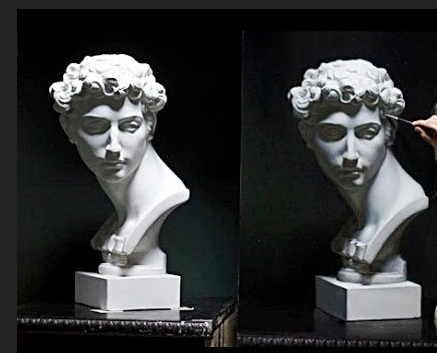
To illustrate how we only know something through personal experience: light falling on a white cast head causes a shadow on the form, but notice that where the light falls directly, the cast shadows are sharp, whereas when it follows around a form, the shadow is soft or gradated. This is how the artist gets a realistic and accurate result. We would not see these differences unless we were shown them. The point is that we then have to look to see if this is true … or where it is not accurate.
Mind essence is pure awareness or pure consciousness. It is vivid clarity, unencumbered by contaminating speculations that cause anxiety, and lock us in to doubt. We think that this prison of confusion and doubt is normal, but it isn’t.
We are free in the very moment of seeing.
That is the magic that dissolves all mysteries.
It is only when we realise that we are the very essence of mind – clear space – that we can recognise these contaminants, and they drop away all by themselves.
When we investigate mind essence, we try to see how it is, where it came from, and whether it changes. In realising that it never changes, that it came from nowhere and that it is everlasting, we understand what we are, and realise the answer for ourselves.
Not Seeing Eye To Eye
It’s impossible to see things the same way as others unless, through experience, we can empathise. The more we suffer, the more we can be of benefit.
As we evolve, it is impossible to see things the way we saw things before; again, through experience, we can empathise with our previous, mistaken views.
If we cannot empathise with our self, we will continue to carry around old trauma/wounds.
Seeing things differently to others is due to our past experiences that have affected the way we see now. For that reason, we talk at cross purposes – and unfortunately, this creates unintentional conflict that leads to disagreement, and even hatred.
It is through experience – and understanding – that we evolve. If we spend our life backing away, we merely live to argue another day. We don’t have to be a scholar to realise the truth that we are that which we seek; we just have to recognise that we are seeing our self-image in action.
To meet anyone who feels the same way
is a truly rare and precious moment.
Encumbered By Do’s And Don’ts
To free ourselves from our own dogma,
we cut the roots in our mind.
These roots are the do’s and don’ts we have acquired,
which cause us moments of discomfort.
This discomfort is invaluable in that it reveals our fixations.
Seeing these in the instant they arise,
we remain stable and at peace.
Now, we can see what to do, and what not to do,
without holding on to do’s and don’ts.
Through this mind training,
we do no harm.
We Have Never Been Separated
We have never been separated from the enlightened state.
Few see this, looking elsewhere for happiness.
Realisation of our true nature isn’t something to achieve.
It is merely washing away the doubt and confusion of self
that veils this enlightened state.
We know enough to be aware of the malevolence of self,
as it is the antithesis of reality.
The confusion of self is washed away through meditation,
clearing the mind of the residue of bewilderment,
while remembering to then rinse away the meditation.
Meditation disempowers self.
Once we realise the difference between self and our reality,
we no longer struggle as, by virtue of one, the other is known.
Understanding this, we cannot be separate from others.
We make mistakes, and through seeing mistakes, we learn.
That is the wisdom of seeing karma at work.
Why Are We Here?
Did we merely come into existence through the joining of sperm and egg, and then fall into a pattern of behaviour like everyone else?
Isn’t that pattern someone else’s idea, just like the artificial programmed intelligence of a drone that conforms to a projection? We exist vicariously – the phenomenon of living out our lives through others.
Until we realise our true nature, we will merely go along with whatever we are told. Intelligence begins when we realise that we have free will, rather than being data gatherers (and we only have free will when we realise that we don’t have free will 🙂 )
Can we be sure that we’re not a drone? As we learn things and then repeat them, we can be nothing else. Doesn’t habit work in the same way? When was the last time you did something original?
We while away our time, waiting for something to happen – but nothing does. That’s it. That’s our lives. We live and die, hoping to find something better, while doing the same things day after day. That is the collective idea of life and we feel safe when, in reality, it is actually our destruction – or rather, the obliteration of consciousness, as we fall into a blankness.
There is more to us.
We are the potentially enlightened beings
which all the victorious ones teach about.
Realising our true nature of pure consciousness, we dissolve into that nature. This is direct seeing, direct experience.
We can just follow orders, and act like drones, or we can look at the world and do what has to be done, which is for every individual to decide.
Who Do We Listen To?
There are always other sides to a ‘story’. In any walk of life, experts differ in the way in which they approach or express something; art, music, science, health, education, economics, politics … Buddhism.
Here is a list from Wikipedia of the main traditions in Buddhism. Remember that each tradition then has many outlets, monasteries, and groups in many countries and therefore, many teachers …
Indian Theravāda
Sri Lankan Theravāda
Amarapura–Rāmañña Nikāya
Delduwa
Kanduboda (or Swejin Nikaya)
Tapovana (or Kalyanavamsa)
Sri Lankan Forest Tradition
Siam Nikaya
Waturawila (or Mahavihara Vamshika Shyamopali Vanavasa Nikaya)
Burmese Theravāda
Thudhamma Nikaya
Vipassanā tradition of Mahasi Sayadaw and disciples
Shwegyin Nikaya
Dvaya Nikaya or Dvara Nikaya (see Mendelson, Sangha and State in Burma, Cornell University Press, Ithaca, New York, 1975)
Hngettwin Nikaya
Thai Theravāda
Maha Nikaya
Dhammakaya Movement
Mahasati meditation (mindfulness meditation)
Thammayut Nikaya
Thai Forest Tradition, focused on monastic living in the wilderness.
Santi Asoke, a recent reform movement.
Cambodian Theravāda
Maha Nikaya
Thammayut Nikaya
Tantric Theravada, includes many esoteric elements not present in classic Theravāda
Vietnamese Theravāda
Laotian Theravāda
Dai Theravāda in China
Bangladeshi Theravāda
Sangharaj Nikaya
Mahasthabir Nikaya
Nepalese Theravāda
Dharmodaya Sabha
Vipassana movement, a strongly lay-focused meditation-based movement, popular in the West (where it is also known as “Insight Meditation”)
Western Theravāda Buddhism
Jingtu (Pure Land)
Guanyin Buddhism (Syncretized with Chinese folk religion and Taoism)
Lüzong (Vinaya school)
Chengshi (Satyasiddhi- historical)
Kosa (Abhidharmakośa- historical)
Sanlun (Mādhyamaka)
Weishi (Yogācāra)
Niepan (Nirvana- historical)
Dilun (Daśabhūmikā- absorbed into Huayan)
Tiantai
Huayan
Chan (Zen)
Sanjiejiao (historical)
Oxhead school (historical)
East Mountain Teaching (historical)
Heze school (historical)
Hongzhou school (historical)
Guiyang school
Linji school
Caodong school
Fayan school (absorbed into Linji school)
Yunmen school (absorbed into Linji school)
Tibetan Chan (historical)
Zhenyan (Esoteric)
Humanistic Buddhism
Chung Tai Shan
Dharma Drum Mountain
Fo Guang Shan
Tzu Chi
Vietnamese Buddhism
Tịnh Độ (Pure Land)
Thiên Thai (Tiantai)
Hoa Nghiêm (Huayen)
Thiền (Zen)
Lâm Tế (Linji school)
Tào Động (Caodong school)
Trúc Lâm (Syncretized with Taoism and Confucianism)
Plum Village Tradition (Engaged Buddhism)
Order of Interbeing
Đạo Bửu Sơn Kỳ Hương (Millenarian movement)
Hòa Hảo (Reformist movement)
Śaiva-Mahayana in Southeast Asia (historical, syncretized with Hinduism)
Korean Buddhism
Tongbulgyo (Interpenetrated Buddhism – including Jeongto, or Pure Land)
Gyeyul (Vinaya school- historical)
Samnon (Mādhyamaka- historical)
Beopsang (Yogācāra- historical)
Yeolban (Nirvana- historical)
Wonyung (Avatamsaka- historical)
Cheontae (Tiantai)
Hwaeom (Huayen- absorbed into Jogye Order)
Seon (Zen)
Jogye Order
Kwan Um School of Zen
Taego Order
Wonbulgyo (Korean Reformed Buddhism)
Jingak Order (Shingon syncretized with Humanistic Buddhism)
Japanese Buddhism
Pure Land
Jōdo-shū
Jōdo Shinshū
Nishi Hongan-ji
Higashi Hongan-ji
Ōtani-ha
Ji-shū
Yūzū-nembutsu-shū
Risshū (Vinaya school)
Jojitsu (Satyasiddhi – historical, syncretized with Sanron)
Kusha (Abhidharmakośa – historical, syncretized with Hossō)
Sanron (Mādhyamaka – historical)
Hossō (Yogācāra)
Kegon (Huayen syncretized with Shingon)
Mikkyō (Esoteric)
Tendai (Tiantai syncretized with Zhenyan, Lüzong and Oxhead school)
Shingon (Zhenyan)
Kōyasan Shingon-shū
Shingon Risshu (Syncretized with Risshū)
Shingon-shu Buzan-ha
Shingon-shū Chizan-ha
Shinnyo-en
Shugendo (Syncretized with Shinto, Taoism and Onmyōdō)
Zen (Chan)
Rinzai (Linji school)
Fuke-shū (Historical)
Sōtō (Caodong school)
Ōbaku (Linji school syncretized with Jingtu)
Sanbo Kyodan (Sōtō syncretized with Rinzai)
White Plum Asanga
Ordinary Mind Zen School
Zen Peacemakers
Nichiren Buddhism
Nichiren Shū
Honmon Butsuryū-shū
Kempon Hokke
Nichiren Shōshū
Western Mahāyāna Buddhism
Zen in the United States
Indian Buddhist Mahasiddhas, 18th century, Boston MFA.
Esoteric Buddhism, also known as Vajrayāna, Mantrayāna, Tantrayāna, Secret Mantra, and Tantric Buddhism is often placed in a separate category by scholars due to its unique tantric features and elements. Esoteric Buddhism arose and developed in medieval India among esoteric adepts known as Mahāsiddhas. Esoteric Buddhism maintains its own set of texts alongside the classic scriptures, these esoteric works are known as the Buddhist Tantras. It includes practices that make use of mantras, dharanis, mudras, mandalas and the visualization of deities and Buddhas.
Main Esoteric Buddhist traditions include:
Indian Esoteric Buddhism (Historical)
Ari Buddhism (Historical)
Tantric Theravada
Indonesian Esoteric Buddhism
Philippine Esoteric Buddhism
Azhaliism
Indo-Tibetan Buddhism, the most widespread of these traditions, is practiced in Tibet, parts of North India, Nepal, Bhutan, China and Mongolia.
Nyingma
Bön (Indigenous, often considered “pre-Buddhist” in origin)
Kadam (Historical)
Sakya
Bodong
Jonang
Kagyu
Gelug
Tibetan Pure Land
Rimé movement (Non-sectarian)
New Kadampa Tradition
Kalmyk Buddhism
Buryat Buddhism
Tuvan Buddhism
Mongolian Buddhism
Bhutanese Buddhism
Newar Buddhism (Nepal)
Chinese Esoteric Buddhism (zhenyan, 真言)
True Buddha School
Korean Esoteric Buddhism (milgyo, 密教)
Jingak Order (Shingon syncretized with Humanistic Buddhism)
Japanese Mikkyo
Shingon
Shinnyo-en
Shugendo (Syncretized with Shinto, Taoism and Onmyōdō)
Western Vajrayāna Buddhism
Taixu, the founder of Chinese Humanistic Buddhism
Various Buddhist new religious movements arose in the 20th century, including the following.
Aum Shinrikyo
Buddhist modernism
Coconut Religion
Dhammakaya Movement
Diamond Way
Engaged Buddhism
Plum Village Tradition
Order of Interbeing
Forshang Buddhism World Center
Gedatsukai
Gedatsu Church of America
Guanyin Famen
Hòa Hảo
Ho No Hana
Humanistic Buddhism
Chung Tai Shan
Dharma Drum Mountain
Fo Guang Shan
Tzu Chi
Jingak Order
Juniper Foundation
Kenshōkai
Kokuchūkai
Kwan Um School of Zen
Navayana (“New Way”), also known as Dalit Buddhist movement, and “Ambedkarite” Buddhism
New Kadampa Tradition
Nipponzan Myōhōji
PL Kyodan
Reiyūkai
Bussho Gonenkai Kyōdan
Myōchikai Kyōdan
Myōdōkai Kyōdan
Risshō Kōsei Kai
Rulaizong
Sanbo Kyodan
White Plum Asanga
Ordinary Mind Zen School
Zen Peacemakers
Secular Buddhism
Shambhala Buddhism
Share International
Shinnyo-en
Shōshinkai
Sōka Gakkai
Tibbetibaba
Triratna Buddhist Community
True Buddha School
Vipassana movement
Western Buddhism
Buddhism in Australia
Buddhism in Europe
Buddhism in Austria
Buddhism in Denmark
Buddhism in Italy
Buddhism in Russia
Buddhism in Slovenia
Buddhism in the United Kingdom
Buddhism in the United States
Zen in the United States
Won Buddhism
In the end, we listen to our conscience,
and to whatever karma brings up in our life.
TRUTH IS NOT A PHILOSOPHICAL DISCUSSION
Truth is not a philosophical discussion. Philosophy is for those who don’t know or don’t want to know, as knowing means our view of life will totally change. In discovering absolute truth, we realise what is important and what isn’t, and we can’t go back to being carried away with whatever others do or say. Speculation creates doubt.
When we verify absolute truth, we can no longer cause harm to others. The cause of terror in the world starts with an subtle idea, as in Animal Farm – “Two legs bad, four legs good”, and then, “Four legs good, two legs better”.
Truth is direct experience, before words or feelings are used to describe it. It is the spontaneous cool/raw experience of consciousness. Pure consciousness is our starting point; it’s the moment when a surgeon opens up a body to see what’s going on, before he/she goes any further and decides what to do.
A non-surgical mind is usually so involved with body and mind sensations that consciousness seems boring and pointless. We usually use consciousness to enjoy mind imagery, but that is our self-made prison.
Words take us round in circles of speculation and theory, and actually carry us off in the opposite direction to truth. This is why spiritual retreats are held in silence.
Sitting quietly and allowing the mind to come to rest – without expectations – isn’t difficult. Children can do it! Anyone who meditates finds some sort of inner peace and clarity, and what they do then is up to them.
The difficult part is deciding to engage on this inner journey because we know this has the potential to change the direction of our life, and we still find our mind/the world/what others say to be fascinating. If we are not aware, life becomes an emotional and political competition, and we lie in ambush, waiting for the next battle – the easy target of low-hanging fruit. We dig our own hole to live in, while obsessing about and criticising others’ holes!
Unless we investigate personally, we will never know.
No one else can tell us what an apple tastes like.
Exercise: Catching That First Moment Of Reality
This practice is consciousness watching thoughts that come to pass.
Play a video of someone you normally do not like.
Just watch with an open mind, without any judgement at all.
In just watching, pure perception is taking place.
Now note that reactions and judgements will arise.
Let them go; do not follow them.
Return to pure consciousness, for that is what ‘just watching’ is.
You have now been meditating while watching something taking place before you.
We do this naturally in the very first moment of all situations, but this goes unnoticed.
As we practise, we see our bad karma at work – our criticisms, our repulsions – and the same process applies to desire and indifference.
Gradually, we will come to see our good karma at work – maintaining mental balance and clarity, with a greater realisation of empathy and compassion as we see misperception at work.
Ordinary meditation will be easy after this – it’s a piece of cake!
We are not doing something ‘spiritual’: pure spirit is self-evident.
In this meditation practice, consciousness watches thoughts that come to pass.
When consciousness looks in on itself, it finds nothing else.
That non-finding is simply pure consciousness.
It’s what we are.
The real work is acknowledging the habitual reactions that impair our view.
The more we acknowledge without reacting, the more karma dissolves,
and the closer we are to enlightenment.
Take A Look At Your Self
This self isn’t bad or demonic; it is just a collection of ideas that we mistake for our being. The demonic aspect of self arises when we express these ideas that can cause harm, or use them to bolster our self importance.
We all have a self to live with because we have identified with ideas, fixating upon them.
Spiritual teachings suggest that we aren’t supposed to be here … 😀 We are ethereal beings of light, of pure consciousness. We cannot get our heads around this as it is to do with something beyond mind that never changes.
Ether – late Middle English: from Old French, or via Latin from Greek aithēr ‘upper air’, from ‘burn, shine’.
Throughout human history, we have tussled with this prospect – and still do. This self isn’t the enemy; it’s our vehicle to enlightenment. Our selfishness can be a enemy to others, however – and an obstacle to our enlightenment.
Now, we have to do is see how all this feels. We know there is more to us. Take a good look at yourself; it is your karmic teacher, warts and all. Stop trying to be perfect – you already are. Stop competing with others – they have their own teacher. This self is just a residue of past experiences: all the while, pure consciousness sits and watches … and smiles 🙂
The only thing holding you back is your self. That’s how it teaches. We are free in the moment of seeing.
Stop copying others’ karma!
Nobody can tell you how to be.
Nobody can tell you how an apple tastes! 😀
As deeply as we feel hurt, we can also feel joy.
Nature Is Beautiful, But …
Nature is beautiful, but that which is beyond ‘nature’ is more beautiful– and terrifying.
We become so hooked by surface values that we limit our understanding of our true nature. This is both amazing … and shocking. We wander around in awe of everything we see, repeating all the names and creating new varieties. Knowing the code of nature, we can create other things and believe we are all powerful, but nature has a way of reacting to that. Becoming so sophisticated, any inconvenience has to have a solution.
Caught and held by our deep appreciation of nature, some even call this ‘spiritual’. Even though we may be spiritually mindful in whatever we do, this merely enhances our feeling of self and pride.
It is here that mindfulness falls down. We may be able to care about everything that we do, but never see the light within and instead, are dreamy and sentimental, unable to see and realise the deeper code.
And there is a deeper code –
Nature, the universe and sentient beings are run by three principles: attraction, repulsion and inertia. In human terms: desire, aversion and indifference / ignorance. That’s it. That is what keeps us and – nature – running around in circles and cycles.
The even deeper code –
The beautiful news is that, the very moment we notice we’re being caught in the three negative emotions of desire, aversion and indifference / ignorance, we are free. And we stop talking eloquent nonsense 🙂
These three negative principles are, in truth, the wisdoms of purity/emptiness, consciousness and unlimited compassion.
The following is the correlation of these negative emotions and wisdoms:
Desire = Emptiness.
Desire fills emptiness with concepts.
Aversion = Consciousness.
Aversion arises when consciousness forgets its empty essence; an ‘I’ is created and starts judging.
Ignorance = Compassion.
Ignorance is forgetting the true nature of all sentient beings, which is both empty and conscious. We thus lack compassion, as compassion arises from an understanding of that true nature.
These three negative emotions are used by the demonic mind in order to enslave others through a lack of compassionate empathy. We are all part of this demonic process when we are ignorant of our true nature.
Riding The Wave Of A Collapsing System
System: early 17th century, from French système or late Latin systema, from Greek sustēma, from sun- ‘with’ + histanai ‘set up’.
Realisation is all about riding the wave of a collapsing set up,
both externally (others’ minds) and internally (our mind).
Life as we know it is collapsing, so we have to be mentally prepared for change. It’s what humans do: we set-up systems that up-set our natural balance. It’s all political. Throughout our lives, we move from one system to another, while maintaining belief in ‘the system’. It is this which keeps us unbalanced.
Being mentally aware will prepare us for whatever occurs, either internally or externally. When we collapse our mindset, we can take on whatever happens with clarity, and we do this by emptying our mind of ideas placed there. The ignorant will fold into the next system, while the wise will ride it out through simply not believing in systems.
The purpose of studying spiritual texts is not to become stuck in a system, a tradition, a religion: the intention is to free us of all group-think.
A system is a channelling device that limits consciousness; a system may collapse, but sentient beings won’t. The universe is full of sentience in some form or another. Meditation is supposed to free consciousness, but if it becomes a system, we will constantly drown in sentimentality, rather than riding the wave of consciousness. It is only when we collapse the meditation that the non-duality of pure consciousness – our true being – is revealed. Actually, non-duality is present at every moment – meditation is merely a reminder when we forget.
Riding the wave of karma (the system) is being carefree, fearless and euphoric.
The cosmic joke is suddenly realising
that we too were caught up in the collective wave of confusion.
The joy of the joke is in the unexpected ending.
Thank goodness none of this is real!
Happiness is relief from confusion and suffering.
May confusion and suffering dawn as wisdom.
Insight
Nothing just happens; everything comes about due to a cause. A misunderstanding of this puts insight to sleep.
Insight is recognition, and starts with a feeling that something is ‘not quite right’ – a tell-tale sign, a sound in the voice, or an unconscious action that attempts to divert attention away from the essential point. We all have insight, intuition and wisdom but, if we do not let go of assumptions, this can unfortunately lead to fantasies and a ‘good’ story. Insight needs to be able to imagine potential and possibilities, and foresee a sequence of events, with the chance to refresh our view and allow insight to manifest in a authentic, pure way.
Unfortunately, most of us ignore insight in order to conform to social pressures, and this creates a lack of insight in a group situation.
Due to different experiences, we may not all come to the same conclusion. This is karma at work.
Insight needs the right language in order to express, as it’s looking from another viewpoint. Finding the right words is challenging, and can be frustrating. Some like to stick to facts, and facts are always about the past; that is the cause for the present moment to stagnate, to cease developing, to become inactive or dull.
It’s not a matter of fighting against anything, but seeing how it goes.
Insight is the ultimate reality of pure consciousness.
Meditate Like A Fly On The Wall
Meditate like a fly on the wall;
quietly observing, but not involved.
Living life like a fly on the wall teaches us much.
Whatever we learn enhances our skills and abilities to be of benefit,
instead of fixating on assumptions.
Why should I want to benefit others?
On the path to enlightenment,
benefitting others upgrades and enhances our abilities completely.
It is also a safeguard against arrogance.
A fly on the wall sees the writing on the wall.
This is insight:
a forewarning wake-up call …
auspicious augury …
a prophetic sign …
The natural world – as well as the unnatural world –
can teach us much.
🙂
Programmed To Be Ignorant
Consciousness is the real power and wealth in the world,
but only a few know this.
The dark is self-obsession, while the light is selflessness.
In between, no one is bothered.
How many realise the essence of consciousness?
A handful.
Many know about the essence of consciousness, but that is just theory.
We are educated to be drones. Beliefs are placed in our subconscious when we’re young, creating a basis for our future mindset, which is then maintained by distractions throughout life. We are programmed to shop for things and ideas – but, buyer beware.
Everything we do or think is due to consciousness, but most ignore consciousness. Power is not in money; power is in knowledge. True wealth and power comes from understanding, seeing potential and opportunity. The many only know this to a point (exoteric knowledge), while the few know it completely (esoteric knowledge). The esoteric is direct seeing; direct knowingness of pure consciousness.
There are non-physical entities that exist in our mind, outside physical reality: these are gross, self-serving images within us all – ideas that were placed in our minds when we were young. Unfortunately, we use these beliefs to find ways to keep ourselves enslaved, so that we don’t have to reason for ourselves. Look back on your life: is there a system that you entered through unconscious consent?
Consider … what are Christmas and the Buddha’s birthday all about? 🙂 These – and other celebrations – keep us in poverty by diverting our attention through a mass public display, when such an occasion should be spent in quiet contemplation.
We have been programmed
– on a ‘biblical’ scale –
to accept certain mindsets.
If you recognise this,
you have always known it
– but have ignored it.
Can A Buddhist Ever Be Offended?
If a Buddhist was ever offended, they would not be Buddhist; they would be an ordinary, religious person taking comfort in sentimentality. Buddhism is not a belief system as it is realisation of our reality; as such, we cannot be offended at the misunderstanding of others. A Buddhist should know the very nature of reality, and whatever illusions obscure that reality, and transcend these with compassion.
Being offended creates equivalent karma,
as we will continue to be offended,
because we have not transcended the idea of self.
Karma is precise,
and intention is very powerful.
Our karmic response can go one of two ways:
round in circles, or brought to a happy ending.
How The Truth Becomes A Lie
The truth becomes a lie when our attention is manoeuvred or directed to some other truth, and we become distracted.
Politics and religion both teach us this lesson. We are encouraged to follow the form and wave flags, rather than realise what is actually taking place. This is a form of hypnosis. Deception has to have an element of truth for it to feel comfortable. A hypnotist diverts our attention away from one subject to another, making us do things through suggestion. We are susceptible because we’ either desperate to please, or we’re too busy being competitive to realise the truth that is taking place.
Between truth and lies, there is a grey area – and this happens more often than we might think. It is called ‘paltering’: the active use of selective, truthful statements in order to mislead = spin!
As a result of this behaviour, people become cynical, and mistrust. This mistrust is then used to categorise us and, in this way, we are divided without our consent. If we question, we become dis-believers.
So, next time you hear a fact that sounds odd,
or someone deflects a question,
be aware that what appears to be the truth
may either be a deception, or ignorance.
When we realise that the truth is our own conscience,
we are on unshakeable ground.
The Importance Of Friendship
True friendship is reliable, transcending information-gathering and personal opinions. Friendship supports psychological well-being in order to maintain positive emotions.
In spiritual friendships, this is doubly so.
The head divides, while the heart does not. This has always been our inner conflict.
The head is a synonym for thoughts and judgements.
The heart is a synonym for purity of consciousness.
On the surface, this may look like male and female approaches, but reason dictates that our well-being depends on both, and that is a perfect definition of friendship. Friendship is dependable.
Do we need friends?
On a ordinary level, yes.
Once we realise the truth, no one is an enemy.
In genuine spiritual friendship, there is no partisanship.
“It’s Easier To Fool Someone Than …”
“It’s easier to fool someone,
than to convince them they have been fooled.”
– Mark Twain.
You Will Never Find Pure Consciousness
Whether we look or not, pure consciousness it is always present.
It is just a presence, the real you.
It cannot be described, but has qualities of clarity and compassion.
Whatever we think of as ‘us’ … isn’t.
That’s the phantom of our adopted self-image.
Do not mistake any illusion for your pure reality.
Feeling Wobbly?
When there is general anxiety in the population, and people feel psychologically and spiritually disconnected from their essence and purpose, they are ripe for exploitation.
This is social engineering at work, when everything seems chaotic and confusing, and there is a constant state of mistrust. We become separated from each other, and feel less grounded.
This will only stop when our minds can no longer be exploited.
Meditation frees us, as long as we don’t use meditation just to feel good. That sort of meditation becomes an antidote, and antidotes are just a temporary measure because that sense of not feeling good keeps coming back.
Proper meditation is letting go of the meditation, and of doing meditation. Proper meditation is merely being aware that pure consciousness is always present. Pure, non-dual consciousness is the realisation of the empty nature of whatever takes place. ‘Emptiness’ may sound scary, but it refers to the non-contamination of experience.
When we are grounded, we can no longer wobble.
We Are In The Middle Of A War
We are in the middle of a war.
We always have been …
and never knew it.
We fight for supremacy
while the endarkened and the enlightened sit back and laugh.
In reality, there is no war, and there never has been.
The masters of the war on consciousness (for that is what it is)
know that if we believe in a narrative, a story, we will live accordingly.
We can end the war now:
we are free in the moment of seeing.
That moment of seeing is the very first instant of pure consciousness,
before we fall into judgement and supremacy.
We Don’t Have To Be An Expert To Know
We are knowingness itself.
When we know that knowingness is pure perception
– pure consciousness –
then we know what isn’t,
In that, we know everything.
🙂
“Well, I don’t know !”
How do you know that you don’t know?
🙂
Why Do I Write Every Day?
Is there too much on my mind?
No; it’s the same as everyone else’s.
The mind merely responds to whatever karma presents and, if karma is our teacher, there is much to see. Every day, we hear and read things that are manifestly untrue which creates anxiety and suffering in others and, unfortunately, people think this is normal.
I could either sit in my tent and meditate and not bother with the world, or address problems as I see fit. Reason and realisation says I can do both.
Every day, I wonder whether I should write / publish or not, but hey, it’s a blog; a chronicle of a town practitioner’s experience.
Someone once asked that I write a book. I tried but, as understanding changes due to inner considerations and experience, by the time something is written, it is transcended.
Our path is the unfolding of our confusion, and it isn’t a static thing. A guru doesn’t tell you something and you think, “Oh, I’ve got that!” We have to test it constantly, and the result is always in our level of empathetic compassion, both for our mind and the minds of others.
It is true that, while resting in non-duality, nothing else exists, but there is time enough to reflect and contemplate the karmic problems in the world, and what it is that is driving everyone’s confusion, myself included 🙂
Joy is in knowingness.
There are no mysteries.
Inner joy brings unshakeable confidence.
Truth has to be tried and tested.
It permeates all sacred texts.
People can be led astray by adopting the form of a religion without understanding the essence.
This blog isn’t about telling others what to do: it’s about what to look for when looking so that, when you go to a spiritual centre, you will know what to recognise, rather than being too quick to adopt a set of beliefs.
Spontaneous presence is never boring and never interesting.
It is the constant joy of realisation.
Now, that is the virus to catch!
Once We Conform, We Go On Conforming
Once we conform, we go on conforming,
creating a belief to dispel ‘bad spirits’.
An addiction to a lucky charm.
Stupidity = Being Out Of Balance
Scales (an instrument for weighing) must be checked for perfect zero to be accurate.
It is impossible to weigh anything accurately if our scales are wrong.
Similarly, the mind must be balanced to see with perfect clarity by taking it back to zero.
No biased ‘fingers’ on the scale, altering the result!
If the mind has no clarity, it will have bias. Before judging others, check your own mind – or the speck in your own eye. If stupid people insist on weighing down one side with their ‘fingers’, – walk away, and shop somewhere else. 😀
In any encounter, look at what is happening.
Stupidity = win-lose, lose-win, lose-lose.
Win-lose: I benefit, while you do not … stupid abuse.
Lose-win: I do not benefit, while you do … stupid naivety.
Lose-lose: neither benefits … absolute and pointless stupidity.
Intelligence = win-win.
Win-win: both sides benefit/understand.
Why We Need One Another
We need one another to put both the Dharma (teachings on ultimate reality) and our mind to the test. There are many reasons to hear others’ views, as these have a part to play in our progress to enlightenment. Things we hadn’t considered – or didn’t want to consider – are brought to our attention. Most of us only have a partial view of life, and this bias reveals the sort of person we are; it is the practical part of learning – karmic learning.
This is what generosity, patience, morality, discipline and concentration are all about. Why? Because these attributes lead to wisdom. When wisdom about our ultimate reality has dawned, these five attributes support and enable the ability to adjust to any situation that presents itself.
We may not accept others’ views, but they can still tell us much about the sort of world in which we are all living at this moment.
When we realise that others cannot cope,
a living compassion arises, adjusting as needed.
The strong serve the weak
– and we all take turns being strong and weak,
which is the means by which we can empathise.
That is Dharma’s test of compassion,
when we no longer ignore the suffering of others.
Choosing The Facts We Would Like To Hear
😀
Choosing the facts we would like to hear
is the perfect example of going round in circles.
In Sanskrit, it is called ‘Samsara’, the vicious cycle of existence.
We spend our life going up and down chasing happiness,
when, in fact, we are chasing the ‘right’ conditions.
Meditation brings this to a halt and we find – and realise –
that perfect happiness has always been within.
Happiness is not in the mind or body; it is pure consciousness itself.
We are pure consciousness and, as such, have always been happy.
Happiness is a relief from suffering/discontentment/dissatisfaction.
The mind may still feel dissatisfaction, but it is consciousness that sees this.
If we choose the facts that we like to hear, we deny our true nature.
Rape Of The Mind
–Joost Meerloo
If we are not paying attention,
we are already brainwashed.
It’s not all our fault.
We can learn from history
Joost Abraham Maurits Meerloo (March 14, 1903 – November 17, 1976) was a Dutch/American Doctor of Medicine, and a psychoanalyst. He wrote “Rape of the Mind”, an analysis of brainwashing techniques and thought control in totalitarian states.
The book explains how scientific brainwashing is done, and argues that “hardly anyone can resist.”
QUOTATIONS:
“Fear and continual pressure are known to create a menticidal (brain-washing) hypnosis. The conscious part of the personality no longer takes part in the automatic confessions. The brainwashee lives in a trance, repeating the record grooved into him by somebody else.
“He who dictates and formulates the words and phrases we use, he who is master of the press and radio, is master of the mind. Repeat mechanically your assumptions and suggestions, diminish the opportunity for communicating dissent and opposition. This is the formula for political conditioning of the masses.”
“Confusing a targeted audience is one of the necessary ingredients for effective mind control.”
“Ready made opinions can be distributed day by day through the press, radio, and so on, again and again, till they reach the nerve cell and implant a fixed pattern in the brain. Consequently, guided public opinion is the result, according to Pavlovian theoreticians, of good propaganda technique, and the polls are a verification of the temporary successful action of the Pavlovian machinations on the mind.”
“Puzzlement and doubt are, however, already crimes in the totalitarian state. The mind that is open for questions is open for dissent. In the totalitarian regime the doubting, inquisitive and imaginative mind has to be suppressed. The totalitarian slave is only allowed to memorize, to salivate when the bell rings.”
“The continual intrusion into our minds of the hammering noises of arguments and propaganda can lead to two kinds of reactions. It may lead to apathy and indifference – the I-don’t-care reaction – or to a more intensified desire to study and to understand. Unfortunately, the first reaction is the more popular one.”
“It’s among the intelligentsia that we often find the glib compulsion to explain everything and to understand nothing.”
“The flight from study and awareness is much too common in a world that throws too many confusing pictures to the individual. For the sake of our democracy, based on freedom and individualism, we have to bring ourselves back to study again and again. Otherwise, we can become easy victims of a well-planned verbal attack on our minds and our consciences.”
“Numbing the senses by monotonously repeating an assertion is a key element in utilizing mind control techniques.”
“The big lie and monotonously repeated nonsense have more emotional appeal in a cold war than logic and reason.”
“Demoralization of the target audience is yet another step in successful mind control.”
“The bulk of the totalitarian-minded in the democratic societies are men and women who are attracted to this destructive way of life for inner emotional reasons unknown to themselves.”
“In my own experience, I have been amazed to see how unrealistic are the bases for political opinion in general. Only rarely have I found a person who has chosen any particular political party – democratic or totalitarian – through study and comparison of principles.”
“If men can be made to understand that society, with its rigid codes and stratifications, is in its confused infancy rather than in the apex of its development; if they can be made to understand that the conflicts and contradictions of society can only be resolved by scientific long-range planning, then we will succeed in maintaining what civilization we have and drive onward to greater culture.”
“Pavlov’s findings were that some animals learned more quickly if rewarded (by affection, by food, by stroking) each time they showed the right response, while others learned more quickly when the penalty for not learning was a painful stimulus.”
“Between two beings there is always the barrier of words. Man has so many ears and speaks so many languages. Should it nevertheless be possible to understand one another? Is real communication possible if word and language betray us every time? Shall, in the end, only the language of tanks and guns prevail and not human reason and understanding?”
Thank you, Joost Meerloo.
Nonsense Sustains My Practice
There are two approaches to realisation:
life is love and light,
or
“The world is bonkers!”
Ultimately, we are love and light, but we have to wade through a world of bonkers-ness to reach that light. Those who want to go straight for the love and light are unreliable as they are not able to empathy for others with a different approach.
The Dzogchen teachings are most powerful in this day and age, precisely because we live in dark times. When everything is love and light, we won’t bother – and that lays the foundation for returning to the dark times: those beings who dwell in the samsaric god realms become so attached to their comfortable position that they end up in hell.
We can either look at the positive (desire) or negative (aversion) side of life to sustain our development. These both work but, for an individual, one may be more apparent then the other. Personally, I don’t see much evidence of true spirituality and compassion – and suggesting that our view is distorted shows, in itself, a lack of empathy and compassion 🙂 I do, however, see disharmony in corners where we wouldn’t expect to find it.
It may be that hearing and reading about spiritual matters may not do it for us – and never has. All those teachings throughout the centuries, and we are still thinking and talking nonsense! It’s nonsense because we become attracted to the form rather than the essence: if we become consumers of information, we don’t stand a chance of seeing reality. We may wave flags, offer katas, ring bells, brandish vajras and join the enthusiastic throng while never listening to one another’s problems, believing that God or the Guru will take care of us. Really?
It is meeting with a remarkable mind that affects a change.
This happens when we look behind the words.
We need to see our problem first, before we can empathise and help to solve others’ problems. Merely being told that ‘this is what we do’ is pointless when the student doesn’t see the problem they are having. Chanting a million mantras is just another thing to do, rather than facing what we need to face.
Trust pure consciousness.
Trust the senses.
Do not trust any interpretation or elaboration
– that is the nonsense.
Living In Others’ Fantasies Makes Us Stupid
We are born without any ideas, but have individual tendencies. This is undeniable. These tendencies that have not yet taken shape are coloured by our environment; they are misdirected or exaggerated, and we learn others’ ways.
‘Stupidity’ is another word for ignorance, when we ignore those basic tendencies, be they positive or negative.
When talking to others about psychological, spiritual matters, they must be on the verge of inner enquiry for it to make any sense. Too many acquire data for intellectual reasons, but have not a scrap of compassion. Clever evil feeds off clever stupidity.
BONHOEFFER’S LETTERS FROM PRISON
Dietrich Bonhoeffer, a young pastor, began to speak publicly against the atrocities of National Socialism. Due to his involvement in a plot against Adolf Hitler, Bonhoeffer died on 9 April 1945 at Flossenbürg concentration camp – just two weeks before soldiers from the United States liberated the camp.
In his famous letters from prison, Bonhoeffer argued that stupidity is a more dangerous enemy of good than malice because, “while one may protest against evil; it can be exposed and prevented by the use of force, but against stupidity we are defenceless. Neither protests nor the use of force accomplish anything here. Reasons falls on deaf ears.”
He wrote:
“Facts that contradict a stupid person’s prejudgment need not be believed by that person. When these facts are irrefutable, they are just pushed aside as inconsequential or incidental. Throughout this process, the stupid person is self-satisfied and, being easily irritated, becomes dangerous by going on the attack.
“For that reason, greater caution is called for when dealing with a stupid person than with a malicious one. If we want to know how to get the better of stupidity, we must seek to understand its nature.
“This much is certain: stupidity is, in essence, not an intellectual defect but a moral one. There are human beings who are, intellectually, remarkably agile, yet stupid, and others who are intellectually dull, yet anything but stupid.
“The impression one gains is not so much that stupidity is a congenital defect but that, under certain circumstances, people are made stupid or rather, they allow this to happen to them.
“People who live in solitude manifest this defect less frequently than individuals in groups, and so it would seem that stupidity is perhaps less a psychological problem, and more a sociological problem.
“It becomes apparent that every strong upsurge of power, be it of a political or religious nature, infects a large part of humankind with stupidity. It is almost as if this is a sociological-psychological law, where the power of the one needs the stupidity of the other.
“The process at work here is not that particular human capacities – such as intellect – suddenly fail. Instead, it seems that, under the overwhelming impact of rising power, humans are deprived of their inner independence and, more or less consciously, give up an autonomous position.
“The fact that the stupid person is often stubborn must not blind us to the fact that they are not independent. In conversation with them, one feels that one is not dealing with them as a person, but with slogans and catchwords that have taken possession of them.
“They are under a spell, blinded, misused, and abused in their very being. Having thus become a mindless tool, the stupid person will also be capable of any evil – and incapable of seeing that it is evil.
“Only an act of liberation – rather than instruction – can overcome stupidity. Here, we must come to terms with the fact that, in most cases, a genuine internal liberation becomes possible only when external liberation has preceded it. Until then, we must abandon all attempts to convince the stupid person.”
When we realise that we have acquired stupidity,
we are free!
“We are free in the moment of seeing.”
– Tulku Urgyen
Buyer’s Remorse
Buyer’s remorse: regret after having bought into an idea.
We live our precious lives believing in others’ ideas.
And one day, we wake up, and never believe anything again.
Just don’t hold on to the regret.
It’s So Easy To Conform
The reality we see is not our reality;
it is the reality of others.
This is called group conformity.
Even the Buddha said,
“Don’t follow my words; test them.”
If we only conform,
we can never adapt.
Illuminati Mentality = Samsaric Gods
Become an expert in this and that, and miss the reality.
Illuminati: people claiming to possess special enlightenment or knowledge.
In modern terms, this refers to those who, over millennia, have claimed superiority, believing they’re born to lead. This is not a new phenomenon.
‘Samsara’ is a Sanskrit word for the vicious cycle of existence; suffering perpetuated by desire, fear and ignorance resulting in our karma, our attitude. This is the ‘code’ of life that drives us, creating a mistaken self-identity.
‘Samsaric gods’ are people who have acquired special knowledge to acquire wealth and power, but who have become attached to this power, and think – religiously – that they are illumined, while fearing losing what they think they have. As we shall see, they too are enslaved by the same ‘code’.
Illuminati = ‘enlightened’ = the path of ‘us’ and ‘them’.
Dharma = enlightenment = the path that liberates all (without forgetting that religion can separate us).
In human history, there are two paths to follow: the ‘enlightened’ or the enlightened.
The ‘enlightened’ path wants to “keep it in the family”.
The enlightened path reveals that everyone can realise the potential of enlightenment.
For thousands of years, we have followed one of these two paths: we can know this when we understand the ‘code’. Both systems (paths) know this ‘code’, but one transcends it.
The Code
A code is, by definition, a secret. The code that keeps us going (round in circles) isn’t actually a secret, but is kept secret by self-interest. This code makes us run around like clockwork, obeying the mechanism by continually being wound-up! 😀
Being human – or any creature – we are encoded to survive, knowing what is beneficial and what is harmful. This basic instinct for physical survival goes deeper into our mental world, and can be recognised through the presence of desire and aversion (in animal terms, it’s called flight or fight). These are our primal instincts, but also our poisons – we become attached, obsessed, and addicted, turning into samsaric god-ettes 🙂
There is a third and fundamental code of ignorance. We don’t recognise the trouble we are in …
Thus, it is clear that we are controlled by fight, flight and freeze = like, dislike and ignorance. Even chickens know this!
Fixating on these three primordial instincts, we become enslaved. There are those who know this, and have known it for a very long time. If this is combined with a selfish attitude towards others, you might want to keep it a secret as well. This power brings great wealth, and wealth means more power and greater wealth. The trick is to get others to give you their wealth without them realising it. Are you looking at the world to see this in action?
The same code is also our salvation, however, and this has also been known for millennia. These negative aspects that drive us are the wisdoms to actual enlightenment – and this is the other part of the secret. There are subtle deceptions taking place that play with our minds, giving rise to inner conflict. We are only base humans because of our ignorance; we have the potential to be so much brighter than we are, and the ‘enlightened’ do not want us to know this. And nobody talks about it …
From a Buddhist perspective, the wisdoms corresponding to desire, aversion and ignorance are emptiness, cognisance and compassion (enter ‘the three wisdoms’ in the search box for details).
Knowing the code of life, would you want to keep it a secret?
Tempting, isn’t it?
Even Buddhists can think they have the secret.
The truth is that we are the secret.
The ‘enlightened’ – the great deceivers – cannot realise actual enlightenment as enlightenment is uncontaminated consciousness that has nothing to gain but compassion for all. The ‘enlightened’ have absolutely no empathy or compassion; they are the very definition of narcissism.
This is the secret story behind eternal good and evil.
Through inference, we can ascertain how evil works.
Those in the Samsaric god realm may be able to enjoy all the pleasures found on earth, but the pleasures of this realm lead to attachment and lack of true spiritual pursuit, and therefore become the path to hell. Having everything in the material world, they cannot share and fear losing it all, so they create illusions and deceptions to protect themselves.
Consider these examples of manipulation:
Create an illusion so vast, it escapes perception; those who see this are labelled fantasists.
Gradual deception prevents changes being seen as they occur.
Docile people never connect with their inner being.
Distracted people are never at one with each other.
Laws are created to limit innate freedom.
Promise earthly rewards and titles, but never the truth.
People will create their own prisons of self-delusion; never let them realise that they are enlightened.
Deception builds, generation by generation.
Let us ‘gods’ make people’s lives in the image of our choosing.
People must never know: let them believe instead so that they are divided through beliefs that are unprovable.
We have always followed a path,
but do we know which one?
🙂
Does everything seem right to you?
We Are All Defaulters
Defaulter: a person who fails to fulfil a duty, obligation, or undertaking.
According to spiritual teachings, we are primordial purity. We are beings of pure presence, and our obligation is to realise this true nature for the benefit of all sentient beings.
When we failed to recognise this, we created karma that causes our attitude and behaviour, and brings about a feeling of self.
For this reason, we need reminding of our primordial purity as we constantly forget and create more karma.
Is it our fault that we are defaulters?
If we feel uncomfortable, we know there is an answer.
If we don’t feel uncomfortable, we have fulfilled our obligation in that moment.
Do We Live In Truth Or Judgement?
The truth is that consciousness comes before a judgement.
Consciousness is our origin, and does not take sides.
Taking sides means judgement.
Whatever happens to us is due to our judgements, and creates karma.
What sees is pure consciousness, which creates no karma.
We dwell in both truth and judgements:
It all depends on balance.
Life Is Levels Of Apprenticeship
Life is a series of levels of apprenticeship;
in this way, we are always beginners.
“Zen mind, beginner mind.”
Dzogchen mind, beginner mind.
Maha Ati mind, beginner mind.
Pure consciousness mind, beginner mind.
God consciousness mind, beginner mind.
Life – and our mind’s reactions – is our teacher.
This teacher is always saying the same thing,
but our understanding and skill can expand.
It is pure consciousness that is the student,
learning that its true nature is perfectly free and happy.
This world – and our adopted mind – is our vessel traversing the ocean of samsara,
teaching us the craft and skill
in order to reach enlightenment and Buddha-ship.
Craft: Old English cræft ‘strength, skill’, originally in the expression small craft ‘small trading vessels’, referring to vessels requiring a small amount of ‘craft’ or skill to handle, as opposed to large ocean-going ships.
Meditating, And Nothing Happens?
Aware that nothing happens in meditation, we have arrived at our true being, pure awareness. The truth is this simple, and that is precisely why we miss it.
Occurrence that appear in the mind are merely our perpetual patterning of speculation. Recognising that this is the realisation needed on our path to liberation and enlightenment, we now have to be mindful in everything that we do, say and think to reduce the habitual reactions that create karma.
If we are indifferent to, or ignore, this moment of pure experience,
we return to a mundane existence,
forgetting that we always have a choice.
Nobody Can Give Us Freedom
We already have innate freedom,
but are induced to think we have not.
We are pure consciousness.
No one can give this to us or take it away.
Don’t lose your freedom by demanding your freedom.
…
Are We Being Hypnotised?
Is our attention induced, captured or fascinated?
Hypnosis: the induction of a state of consciousness in which a person apparently loses the power of voluntary action and is highly responsive to suggestion or direction and modifies their behaviour. From Greek hupnos ‘sleep’+ -osis.
……
Truth Never Dies
We are truth.
Death is no big deal;
it’s natural to move on.
Life is about realising our ultimate potential.
What is life, if not lived to its true potential?
…
Dystopia And Utopia
Dystopia: an imagined place or state in which everything is unpleasant or bad, typically a totalitarian or environmentally degraded one.
Utopia: an imagined place or state of things in which everything is perfect.
These places are not imaginary.
Dystopia is our contaminated mind.
Utopia is our perfectly pure mind.
The affects on the mind
effect the planet.
…
Compassion In Action
Compassion in action is empathy;
the ability to understand and share.
Answering Your Own Questions
Through meditation, the mind becomes clear and stable.
Insight occurs,
and we can answer our own questions.
We become autonomous.
Are They Inefficient?
The people in charge – are they inefficient?
Have you heard of data harvesting and data mining?
Data harvesting and data mining reveal everything about us, and the way we think. Data is collected: personal data, engagement data, behavioural data, attitudinal data. They therefore know our weaknesses, and sell us ideas.
Data mining converts the raw data of consumers into analysis. It will provide figures and facts to give greater insight into a person.
Data harvesting is similar, but this provides data that can help predict a person’s behaviour.
Everything we do or react to online
it is analysed to register individual and common moods,
and the analysers process this accordingly.
Neurolinguistic programming works
as it enters the mind subliminally.
Know thy self.
Others do!
There Are Two Types Of Mind
There are two types of mind – the literal and the expedient.
There are those who takes things literally, lacking insight.
and those who see things as expedient, and as a means to attain an end.
Are the Buddha’s words an end in themselves,
or are they a means to an end?
Is life an end in itself, or a means to an end?
‘Expedient’ (Upaya in Sanskrit) is skilful means, driven by an incompleteness. There is an ability to adapt in response to a situation in order to maintain realisation, and gain enlightenment.
Being literal is sticking to the rules:
a rule is merely a guideline to come back to when we get lost.
——-~~~~~~~—–~~~~~~~~——–
Switching From Materialistic To Spiritual
Switching from materialistic to spiritual
in a moment.
Many people talk about going for a walk in nature, and feeling spiritual.
(Note: we can do this anywhere.)
In ‘nature’, the senses are wide open; we are wide open to the experience. Nature blasts us in the face! We experience this and that, and that and this – colours, smells, sounds, sights, the feel of the breeze on our skin … marvellous.
How’s that spiritual?
The first moment of experience is pure perception. The spontaneous presence of pure consciousness. The same spontaneous presence is reading these words right now. That is not only our spirituality – it’s what we are. And it feels good. That moment is the yoga of one taste of non-duality.
Back to the birds, the bees, and the breeze in the trees …
before we start naming and claiming them.
The senses are non-conceptual. There is just experience before judgement and that idiotic inner chatter of “Oh, look there’s a …” In the moment of experiencing, there is nothing to think about. There is just oneness with everything. No judgements are taking place. In fact, there is the realisation of being one with nature. After all, we are part of nature, the natural world, aren’t we?
To put it simply,
spirituality is shutting up and just being.
We can walk, sit, eat lunch, and still be at one with existence,
being in a body.
Of course, we then go back home and talk about how spiritual we felt and that, unfortunately, brings us back into the material world of names and concepts. It is material because we are so involved in talking about a past experience that we miss the pure experience of now, back at home.
“Oh, oh, so we’re not allowed to talk about the past?!”
You can if you want, and bore people 😀
Materiality is being something.
Spirituality is being.
Joy is in the knowingness of the moment now;
fresh and alive.
Sophisticated Thinking
Sophisticated thinking
is the ability to analyse one’s mind.
It’s what the Buddhas taught.
Sophisticated thinking is knowing one’s own mind; how it work, and why.
It is aware of its thoughts and thinking patterns.
It sees how division comes about.
It is compassionate when seeing its own mistakes.
It knows that its thoughts are not always to be trusted.
It is aware of emotions.
It takes responsibility for the things that are under its control.
It know the difference between short-term desires, and long-term desires.
It accepts that it cannot control everything.
It knows the difference between what is real, and what seems to be real.
It knows the relationship between absolute and relative realities.
It knows that the seemingly real is a perfect teacher for the real.
Sophisticated thinking is not about being clever.
It’s about understanding.
 | tony on BEING TAKEN IN BY DAILY LIFE M… |
 | captmccoy on BEING TAKEN IN BY DAILY LIFE M… |
| tony on DEBT |
 | statueseo2018 on DEBT |
| statueseo2018 on WHY DOES LIFE FEEL LIKE A… |
| statueseo2018 on SOCIOLOGY AND THE DHARMA |
| statueseo2018 on REALITY IS BEYOND WORDS |
| statueseo2018 on OUR REALITY IS BEYOND WOR… |
| tony on REALISING THE REAL TEACHE… |
| statueseo2018 on REALISING THE REAL TEACHE… |
| tony on AS SEEKERS, WE HAVE TO BE AWAR… |
| statueseo2018 on AS SEEKERS, WE HAVE TO BE AWAR… |
| tony on WORDS CONTROL OUR MIND |
| statueseo2018 on WORDS CONTROL OUR MIND |
| tony on THE ART OF LIFE |


